

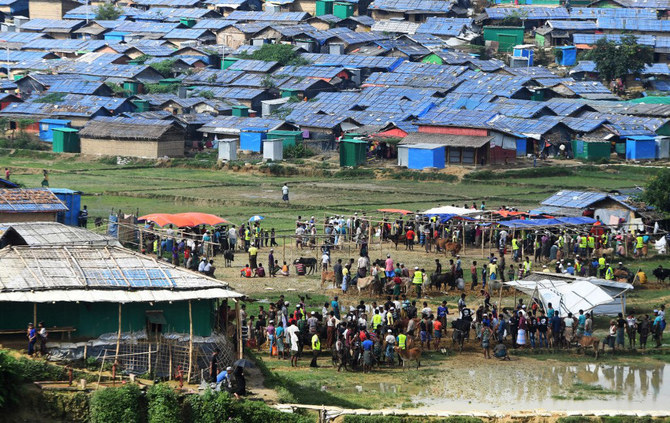

DHAKA: Bangladeshi scientists have introduced eco-friendly housing to Rohingya refugee camps in Cox’s Bazar using a new durable material developed in a project financed by the Jeddah-based Islamic Development Bank.
Bangladesh hosts more than 1.1 million Rohingya who fled neighboring Myanmar during a military crackdown in 2017. Most of them live in Cox’s Bazar district, a coastal region in the country’s east, which with the arrival of Rohingya, became the world’s largest refugee settlement.
The location, climate and topography of Cox’s Bazar make it vulnerable to natural hazards and extreme weather events such as cyclones, landslides and flash floods. The Rohingya crisis has increased the size of the population, creating new environmental risks due to deforestation and infrastructure pressure.
The construction of sustainable housing based on jutin — a combination of jute fiber and resin — has been spearheaded in Cox’s Bazar by the Dhaka-based ICDDR,B (formerly known as the International Centre for Diarrhoeal Disease Research, Bangladesh), one of the world’s leading global health research institutes that also undertakes environmental intervention work.
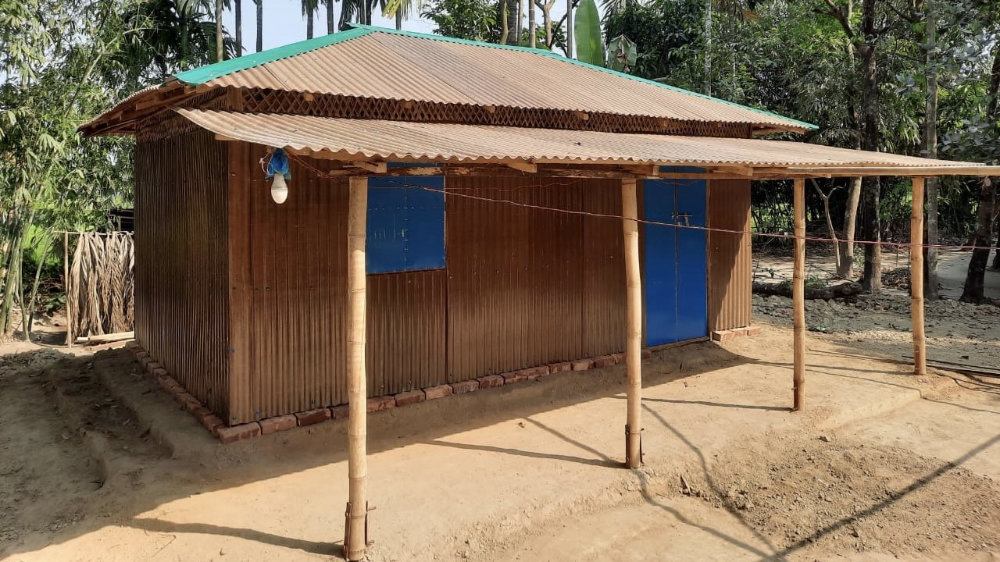
“The houses made of jutin are heat resistant, which means people will feel significantly cooler temperatures while living in these houses compared with outside temperatures,” project coordinator Dr. Mohammad Mahbubur Rahman told Arab News earlier this week.
In a pilot project, the ICDDR,B has built six jutin houses in Cox’s Bazar. Two of them are expected to be handed over to Rohingya refugees and another four will host communities in the area next month.
“Our research is still underway,” Rahman added. “We are now collecting data on these houses in different conditions, like the changes of temperature between day and night, and in different seasons.”
Jutin was invented by Bangladeshi scientist Dr. Mubarak Ahmad Khan, who patented the material in 2008.
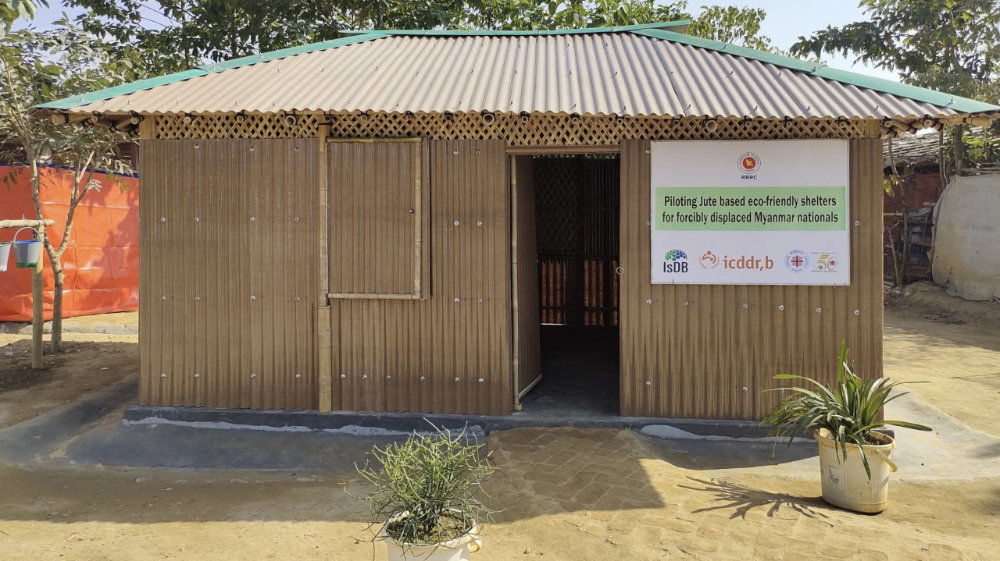
Lightweight, durable, bio-acceptable, heat and saline water-resistant, jutin has been developed as an alternative housing material in disaster-prone coastal areas of Bangladesh. According to Khan, it is four times stronger than tin, which is traditionally used in small house construction.
“Jutin is mainly a housing material which can be used instead of wood. It also has uses in the electric appliance and car-making industry,” Khan said. “In the cyclone-prone areas, sometimes people get injured when tin from the roofs flies away due to gusty winds.”
ICDDR,B research on introducing jutin to the camp areas of Cox’s Bazar was financed with an $100,000 grant under IsDB’s “Transform Innovation” initiative.
It costs about $1,000 to build one 14-square-meter jutin house measuring 2.6 meters in height.
Dr. Farjana Jahan, principal investigator of the jutin house pilot project, said that makeshift houses for Rohingya refugees are mainly made from plastic that is replaced every six months.
“Jutin houses are much more durable and last up to 60 years,” she told Arab News. “Jutin can be considered as a climate smart solution for addressing the shelter issues in the Rohingya camps.
“These jutin houses are fully environment friendly, free from chemical exposure, have enough ventilation and daylight facilities, and can be dismantled easily during an emergency. It will also reduce the concern with fire incidents, which is a big issue in the highly congested camp areas.”


