Saudi aviation authority steps in to calm angry travelers as ticket prices skyrocket

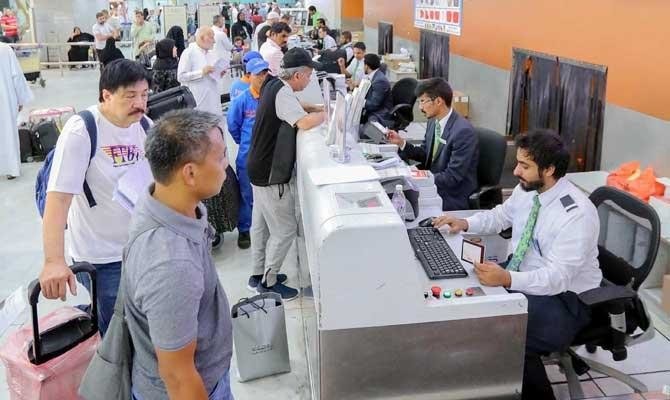
Saudi travelers vented out their frustration of paying as high as SR1500 ($400) for some destinations within the country. (File)
Short Url
Updated 26 April 2022
Follow

Saudi aviation authority steps in to calm angry travelers as ticket prices skyrocket

RIYADH: With Saudi airfares skyrocketing on some domestic routes, the aviation authority has stepped in to calm angry travelers with a set of measures including reviewing the pricing structure and current capacity.  

The General Authority of Civil Aviation said it has recently noticed a change in the prices of some categories of tickets. This has prompted the authority to take a slew of direct measures that will lead to a review of the pricing structure of domestic air transport and an increase in seats capacity and number of flights.

This comes following an angry campaign on social media where many Saudi travelers vented out their frustration of paying as high as SR1500 ($400) for some destinations within the country. 

The GACA said these steps are aimed at ensuring the provision of suitable prices for passengers and enhancing competitiveness in the air transport sector. It insisted that the rights and protection of passengers are a top priority for the authority to which it is committed.

Hashim Almanashi, a passenger affected by the matter, told Arab News: “Ticket prices had increased by nearly 300 percent, this is honestly an unexplainable increase.” 

Almansshi has a family of six members living in Eastern Provence of the Kingdom, and it will require him a “major budget” to book tickets for each member with these rates, he said.

He is now delighted by the response of GACA, noting that prices have already decreased by nearly 40 percent after the announcement.

“I checked the rates before and after and found a significant decrease in ticket prices after the announcement, it was SR1500, and now it is in the range of SR900,” he said.  


Islamic banks’ market share in Turkiye rises to 9.2%: Fitch Ratings

Updated 18 February 2026
Follow

Islamic banks’ market share in Turkiye rises to 9.2%: Fitch Ratings

RIYADH: Islamic banks in Turkiye lifted their asset market share to 9.2 percent in 2025 from 8.1 percent a year earlier, as financing and deposits outpaced the broader banking sector, a new analysis showed. 

In its latest report, Fitch Ratings said financing and deposit market shares rose to 7.9 percent and 10.4 percent, respectively, by the end of 2025, compared with 7.3 percent and 9.4 percent in 2024.

The agency noted that new digital Islamic banks are emerging in the country, with investment from Gulf Cooperation Council countries expected to continue. 

Turkiye’s strong ties with Islamic countries across the Balkans, Africa and the Middle East support the development of its Islamic banking sector, attracting investors and contributing to the industry’s growth.

In its latest report, Fitch stated: “Three recently established private Islamic banks (two digital) grew rapidly in the first nine months of 2025. Investment in digital participation banking from the Gulf Cooperation Council countries underscores the potential for further investment from the region.” 

It added: “Planned establishment of new participation banks, and rapid growth of recently established banks – albeit from small bases – means that the segment landscape may be reshaped in 2026.” 

Dubai Islamic Bank PJSC’s investment in digital bank TOM underscores the potential for further GCC investment. 

Turkish regulators have approved the establishment of Halk Katilim Bankasi A.S. and Adil Katilim Bankasi A.S. (digital), while BIM Birlesik Magazalar A.S.’s application is pending. 

Fitch added that state-owned participation banks may merge or pursue initial public offerings, potentially reshaping the banking landscape. 

The report predicts Islamic banks’ market share will rise further in 2026, supported by strong internal capital generation and growth appetite. However, the non-performing financing ratio may increase moderately due to high inflows. 

“The segment’s non-performing financings ratio deteriorated to 2 percent at end-2025 compared to 1.2 percent in 2024 but remained below the sector average of 2.5 percent,” said Fitch. 

It added: “We expect pressure to persist given still-high financing rates, high but declining inflation, and the sensitivity of unsecured retail (lower share than conventional banks) and SME segments to economic cycles. We forecast a moderate increase in the segment NPF ratio in 2026.”