

India, EU to establish council to broaden ties amid ‘challenging global landscape’

1 / 2
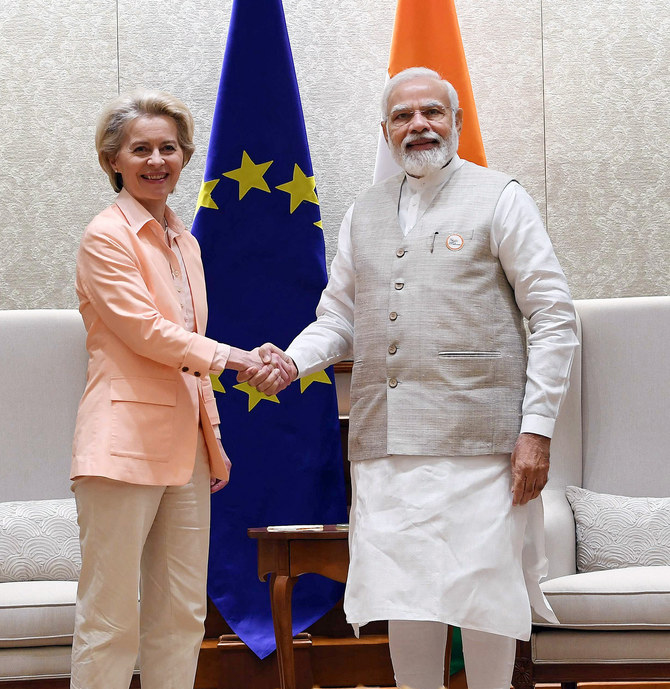
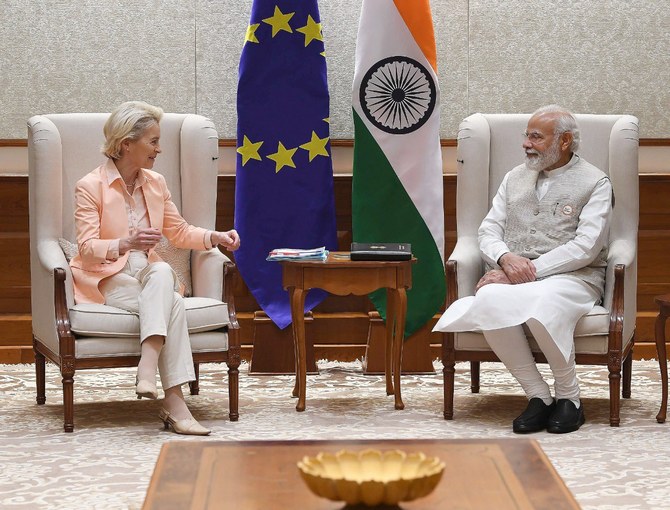
Von der Leyen said the EU relationship with India was “more important than ever” amid the backdrop of the war in Ukraine. (Photo courtesy: Office of the Prime Minister of India)
2 / 2
India’s Prime Minister Narendra Modi (R) said his meeting with European Commission President Ursula von der Leyen in New Delhi was “fruitful.” (Photo courtesy: Office of the Prime Minister of India)
Short Url
Updated 25 April 2022
Follow

India, EU to establish council to broaden ties amid ‘challenging global landscape’

  • India is the only other country besides US to have this technical agreement with Brussels
  • EU chief’s trip follows a stream of top visits to New Delhi after Russia’s invasion of Ukraine 

NEW DELHI: India and the EU on Monday launched a trade and technology council to boost cooperation as both sides face “a challenging global landscape,” with a visit from the bloc’s chief coming after a stream of high-level visits to New Delhi since Russia’s invasion of Ukraine. 

European Commission President Ursula von der Leyen’s two-day trip is widely seen as part of the West’s continued efforts to encourage India to reduce ties to Russia, its main weapons supplier. 

India has called for an immediate end to violence but refrained from explicitly condemning the Russian invasion. 

Prime Minister Narendra Modi said in a tweet that Monday’s meeting with Von der Leyen, where the leaders discussed efforts to deepen strategic engagement, was “fruitful.” 

“Today, our relationship is more important than ever,” Von der Leyen said during the meeting. 

“We have so much in common … and we are both facing a challenging global landscape.” 

In a joint statement, India and the EU said they had agreed on how “rapid changes in the geopolitical environment highlight the need for joint in-depth strategic engagement.” The newly established council is set to provide them with a mechanism for strategic coordination. 

India is the second country to have this technical agreement with the EU, the first being the US.

The EU chief said in a series of tweets that the bloc and India will start negotiations on trade and investment agreements, while highlighting their cooperation on energy security and the fight against climate change. 

The flurry of top visits to New Delhi following the war in Europe is part of an ongoing effort to have world democracies stand together against Russia, according to Dr. Ummu Salma Bava, professor at the Centre for European Studies of Jawaharlal Nehru University in New Delhi.

“No doubt there’s a concerted effort to bring India to the democracy camp … The West would like to see India in their grouping and that would add to their collective weight,” Bava told Arab News. 

Von der Leyen’s visit comes days after that of British Prime Minister Boris Johnson, who agreed to increase bilateral defense and business cooperation with Modi’s government.

Ukraine did not appear to feature prominently during Von der Leyen’s talks with Modi, though Indian Foreign Minister Dr. S. Jaishankar said in a tweet that he and the EU chief had “exchanged views on the economic and political implications of the Ukraine conflict.” 

“They want India to take one kind of a stand which of course would mean anti-Russia, which India will be very, very cautious about. India does not want to be projected in this kind of binary,” Bava said.


Cuba says a 5th person died after people on a Florida-flagged speedboat opened fire on soldiers

Updated 56 min 14 sec ago
Follow

Cuba says a 5th person died after people on a Florida-flagged speedboat opened fire on soldiers

  • Authorities in Cuba said that on Feb. 26 Cuban soldiers confronted a speedboat carrying 10 people as the vessel approached the island and opened fire on the troops
  • The shooting threatened to increase tensions between US President Donald Trump and Cuban authorities

HAVANA: Cuba said a fifth person has died as a consequence of a fatal shootout last month involving a Florida-flagged speedboat that allegedly opened fire on soldiers in waters off the island nation’s north coast.
The island’s interior ministry said late Thursday in a statement that Roberto Álvarez Ávila died on March 4 as a result of his injuries. It added that the remaining injured detainees “continue to receive specialized medical care according to their health status.”
Authorities in Cuba said that on Feb. 26 Cuban soldiers confronted a speedboat carrying 10 people as the vessel approached the island and opened fire on the troops. They said the passengers were armed Cubans living in the US who were trying to infiltrate the island and “unleash terrorism”. Cuba said its soldiers killed four people and wounded six others.
“The statements made by the detainees themselves, together with a series of investigative procedures, reinforce the evidence against them,” the Cuban interior ministry said in its statement, adding that “new elements are being obtained that establish the involvement of other individuals based in the US”
Earlier this week, Cuba said it had filed terrorism charges against six suspects that were on the speedboat. The government unveiled items said to have been found on the boat, including a dozen high-powered weapons, more than 12,800 pieces of ammunition and 11 pistols.
Cuban authorities have provided few details about the shooting, but said the boat was roughly 1.6 kilometers (1 mile) northeast of Cayo Falcones, off the country’s north coast. They also provided the boat’s registration number, but The Associated Press was unable to readily verify the details because boat registrations are not public in the state of Florida.
The shooting threatened to increase tensions between US President Donald Trump and Cuban authorities. The island’s economy was until recently largely kept economically afloat by Venezuela’s oil, which is now in doubt after a US military operation deposed then-Venezuelan President Nicolás Maduro.