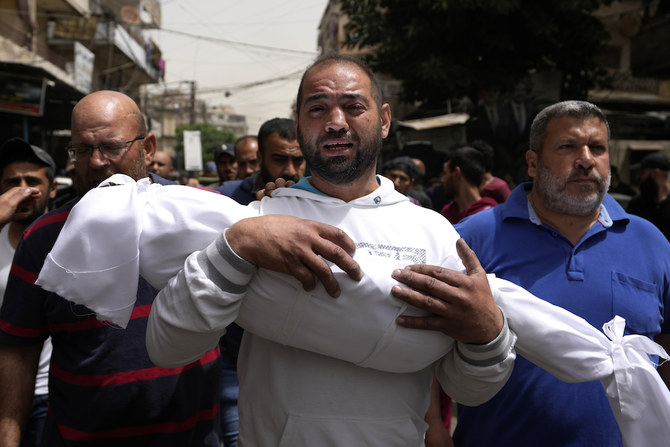


BEIRUT: Funerals were held on Monday in the Lebanese port city of Tripoli for those who died after the boat they were onboard capsized and sank.
The Lebanese flag flew at half-mast over the Lebanese Presidential Palace on Monday in mourning for the victims, with President Michel Aoun following up on the work of specialist military and security forces in their search for the missing passengers and the course of the investigation to uncover the circumstances and establish responsibility for the incident.
Commercial establishments in Tripoli closed their doors to mourn the victims.
The UNHCR estimated there were 84 passengers on board the vessel when it capsized 5.5 km off the coast of Tripoli. The number of missing people is around 30, and there are no more than 45 survivors.
Rescue teams searched the Mediterranean for survivors after the overloaded boat capsized while being pursued by naval forces.
On Monday morning, they found two bodies on the beach in Tripoli. One was Khadija Al-Nimri. The other was Amir Kaddour.
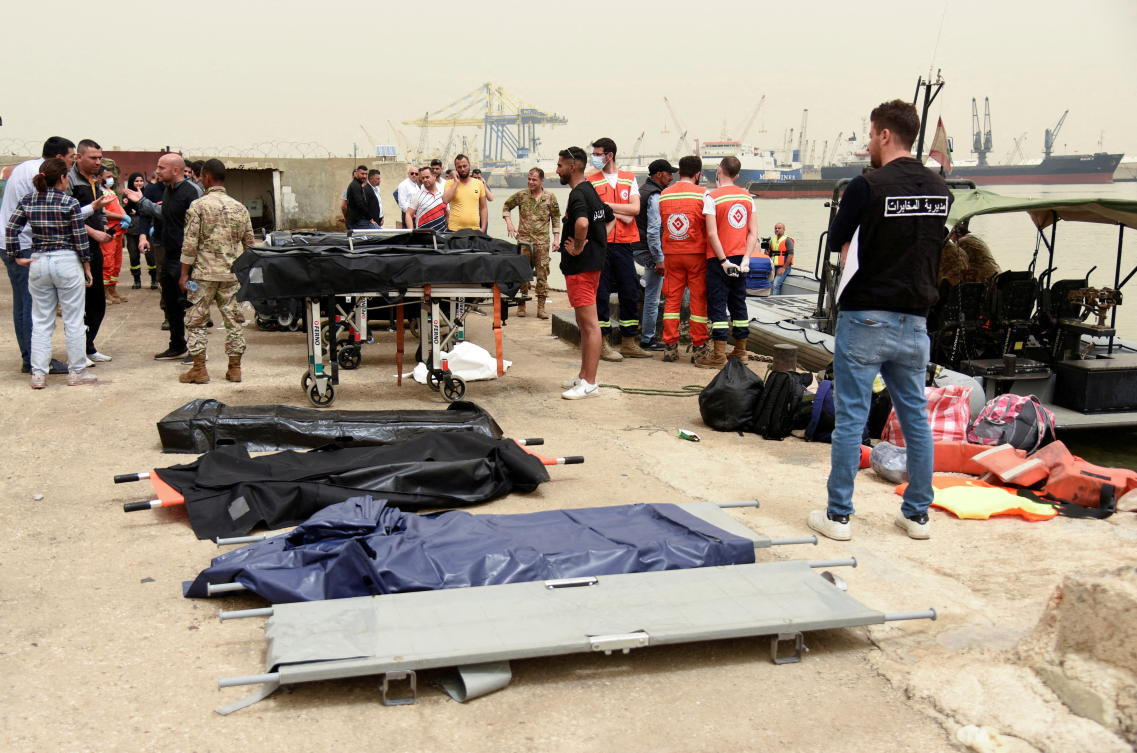
People stand near stretchers that are prepared for dead bodies after a boat capsized off the Lebanese coast of Tripoli overnight, at port of Tripoli, northern Lebanon April 24, 2022. (Reuters)
A hospital issued a call to anyone who knew Sarah Ahmed Talib to come forward to identify and receive her body.
Another victim was 25-year-old Mohammed Talib, who drowned three days after his engagement.
Most of those on board were families from Tripoli and the passengers were said to include Syrians and Palestinians.
They were sailing to Italy in search of a decent life.
Two of the victims — 18-month-old Taleen Mohammed Al-Hamwi and her mother Duha — were buried in Tripoli amid scenes of deep sorrow and heavy gunfire.
But there was calm in Tripoli’s neighborhoods following the heightened emotions of Sunday, when protesters attacked army checkpoints and outposts after it brought in reinforcements and strengthened its presence in the city.
The anger comes ahead of parliamentary elections on May 15 and against a backdrop of economic turmoil and deteriorating living conditions.
Protesters removed pictures of election candidates from the walls of the city, which has some of Lebanon's most impoverished neighborhoods, with people also targeting politicians in Beirut and further afield.
Protesters chased Energy Minister Walid Fayyad in the capital, pushing him against a wall and slapping him. The assault was filmed.
“How dare you go out while people are still drowning in the sea? It's time to wake up,” they demanded to know.
Fayyad's office described his assailants as “a well-known group of saboteurs whose moral degeneration reached the point where they treacherously (and) physically assaulted the minister in the middle of the street.”
His office said the minister had decided “to personally prosecute everyone who incited, monitored, planned, and contributed to the attack.”
On social media, Lebanese activists posted a picture of Prime Minister Najib Mikati's yacht anchored in the French city of Nice.
The yacht is 79 meters long and valued at $100 million.
A sign raised in front of the yacht read in Arabic and French: “The people of Tripoli were assassinated by the owner of this yacht.”
While the Lebanese were dealing with the repercussions of the boat tragedy, UN peacekeepers were investigating rocket fire from Lebanon into Israel that prompted Israeli retaliation.
A Grad missile was fired on Sunday night from the Ras Al-Ain-Qlaileh area, south of Tyre, toward Israel.
Despite the Israeli side’s assertion that the missile “fell in an open area, and the warnings were not activated,” Lebanese Army Command said the border areas south of Tayr Harfa, Wadi Hamoul, Alma Al-Shaab, and the outskirts of the town of Zebqin were hit by Israeli artillery. No injuries or damage was reported.
The area was targeted by about 50 artillery shells.
Israel also fired about 40 flare bombs over the towns of Tayr Harfa, Naqoura, Shihin, and Bidias.
According to a statement by Army Command on Monday, an army unit found two 122mm Grad rockets installed on aluminum slings ready for launch. These were disabled by specialist units.
The breach was followed up in coordination with UNIFIL, which announced detecting "the firing of a missile from southern Lebanon toward Israel.”
The UNIFIL Head of Mission and Force Commander Maj. Gen. Aroldo Lazaro immediately contacted authorities on both sides of the Blue Line and urged them to exercise restraint.
But the Israeli army responded by firing dozens of shells into Lebanon.
Lazaro called on all parties to avoid further escalation, expressing concern over the “disproportionate response.”
UNIFIL said it had opened an investigation and called on both sides to exercise restraint.