

Malaysia’s palm oil board urges countries to reconsider food versus fuel priorities

Global edible oil supplies were already choked by adverse weather and Russia’s invasion of Ukraine
Short Url
Updated 25 April 2022
Follow

Malaysia’s palm oil board urges countries to reconsider food versus fuel priorities

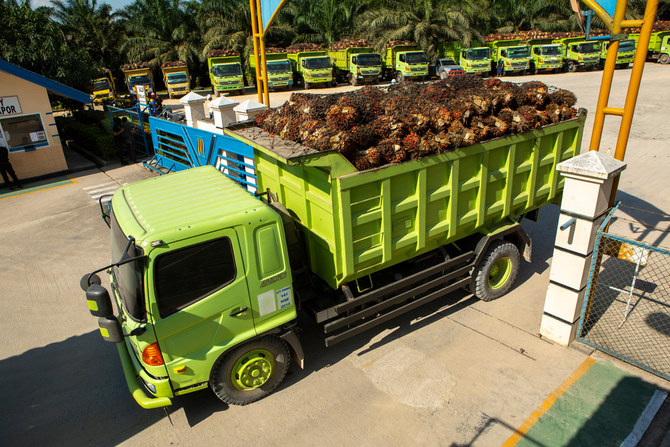
KUALA LUMPUR: Countries should pause or slow down the use of edible oil as biofuel to ensure adequate supply for use in food, a state-backed Malaysian palm oil group said on Monday, warning of a supply “crisis” following an Indonesian ban on palm oil exports.


Indonesia, which is the world’s top producer and exporter of the edible oil, on Friday said the ban will commence on April 28, in a shock move that could inflame surging global food inflation and constrain supplies.


Global edible oil supplies were already choked by adverse weather and Russia’s invasion of Ukraine, and now consumers around the world will have no option but to pay top dollar for supplies.


“Exporting countries and importing countries need to have their priorities right, this is the time to temporarily reconsider food versus fuel priorities,” said director general of the Malaysian Palm Oil Board Ahmad Parveez Ghulam Kadir.


“It’s very important for countries to ensure available oils and fats are used for food and ... temporarily stop or reduce their biodiesel mandates,” he said, adding that countries could continue their existing biodiesel mandates once supply returns to normal.


Palm oil, the most widely used edible oil, is also used as a biodiesel feedstock.


Indonesia and Malaysia have made it mandatory for a certain amount of palm oil to be used for biofuel, and just last month said they remain committed to those mandates despite higher palm prices.


Other countries also make biofuels from animal fats and plant oils like corn and soy.

Demand for such biofuels has boomed in recent years due to climate change mitigation efforts.


Malaysia, which accounts for 31 percent of global palm oil supply, is the world’s second largest producer of palm oil after Indonesia, which makes up 56 percent.


Producers in Malaysia are facing a pandemic-induced labor shortage and said they cannot meet the gap left in global supply by Indonesia’s ban.


Malaysia also needs to look at its stock and production forecast to ensure local demand is not neglected while fulfilling global demand, Ahmad Parveez said.


Following Indonesia’s announcement, Chicago soy oil futures surged to their highest since 2008 while crude palm oil futures rallied to their highest in six weeks.


Closing Bell: Saudi main market ends week in red at 11,189

Updated 05 February 2026
Follow

Closing Bell: Saudi main market ends week in red at 11,189

RIYADH: Saudi Arabia’s Tadawul All Share Index closed lower at the end of the trading week on Thursday, falling 1.34 percent, or 152.54 points, to finish at 11,188.73. 

The benchmark index opened at 11,320.52 and trended lower throughout the session, finishing well below its previous close of 11,341.27.  

Market breadth was sharply negative, with only 28 gainers compared with 236 decliners. Trading activity saw a volume of 239 million shares exchanged, with total turnover reaching SR5.5 billion ($1.47 billion). 

In the parallel market, Nomu closed higher, rising 0.23 percent to 23,865.95, although decliners continued to outnumber advancers. The MT30 index closed at 1,508.60, down 1.46 percent, shedding 22.38 points by the end of the session. 

Among the session’s top gainers, Dar Al Majed Real Estate Co. led advances, rising 5.43 percent to close at SR9.91. 

Al Aziziah REIT Fund added 4.67 percent to SR4.48, while Al Majed Oud Co. gained 2.81 percent to SR161.20. AFG International Co. advanced 2.45 percent to SR17.17, and Al Mawarid Manpower Co. rose 1.37 percent to SR125.70.

On the losing side, Saudi Research and Media Group posted the steepest decline, falling 6.88 percent to SR107. Cherry Trading Co. dropped 6.23 percent to SR28.88, while Saudi Arabian Mining Co. slipped 5.41 percent to SR72.55.  

Almasane Alkobra Mining Co. declined 5.38 percent to SR102, and Power and Water Utility Co. for Jubail and Yanbu ended 4.56 percent lower at SR31.36. 

On the announcements front, Saudi Industrial Investment Group released its interim financial results for the twelve-month period ended Dec. 31, 2025, reporting a return to profitability on an annual basis despite posting a quarterly loss.  

The company recorded a net loss of SR104 million in the fourth quarter, compared with a net profit of SR201 million in the same quarter of the previous year, which it attributed mainly to lower selling prices, higher operating costs, and increased general and administrative expenses.  

For the full year, however, the group posted a net profit attributable to shareholders of SR197 million, compared with SR161 million a year earlier, supported by higher sales volumes and improved operational performance at several subsidiaries. The stock last traded at SR14.77, down 3.59 percent. 

Separately, Saudi Exchange Co. announced the approval of a request by Merrill Lynch Kingdom of Saudi Arabia to terminate its market-making activities for Saudi Arabian Oil Co., effective Feb. 8.

The exchange said the termination relates specifically to the market-making agreement for Saudi Aramco shares and was approved in line with applicable market-making regulations.