

Sign language to benefit 20 million deaf visitors of the Two Holy Mosques

1 / 3
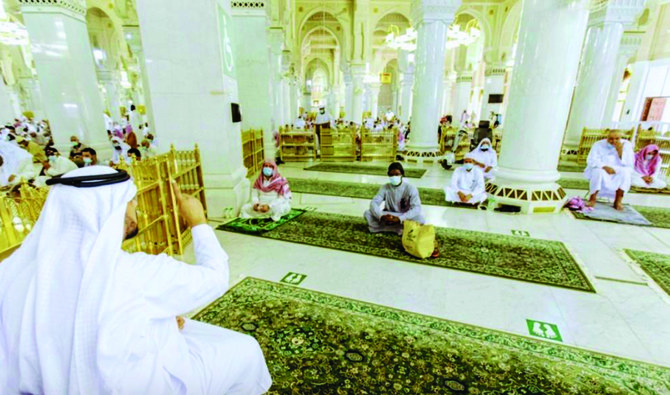
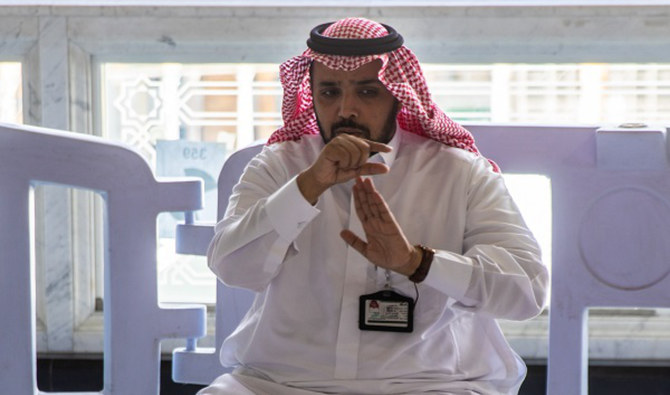
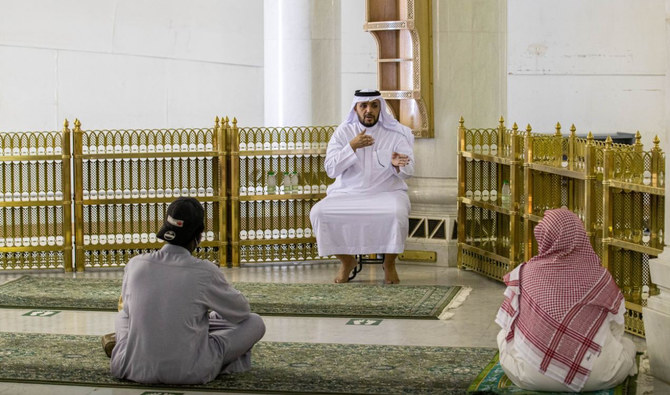
Saudi Arabia has ensured the rights of persons with disabilities and provided them with all kinds of care and support. A sign language translator interprets a sermon for those with hearing disability at the Prophet’s Mosque. (Supplied)
2 / 3
(Supplied)
3 / 3
(Supplied)
Short Url
Updated 22 April 2022
Follow

Sign language to benefit 20 million deaf visitors of the Two Holy Mosques

  • Sign language has developed and flourished through the Saudi deaf community over generations

MAKKAH: 

In line with the Kingdom’s Vision 2030, the Directorate General of Services for Persons with Disability at the General Presidency for the Affairs of the Prophet’s Mosque continues its work and efforts in serving people with disabilities at the mosque during Ramadan.

The directorate allocated a special room to serve people with disabilities in the mosque, which can accommodate around 100 people. Staff trained in sign language interpret the Friday sermons and lectures to people with hearing impairments.

During an interview with Arab News, Dr. Khalid bin Sulaiman Al-Thukair, a sign language translator at the Prophet’s Mosque, stated that the General Presidency for the Affairs of the Two Holy Mosques was one of the first to translate Friday sermons to a group of deaf people live in the Islamic world through a specialized room on the roof of the Prophet’s Mosque.

Later, a live broadcast of the sessions was done on Channel 2 and the Prophet’s Sunna channel.

“Nearly 20 million Arab Muslim deaf people around the world benefit from the Friday sermon,” said Al-Thukair, adding that previously, hearing-impaired people used to benefit only from Friday prayers and did not benefit from the sermons of the Two Holy Mosques.

He stressed that the biggest achievement for the interpreter is seeing the effect of his translation on hearing-impaired people.

“The translator succeeds in conveying 70 to 90 percent of the content to the deaf, most of whom are keen to attend the Friday prayer,” said Al-Thukair.

“The translator analyzes the information and simplifies it … for the deaf in a fraction of a second. The Arabic language has approximately 12 million words, while sign language does not exceed 20,000 words.”

He said sign translators are the ears of the deaf and that the reactions from the Arab and Islamic worlds are impressive and remarkable. “Saudi signs are the nucleus of religious sign language in the world. One hundred and fifty deaf people from all over the world usually meet in the last 10 days of Ramadan in a place dedicated and equipped for them at the roof of the Prophet’s Mosque from the southern side through gate No. 5 to enjoy the translation and knowledge.”

FASTFACTS

  • The Arabic language has approximately 12 million words, while sign language does not exceed 20,000 words.
  • The biggest achievement for the interpreter is seeing the effect of his translation on hearing-impaired people.

Maram Al-Juaid, a linguist specialized in sign language, told Arab News that “sign language is not just random movements with hands, but a linguistic system consisting of symbols that represent words, concepts, or ideas of language.

“It is done by (moving) one hand or both hands to give meaning to things and people. Its unique linguistic characteristics are characterized by expressions of face, body organs and language signs such as hand shape, movement, place and direction of the palm. It is a language linked to the environment and the customs and traditions surrounding it. Like spoken language, sign language varies from to region to region and reflects the history, culture and social norms of the deaf community.”

Al-Juaid noted that Saudi sign language is a stand-alone language and not a translation of the spoken Arabic language. “It has a specific system that distinguishes it from spoken languages. Like other human languages, it has developed and flourished through the Saudi deaf community. It is (a) language rich in vocabulary and forms the main component of deaf culture in the Kingdom, where deaf people were keen to pass it on through generations to be the main language in all educational, cultural and social aspects of life.”

She added that Saudi Arabia has ensured the rights of persons with disabilities and provided them with all kinds of care and support in the Kingdom, including deaf and hearing-impaired people.

“The Kingdom accorded (a) great deal of importance to facilitating the learning of Saudi sign language and promoting the linguistic and cultural identity of the deaf. It has also provided human assistance to this precious segment of the society, including Saudi sign language translators.”

Al-Juaid highlighted the attention and care that the General Presidency for the Affairs of the Two Holy Mosques accords to the deaf and hearing-impaired people.

“It (has) allocated to them a special prayer room with a sign language translator to interpret speeches, lessons and fatwas. It has also provided them with dedicated places where they can learn to memorize and recite the Holy Qur’an in Saudi sign language.

“Other services include guidance symbols within the Holy Mosque to guide them to the various locations and facilities inside the mosque through drawn and abbreviated symbols. The Fatwa Robot is another great technical leap in providing pilgrims with a great service. It is the most popular among pilgrims as it provides them with legitimate answers to their questions about the rituals they perform and other religious issues,” explained Al-Juaid.


Navigating Ramadan as a non-Muslim expat in Saudi Arabia

Updated 5 sec ago
Follow

Navigating Ramadan as a non-Muslim expat in Saudi Arabia

  • Rebecca Cousins: Evenings really come alive, whether you’re out to enjoy an iftar or being welcomed into the home of a friend to break fast with them
  • Lily Moffatt: Whether you’re religious or not, it’s incredibly rare to see an entire city — its rhythm, retail, hospitality, and social life — shift collectively around a spiritual moment

RIYADH: As Ramadan begins, it is the ideal time to embrace Saudi culture, understand the spiritual significance of the holy month, and learn how to navigate it with respect and solidarity in the Kingdom.

“For me, Ramadan is one of the most exciting times of the year to be in Saudi Arabia or the Middle East in general. Yes, the daytime is a little quieter, including the roads, which is a huge plus! But the evenings really come alive, whether you’re out to enjoy an iftar or being welcomed into the home of a friend to break fast with them,” Rebecca Cousins, who has been living and working in the Kingdom for three years, told Arab News. 

To truly support your Muslim friends during Ramadan, it helps to understand its significance.

Ramadan is the ninth and holiest month of the Islamic calendar, observed by Muslims worldwide to commemorate the first revelation of the Qur’an to the Prophet Muhammad, peace be upon him, in 610.

It’s also a period of deep worship, when the usual bustle of business tends to slow down.

During this holy month, Muslims fast from Fajr (dawn) until the Maghrib (sunset) prayer, abstaining from eating, drinking, smoking, and sexual relations during the fasting hours.

It is a time dedicated to self-discipline, spirituality, and charity.

Lily Moffatt, co-founder of the podcast “Saudi Life: Unpacked,” has been living in Saudi Arabia for three years. She underscored the importance of leading with empathy. 

“It can be easy to focus on the inconveniences: altered hours, your favorite cafe opening later, the afternoon energy dip … but this is a month rooted in discipline, reflection, and faith. Fasting, particularly in the late afternoon, requires immense self-control.

“Be mindful about eating or drinking in front of those who are fasting, and be conscious of your tone when discussing the changes Ramadan brings. A little consideration goes a very long way,” she said. 

Highlighting the advice she would give non-Muslim expats experiencing Ramadan for the first time, Frankie Hilton, co-founder of the podcast alongside Moffatt, stated: “My advice would be to embrace every second of it. It’s very easy to feel overwhelmed when something is out of your comfort zone or unknown, but Ramadan is one of the most beautiful moments in the year. Say yes to an iftar or sahoor invite, speak to your friends about the reasons behind breaking your fast with a date, understand what age someone started fasting; it’s a time to learn and embrace something that feels new.”

Often during Ramadan, you may be invited to iftar (breaking the fast) or sahoor (the pre-dawn meal) at a Saudi home.

Cousins encouraged non-Muslims to engage in Ramadan traditions, stating: “I would definitely say yes to every invitation, whether it’s an iftar or sahoor with colleagues at a restaurant, or an invitation to join something more personal and intimate at someone’s home. In both cases, it will be an enlightening experience if it’s your first time, and my recommendation is to fast for the day and share in the enjoyment of that first sip of water and date, too.”

A helpful rule of thumb is to never arrive empty-handed. Simple items to bring include dates, desserts, small biscuits, or sambusas.

If you are a whiz in the kitchen, feel free to bring a Ramadan favorite such as lentil soup, jareesh, harees, or al-habb.

You will often hear people exchanging Ramadan greetings, including “Ramadan kareem,” which is used to wish someone a “generous Ramadan,” and “Ramadan mubarak,” which translates to “Blessed Ramadan.”

The response can be kept simple; it is more about the meaning, your intention, and how you say it rather than the exact words you use.

You can say “Ramadan mubarak” back, or use the phrase “Allah yubarak feek,” which means “May Allah bless you, too.”

Or, keep it simple with something like “Happy Ramadan to you too” or “Ramadan mubarak to you and your family.”

A good rule of thumb is to avoid questions that can be seen as ignorant or inappropriate.

Common examples to avoid include, “Not even water?” or “Who will know if you just sneak a snack?”

You might also avoid comments like, “You must be so lucky, you’ll lose so much weight,” or “I feel so bad eating in front of you.”

These questions and comments can be seen as insensitive, and a quick search online can easily clear up any basic doubts of this sort.

Oftentimes during the fasting period, Muslims engage in deep prayer and dua, even while working or driving around the city.

If you choose to listen to music in the car or at the office, it is best to wear headphones or limit the volume, as loud music can be seen as disruptive during the fasting hours.

Eating and drinking are perfectly fine during Ramadan fasting hours, but be mindful of where you are doing so.

Try to avoid eating in public or in front of coworkers and friends who are fasting. This also includes smoking, which should be done indoors or in private areas.

It is not always a matter of legality, but rather a matter of solidarity, tolerance, and support for those around you.

Among the highlights of Ramadan are the brightness, the strong family ties, and the liveliness of the night markets.

Cities truly come alive after dark with Ramadan tents, bustling souqs filled with special meals, and restaurants hosting unique gatherings.

There is so much to see and do, from the Ramadan festivities in Jeddah’s Al-Balad to the traditional souqs in Riyadh and the Eastern Province.

If you would like to take your Ramadan connection a step further, consider giving back.

A major tradition for families during this month is charity. Ramadan is truly a time for generosity.

Whether you choose to make a donation through the authorized Ehsan platform or host an iftar gathering, giving back is a wonderful way to show solidarity.

Around the time of breaking the fast, you will often see people sharing dates and water with one another.

A kind gesture for a non-Muslim is to keep cold water, dates, or laban in your car to pass out to those on their commute back home.

These small acts of kindness help build bridges, foster friendships, and create greater understanding between everyone in the community.

Ramadan is a reminder of peace and spirituality and a time for family and prayer.

On the topic of dos and don’ts, Hilton stated: “Yes, it’s important to acknowledge the fasting of water and food, but also acknowledge it’s a time to also abstain from negativity and bad thoughts. This is something I always try to embrace in Ramadan — learning to be patient and kind to yourself and those around you.”

Regardless of whether you are Muslim or not, many expats choose to fast during Ramadan, as it is proven to have numerous health benefits, as well as improving spiritual strength. 

Fasting with your fellow Muslim coworkers, neighbors, and friends is also a powerful symbol of support, solidarity, and community.

A final tip is to be open to new experiences. Ramadan is a time for community, spirituality, open-mindedness to new traditions, gatherings with loved ones, and moments of deep reflection, regardless of your faith.

“Pause,” Moffatt advised. 

“Whether you’re religious or not, it’s incredibly rare to see an entire city — its rhythm, retail, hospitality, and social life — shift collectively around a spiritual moment. Ramadan in Saudi Arabia invites you to slow down. Even just slightly.

“Take an evening stroll after iftar when the streets come alive. Accept invitations. Visit Ramadan tents. Notice the generosity, the sense of community.

“It’s a beautiful reminder that life doesn’t always need to move at full speed and that shared moments, especially across cultures, are where the real richness lies.”