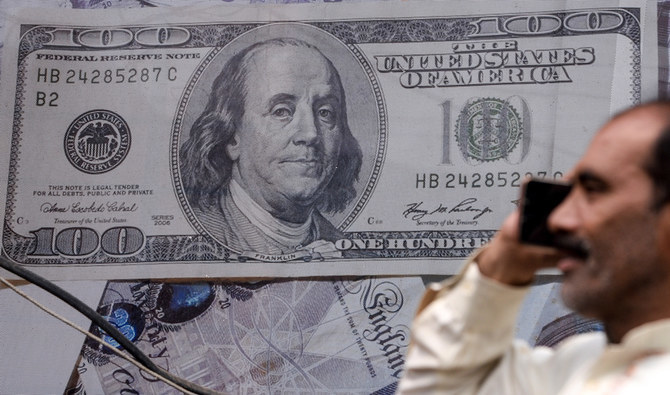
KARACHI: Pakistan’s national currency on Thursday continued its depreciating trend against the US dollar amid increasing demand for import payments as the country embarks on crucial talks with the International Monetary Fund (IMF) for the revival of a $6 billion loan program.
The rupee lost its value by 0.56 percent on Thursday to close at Rs186.97 against the greenback in the interbank market. The currency has depreciated by Rs5.42 since Monday.
“The demand for dollar is increasing due to import payments, especially to buy oil from the international market, which is putting the rupee under pressure,” Samiullah Tariq, director research at Pakistan Kuwait Investment Company, told Arab News.
“The market sentiment will improve after successful talks with the IMF and after receiving inflows from China since Beijing has agreed to roll over $2.3 billion [of Pakistan’s debt],” he continued. “As of now, the higher demand for the dollar persists.”
Pakistan’s newly appointed finance minister Miftah Ismail on Wednesday left for Washington to negotiate with IMF officials for the revival of the $6 billion Extended Fund Facility after the previous administration deviated from the program objectives by announcing a $1.7 billion relief package.
Ismail said before leaving Islamabad the IMF wanted Pakistan to reverse the relief package which he described as a “landmine laid for the government of Prime Minister Shahbaz Sharif.”
He told journalist at a news conference that the fund wanted the country to increase fuel prices, rollback the amnesty scheme announced for industries, cut circular debt, and hike power tariffs.
However, Ismail said PM Sharif had “instructed me to make sure that there is least burden on the people in return for the revival of the program.”
Pakistani finance minister was confident he would successfully manage to get the program revived, saying: “We will negotiate the IMF program and whatever belt tightening would be required we will do that and cut PSDP [Public Sector Development Fund].”
He still hoped the government would introduce people- and development-friendly budget.
Pakistani economists said the government would need to swallow a bitter pill by reversing the relief package announced by former prime minister Imran Khan at the end of February.
“This was an economic land mine that the outgoing government had planted,” Dr. Sajid Amin Javed, senior economist at the Sustainable Development Policy Institute, told Arab News. “It was not a sustainable move at a time when international oil prices were increasing at higher pace and its fallout was expected in the form of higher fiscal deficit.”
“You will have to reverse this decision to continue with the IMF program,” he noted while adding: “The economic cost of exiting the IMF program will be far higher because at the moment our economy is bleeding due to highest current account deficit, rupee at the lowest historic level, higher inflation and interest rates.”
He said the new government might want to convince the IMF to continue with the relief package until June 2022, though it would not be sustainable.
“The government will have to reverse this,” Javed explained. “But instead of putting sudden burden [on people], the impact can be passed on gradually.”
The government on Friday decided to keep the prices of petrol and diesel unchanged at Rs149.86 and Rs144.15 per liter, respectively. However, the prices worked out by oil marketing companies for the fortnight was Rs173.96 per liter for petrol and Rs204.69 for diesel.
“The government should take bold decisions and de-freeze petroleum prices,” Javed suggested. “The bottom poor segment of the country should be protected through targeted subsidies.”
He agreed with the new finance minister who said the fuel subsidy was benefiting the country’s richer segments instead of its poor citizens.
“An owner of Land Cruiser is availing Rs1,680 of subsidy on every fuel tank,” Ismail told the news conference on Wednesday.


![]()

Pakistani rupee continues to depreciate amid higher dollar demand for import payments
Short Url
https://arab.news/g6aux
Pakistani rupee continues to depreciate amid higher dollar demand for import payments
- Experts hope market sentiment will improve after successful IMF talks, inflows from China
- Economists believe government will have to reverse relief package announced by ex-PM Khan
Latest updates


Recommended


© 2026 SAUDI RESEARCH & PUBLISHING COMPANY, All Rights Reserved And subject to Terms of Use Agreement.