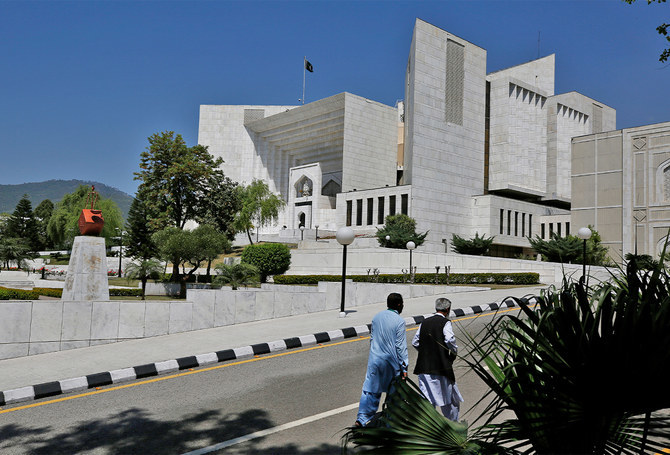
ISLAMABAD: The Supreme Court of Pakistan said on Monday it was not right for the country’s leaders to publicly object to its verdicts, saying it was their responsibility instead to defend its rulings.
The observation was made by Chief Justice of Pakistan (CJP) Umar Ata Bandial while hearing a presidential reference seeking the interpretation of Article 63-A of the constitution which sets down rules for the disqualification of lawmakers in the case of defection and violation of party policy.
The reference was filed at a time when former prime minister Imran Khan was facing a no-confidence motion against him and more than a dozen of his party lawmakers had showed willingness to vote against him during the National Assembly proceedings.
Khan lost his parliamentary majority when one of his key allies announced its decision to side with the country’s opposition, making it unnecessary for the dissident elements in his political party to weigh in during the voting process.
“We are cursed for doing our jobs and protecting the Constitution,” Dawn quoted the chief justice as saying.
He then asked Islamabad Advocate General Niazullah Khan Niazi: “Why should the court get involved in your political matters?“
The chief justice said the Supreme Court’s decisions were criticized at the gatherings of “10 to 15,000 people,” even when “the court fulfills its constitutional responsibilities.”
“National leaders should defend court decisions,” he continued.
The CJP’s observations were made only a few days after ex-PM Khan’s political rallies in which he wondered why the country’s superior judiciary opened its doors at midnight when his close aides were trying to stall the no-trust vote.
“Protecting the Constitution is our responsibility,” Justice Bandial maintained. “We will fulfill our responsibilities.”
He also noted the Supreme Court worked for 24 hours, adding that no one should “raise a finger on the court proceedings.”
The presidential reference, a copy of which is available with Arab News, called defections from a political party a “morally reprehensible and destructive act which shakes the confidence of the public in the democratic process.”
It also requested the court to give its opinion on whether a defector should be disqualified for life from electoral activity or public office and if his or her vote, after defecting, should be counted in a parliamentary motion.
The court heard arguments from various lawyers before adjourning the hearing until 1pm on Tuesday.


![]()

Pakistan’s top court objects to public criticism, says it fulfils constitutional responsibilities
Short Url
https://arab.news/6922g
Pakistan’s top court objects to public criticism, says it fulfils constitutional responsibilities
- The CJP asks why the court should deal with political matters when it is later criticized
- Chief Justice Umar Ata Bandial maintains ‘national leaders should defend court decisions’
Latest updates


© 2026 SAUDI RESEARCH & PUBLISHING COMPANY, All Rights Reserved And subject to Terms of Use Agreement.