



DUBAI: In a few days, the art world will descend on Italy for its most prestigious event: The 59th Biennale, which this year features a strong showing of nations and artists from the Middle East.
Running from April 23 until Nov. 27, and not held since 2019 due to the coronavirus pandemic, this year’s edition is curated by Cecilia Alemani and themed “The Milk of Dreams.”
First held in 1895, the event offers a chance for each country to represent the culture and art of its people. This edition, the Middle East region, including Iran, the Levant, Gulf and North Africa, is being presented through country pavilions, collateral events and individual artists. Participation is no easy feat, particularly after the trials and turbulations of the pandemic.
The following is a list of highlights for visitors interested in the Middle East region.
Saudi Arabia features conceptual art of Muhannad Shono
For the Kingdom’s second showing at its permanent pavilion in the Arsenale, the work of Saudi artist Muhannad Shono, curated by Reem Fadda, will be on display. Still tight-lipped as to what will be shown, we can expect thought-provoking art that prompts us to think more deeply about the way we create and communicate — such as his idea of the line and its exploration of language, and as a fundamental visual necessity for any form of art or written word.
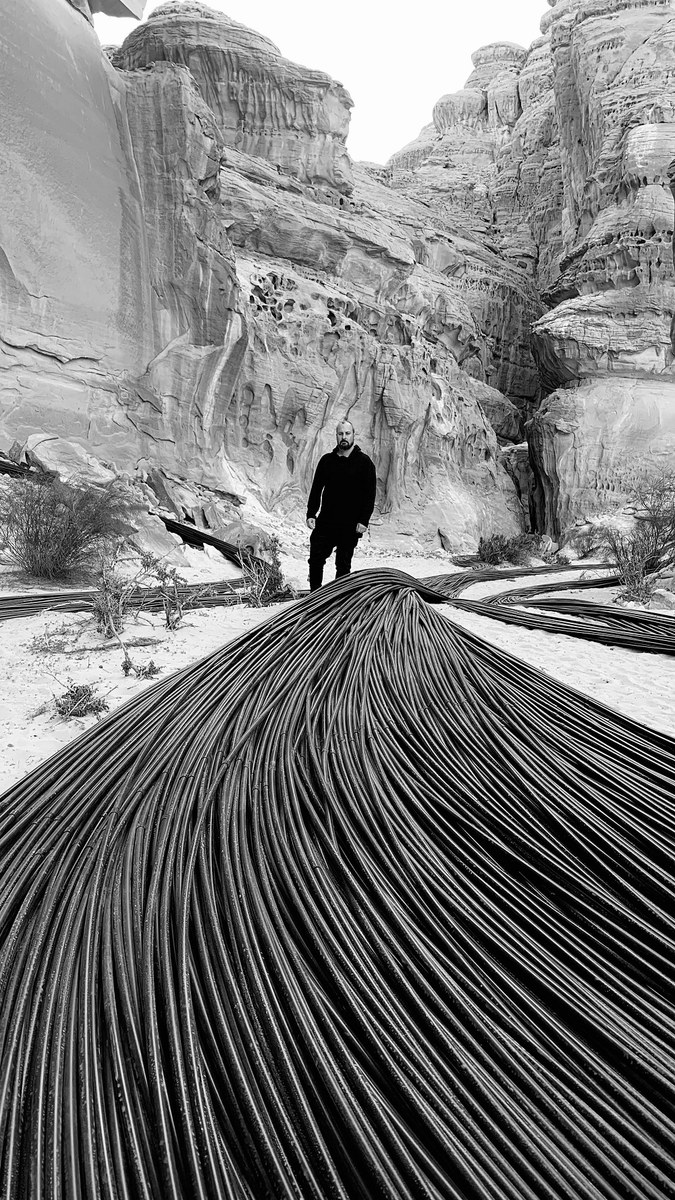
Photography by Marwah AlMugait
A major component of the pavilion will be a reflection on significant social changes in the Kingdom and how these have channeled a new wave of creative outburst and critical dialogue. Fadda is the director of the Cultural Foundation in Abu Dhabi. She was most recently a co-curator at the second edition of Desert X AlUla and has worked on a variety of exhibitions in Saudi Arabia. In 2013 Fadda curated the UAE National Pavilion showing the work of Mohammed Kazem.
Emirati Mohamed Ahmed Ibrahim’s ‘Between Sunrise and Sunset’ for UAE pavilion
For this year’s UAE Pavilion, located in the Arsenale, Mohamed Ahmed Ibrahim, originally from the town of Khor Fakkan with the backdrop of the dramatic Hajar mountains, will present a solo show titled “Between Sunrise and Sunset”. It is curated by Maya Allison, the founding executive director of The NYU Abu Dhabi Art Gallery, featuring a new body of work created especially for the event.
The artist, a longtime veteran of the UAE art community, is notable as one of “The Five”, a group of Emirati artists who worked at the Emirates Fine Arts Society and included Hassan Sharif, his brother Hussain Sharif, Abdullah Al-Saadi and Mohammed Kazem. The group is named after its participation in the 2002 exhibition titled “5 UAE,” held in Germany.

Image Courtesy of National Pavilion UAE La Biennale di Venezia. Photo by John Varghese
While the works Ibrahim will show in Venice have yet to be revealed, what we do know is that they will comprise an installation made using the artist’s human-sized, organic and abstract sculptural forms, drawing from his deep connection to his hometown’s natural environment.
The exhibition is the fifth collaboration between Allision and Ibrahim, and marks the launch of the third book that Allison has produced that explores the artist’s work. The accompanying publication, titled “Mohamed Ahmed Ibrahim: Between Sunrise and Sunset” is the first monograph of Ibrahim’s work, co-edited by Allison and Cristiana de Marchi, a poet, artist and curator.
Participation in the Venice Biennale is for all artists one of the most important moments of their careers. Ibrahim’s work, which mixes aspects of Land Art with local motifs, painting and sculpture and his signature undecipherable language, has long pushed the boundaries of art in the Arab world. He is now a star but had in 1999 faced public criticism of his work. He sought refuge with fellow artist Sharif before finding the courage to create art again.
Oman debuts at the Biennale
The small Sultanate of Oman is marking its first-ever participation in Venice this year — one of the first countries, alongside Nepal and Uganda, to debut a national pavilion since Ghana in 2019.
Funded by Oman’s Ministry of Culture and curated by Aisha Stoby, an art historian specializing in creations from Oman and the Arab world, the pavilion presents a retrospective of sorts on the country’s contemporary scene, which has been little regarded until now by Arab historians.
Stoby includes five artists: Pioneering Omani painter Anwar Sonya; Hassan Meer, founder of The Circle, a platform for experimental art in the sultanate, and Stal Gallery in Muscat; Budoor Al-Riyami, an installation artist and photographer who won the Grand Prize at the 13th Asian Art Biennale in 2008; Radhika Khimji, known for her feminist work that incorporates sculpture, collage and textile; and lastly, there is the work of the late sound and installation artist Raiya Al-Rawahi who passed away at the young age of 30 from cancer in 2017.

Portrait of Hassan Meer. Supplied
“Although we are showing three generations of Omani artists, it is a presentation showcasing different perspective(s) of how we might ourselves (be viewed) from a future perspective in terms of ecology, society and art,” Stoby told Arab News.
She explained how Oman has a “thriving local ecosystem” for arts and culture bolstered by institutions and state-funded initiatives. “This presentation in Venice has long been anticipated and we hope it will be the first of several,” she added.
The team that staged the exhibition was entirely Omani, Stoby said, including the exhibition’s architect, Haitham Busafi.
Emerging Emirati artists at Palazzo Franchetti
Marking a first for Abu Dhabi Art, the annual fair that takes place each November in the UAE’s capital is presenting the work of several emerging UAE artists in Venice from the program “Beyond: Emerging Artists” at Palazzo Franchetti (April 20 to May 22).
A collateral event to coincide with the Biennale Arte, the exhibition is the program’s first iteration in Italy and will present the 2021 work of the commissioned artists Christopher Joshua Benton, Maitha Abdalla and Hashel Al-Lamki, who were supported by guest curators Sam Bardaouil and Till Fellrath, co-founders of multidisciplinary curatorial platform Art Reoriented and shown at Abu Dhabi Art 2021.
The aim of staging their work in Venice is to provide the artists with greater international exposure. The program was funded in 2021 through the newly launched cultural philanthropy initiative Friends of Abu Dhabi Art.
The exhibition combines film, installation, and sculpture. Highlights include Benton’s “The World Was My Garden” installation working with the palm tree as a metaphor for migration, labor economies and the history of slavery in the Gulf. The exhibition’s centerpiece is “My Plant Immigrants,” an almost three-meter-tall date palm tree suspended in the air by Benton.

Flying Closer to the Sun (2021) by Maitha Abdalla. Supplied
Abdalla’s “Too Close to the Sun” incorporates video performance, sculpture, and works on canvas and photography to explore the artist’s understanding of the wild nature of women that social forces have often attempted to tame. Her work touches on various themes, including the archetype of the feminine psyche, the wildness of human nature and the free-spirited, untamable character of wild animals.
Al-Lamki’s “Neptune,” on the other hand, is a multidisciplinary piece featuring sculptures and works on canvas that traverses natural, built and imagined realms to foreground the scarcity of the Earth’s resources and how such lack impacts the human psyche.
The “Beyond: Emerging Artists” initiative invites local and international curators to work with UAE-based emerging artists of their choosing in a year-round program, encouraging them to hone their skills. Participating artists are provided with a budget and curatorial support to create ambitious new works that are shown in exhibitions through Abu Dhabi Art.
Lebanon participates against all odds
For a country afflicted by severe economic, social and political challenges, to show at the Venice Biennale says something crucial about what the Lebanese feel about their culture and heritage. It is a sign of the country’s determination to preserve its identity and history through contemporary art.
Funded by private Lebanese donors with support from the Lebanese Ministry of Culture and curated by Nada Ghandour, the pavilion is situated in the Arsenale, one of the two main venues of the biennale, and presents the work of two Lebanese artists: Painter Ayman Baalbaki, residing in Beirut, and filmmaker Danielle Arbid, based in Paris.
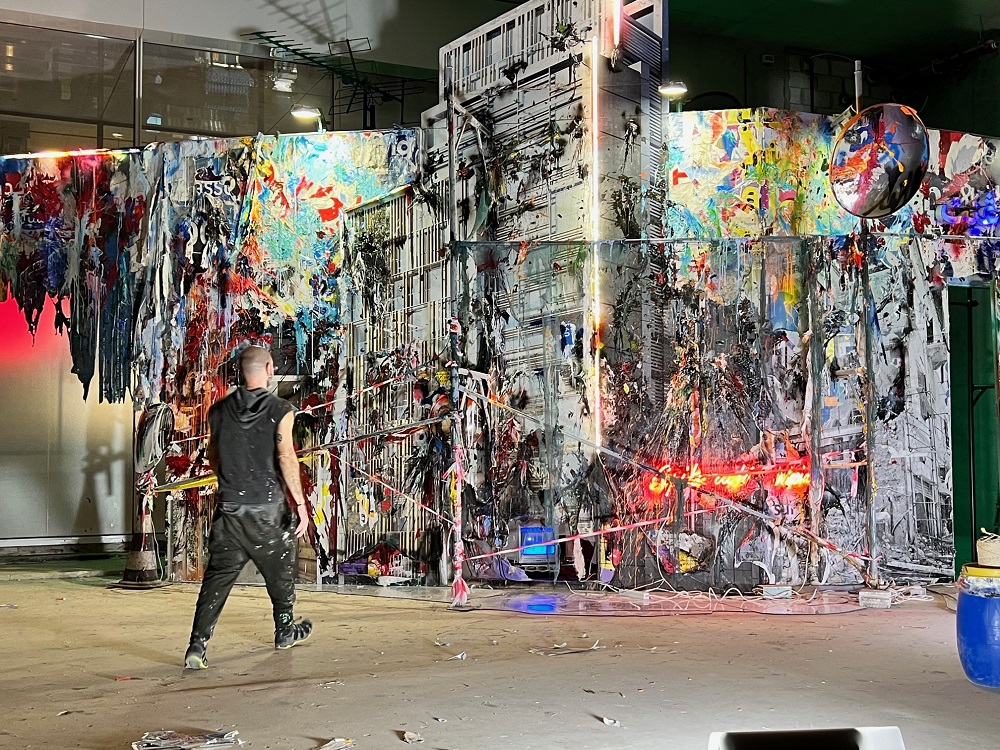
Ayman Baalbaki in the studio. Courtesy the artist
“We wanted to be in the Arsenale and participate this year to say to the world that Lebanon still exists on an international level, especially through its art and culture,” Ghandour told Arab News. “We are showing another face of Lebanon, not only the country’s problems, but the art and culture that we have.”
It offers a dialogue, says the curator, between the Lebanese living in the country and those abroad. Baalbaki, known for his expressionistic canvases featuring bursts of rich impasto in vibrant palettes often tells of the emotional impact of conflicts in the Arab world, particularly in Lebanon. Abid’s work, on the other hand, draws her inspiration from her cross-cultural upbringing living in France, Lebanon and the West.
Palestine participates through collateral event
Palestine is participating in the biennale as an official collateral event through the four-year-old Palestine Museum US, the first such institution in the Western hemisphere. The exhibition at the Palazzo Mora is titled “From Palestine with Art,” and is curated by Nancy Nesvet, also head curator of Palestine Museum US.
It presents the work of 19 artists residing in Palestine and countries around the world. Artists presented include Samia Halaby, Mohammed Alhaj, Nabil Anani, Nadia Irshaid Gilbert, Mohammed Khalil and Jacqueline Bejani, among others.
“We hope to show the world that despite living in exile and under the most difficult conditions under occupation, Palestinian artist(s) are able to excel and produce inspiring works of art that celebrate the beauty of Palestine, the strength of its people, and its rich cultural heritage,” Saleh told Arab News.

Jacqueline Bejani, palestinian portraits, 2022, acrylic on canvas. Supplied
The museum opened on April 22, 2018, as an independent non-profit organization. Founded by Palestinian-American businessman Faisal Saleh, it is the only such facility in the Americas and has over 92 square meters of permanent exhibition space featuring over 200 works of art by over 50 artists. In addition, it displays traditional Palestinian embroidery, thobes, books, artifacts and murals. It hosts regular musical concerts, lectures, plays, artist talks and exhibitions.
“We are always fighting for visibility which is difficult to achieve in the mainstream Western media,” added Saleh. “This very important art event gives us a great opportunity to get the Palestine name out in a big way.”
Artist Zineb Sedira represents France
French-Algerian artist Zineb Sedira, whose work has long incorporated autobiographical narrative, fiction and documentary to explore how politics, colonialism and migration have shaped present identities, represents France this year at the Biennale.
Working primarily in photography and video art, Sedira’s work sheds light on present international solidarities related to historical liberation struggles — topics explored in “Dreams Have No Titles.” Her exhibition at the pavilion has been curated by Yasmina Reggad, Sam Bardaouil and Till Fellrath.

“Dreams Have No Titles,” Zineb Sedira. Supplied
The show presents a film by the same name in which the artist explores the links between Algerian cinema of the 1960s and 1970s to Italian and French producers of the same time and the influences on Algerian national identity at the time. The film incorporates “mise en abyme-like re-enactments as well as “makings of” film scenes from the past as if to resurrect them in the present.
Dubai-based Ramin and Rokni Haerizadeh and Hesam Rahmanian at Complesso dell’Ospedaletto
Dubai-based Iranian artists Ramin and Rokni Haerizadeh and Hesam Rahmanian are showing their work in a new site-specific creation titled “ALLUVIUM” at the Complesso dell’Ospedale.

“ALLUVIUM” by Ramin and Rokni Haerizadeh and Hesam Rahmanian. Supplied
The exhibition, which takes place after the artists won the OGR Award at Artissima art fair in Turin, Italy in 2017, and their show “Forgive me distant wars for bringing flowers home” at OGR, or Officine Grandi Riparazioni, in Turin, looks metaphorically at the remnants left from the flow of news and history.
The artists explore what remains from this cycle and through their art attempt to give it new life and purpose as a way of cultural resistance.
Firouz Farmanfarmaian represents Kyrgyzstan for nation’s first-ever pavilion
The Iranian-born French national is presenting “Gates of Turan,” an exhibition curated by Janet Rady on the island of the Giudecca for the Kyrgyz Republic’s first-ever national pavilion in Venice.
The exhibition looks at the shared tribal heritage of the Turanian nomads of Kyrgyz, an Iranian tribe of the Avestan age (circa 4-6 century AD), who occupied “the land of Tur,” a historic region encompassing present-day Uzbekistan, Kazakhstan, Kyrgyzstan, Tajikistan, Turkmenistan and northern parts of Afghanistan and Pakistan.
Through the works on show, which features 10 hand-stitched, hand-felted Shirdaks designed by the artist to represent the tribal banners of the 10 nomadic communities of ancient Turan, Farmanfarmaian delves into the tribal identity of modern-day Kyrgyz and its shared tribal ancestry.

Kayakalak Panel One, Kyrgyz felt and yak wool, 2022. Supplied


