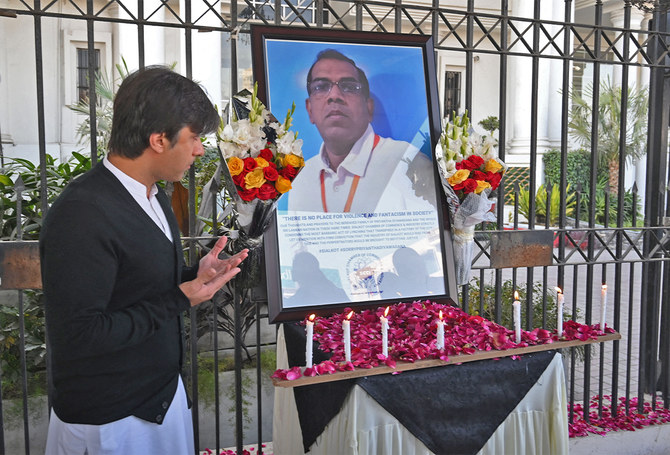
ISLAMABAD: A Pakistan court Monday sentenced six men to death and dozens more to jail terms ranging from two years to life for the brutal mob slaying of a Sri Lankan factory manager accused of blasphemy.
The vigilante attack in Sialkot last December caused outrage, with then prime minister Imran Khan calling it a “day of shame for Pakistan.”
Few issues are as galvanizing in Pakistan as blasphemy, and even the slightest suggestion of an insult to Islam can supercharge protests and incite lynchings.
On Monday, prosecutors said 88 of 89 people on trial for the murder of Priyantha Kumara had been convicted, with six sentenced to death, nine to life in prison and the rest to jail terms ranging from two to five years.
“The prosecution team worked very hard to present its case to the court and to reach this judgment,” Abdul Rauf Wattoo, the lead public prosecutor, told AFP.
“We are satisfied with the outcome.”
The trial was overseen by a special anti-terrorism court, established to speed up justice in high-profile cases that can otherwise spend years being processed.
At the time of the killing, local police officials told AFP that rumors spread that Kumara had torn down a religious poster and thrown it in the dustbin.
Several gruesome video clips shared on social media showed a mob beating the prone victim while chanting slogans against blasphemy.
Other clips showed his body being set ablaze.
Many in the mob made no attempt to hide their identity and some took selfies in front of the burning corpse.
Hafiz Israr ul Haq, lawyer for one of the men sentenced to death, called the verdict “unfair.”
“This was a case of mob violence and in such cases no individual’s role can be ascertained with certainty,” he told AFP.
Rights groups say accusations of blasphemy can often be wielded to settle personal vendettas, with minorities largely the target.
In April 2017, an angry mob lynched university student Mashal Khan when he was accused of posting blasphemous content online.
A Christian couple was lynched and their remains burnt in a kiln in Punjab in 2014 after being falsely accused of desecrating the Holy Qur’an.


![]()

Pakistan court sentences six men to death for Sri Lankan national’s lynching
Short Url
https://arab.news/g48dc
Pakistan court sentences six men to death for Sri Lankan national’s lynching
- Priyantha Kumara was lynched by dozens of people who later set his body ablaze
- The incident had created a tough diplomatic situation for Pakistan last year
Latest updates


© 2026 SAUDI RESEARCH & PUBLISHING COMPANY, All Rights Reserved And subject to Terms of Use Agreement.