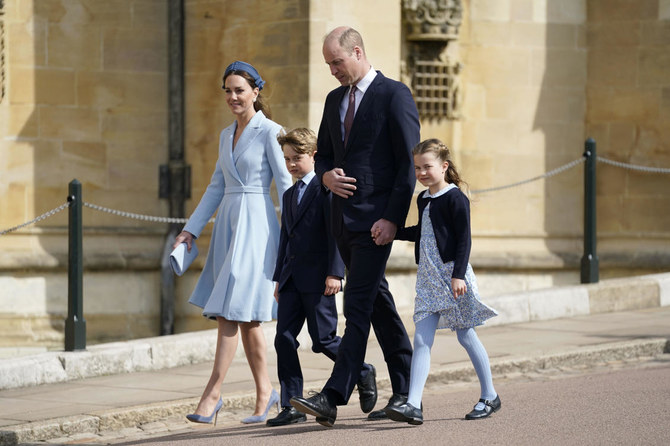
LONDON: Senior British royals including Prince William and his wife Kate have attended an Easter Sunday church service at Windsor Castle.
Queen Elizabeth II, who has been experiencing mobility problems, did not attend the service at St. George’s Chapel on the castle grounds, a fixture in the royals’ calendar.
William and Kate, also known as the Duke and Duchess of Cambridge, were accompanied by two of their three children: Prince George, 8, and 6-year-old Princess Charlotte.
Also in attendance were the queen’s youngest son, Prince Edward, with his wife Sophie and their children, and Princess Eugenie, the daughter of Prince Andrew.
The queen, who turns 96 on Thursday, is celebrating her Platinum Jubilee this year, marking 70 years on the throne.
She cut back on public duties on her doctors’ orders since spending a night in hospital in October, and also had a bout of COVID-19 in February. She attended a memorial service last month for her late husband Prince Philip, and has continued to meet virtually with diplomats and politicians.
On Thursday she had a visit from her grandson Prince Harry and his wife Meghan — the first time the couple has visited the UK together since they stepped down as working royals in 2020 and moved to California.
Harry and Meghan visited the queen at Windsor, 20 miles (32 kilometers) west of London, on their way to the Netherlands for the Invictus Games. Harry is founder and patron of the international sports competition for wounded or ill military personnel and veterans.

William and Kate lead royals at Easter service; queen absent
https://arab.news/n3jt5
William and Kate lead royals at Easter service; queen absent
- Queen Elizabeth II did not attend the service at St. George’s Chapel on the castle grounds
- On Thursday the queen had a visit from her grandson Prince Harry and his wife Meghan
International baby milk recall leads to French legal action
- Eight French families have joined a lawsuit filed by Foodwatch
- The complaint, while not naming the manufacturers or government agencies, calls for a legal investigation
PARIS: A recall of potentially contaminated infant milk formula in some 60 countries has taken a legal turn in France after a watchdog and eight families filed a lawsuit accusing manufacturers and the government of acting too slowly.
Eight French families, who said their babies suffered severe digestive problems after drinking formula named in the recall, have joined a lawsuit filed by Foodwatch, which AFP has seen.
The complaint, while not naming the manufacturers or government agencies, calls for a legal investigation.
Foodwatch, a European consumer association, believes that producers could not have ignored the risks to babies by leaving their milk on sale in France and in more than a dozen European countries, as well as in Australia, Russia, Qatar or Egypt.
Several manufacturers, including giants like Nestle, Danone, and Lactalis have issued recalls of infant formula in more than 60 countries, including France, since December due to a risk of cereulide contamination.
Cereulide, a toxin produced by certain bacteria, is “likely to cause primarily digestive problems, such as vomiting or diarrhea,” according to the French health ministry, though it said last week it so far had not determined a link to the symptoms experienced by the infants.
In the complaint, Foodwatch accuses milk powder manufacturers of delaying action between the initial warnings in December and the recalls, some of which were not widely publicized. They became more widespread in January.
Foodwatch believes that parents were told too little, too late, and in a confusing manner. French agriculture minister Annie Genevard said however that procedures had been “very well followed.”
Two separate criminal investigations have already been opened in France following the deaths of two infants who consumed infant formula recalled by Nestle due to “possible contamination” by a bacterial substance, although no “causal link” has yet been established, according to authorities.
Authorities are accused in the Foodwatch complaint of delaying action and of deficiencies in their controls.
The European Food Safety Authority (EFSA) announced meanwhile that it had been asked by the European Commission to establish a standard for cereulide in children’s products. It will issue an opinion on February 2.


