Saudi’s King Khalid and Madinah airports score high in operational efficiency in March: GACA

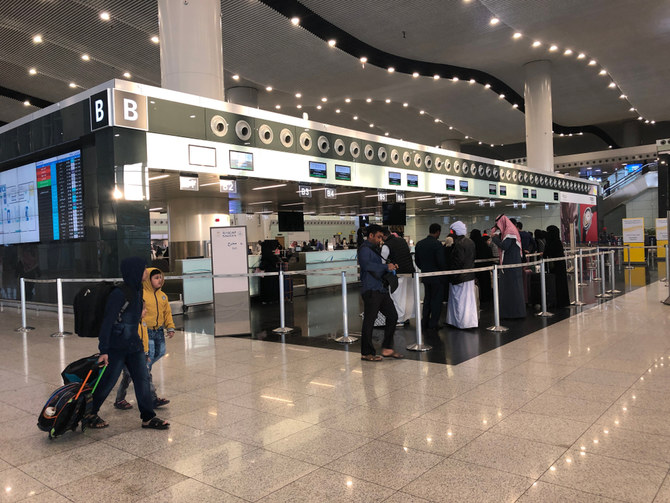
King Khalid airport, which has five terminals feeding 58 airlines to make 91,000 flights annually, claimed the top position for highest compliance to operational standards. (Shutterstock)
Short Url
Updated 17 April 2022
Follow

Saudi’s King Khalid and Madinah airports score high in operational efficiency in March: GACA

RIYADH: Saudi Arabia’s King Khalid International Airport in Riyadh scored highest with 82 percent compliance to operational standards in March, the latest data from the Saudi General Authority of Civil Aviation showed. 

Divided into three categories, GACA ranks airports based on their compliance to 14 operational criteria, including check-in, security, customs control, the waiting times for passengers, and the time spent in baggage handling, in accordance with international best practices.

King Khalid airport, which has five terminals feeding 58 airlines to make 91,000 flights annually, claimed the top position for highest compliance to operational standards, in the category of international airports having the capacity to handle more than six million passengers annually.   

Saudi’s other airbase, the Prince Mohammad Bin Abdulaziz International Airport, also known as Madinah Airport, has also claimed the highest position with 82 percent compliance to GACA’s set standards in March, under the same category.  

Those were followed by Saudi’s other two airports King Fahd International Airport in Dammam and King Abdulaziz International Airport in Jeddah, with compliance rates of 64 percent and 55 percent, respectively.

Whereas in the second category of international airports that has less than 6 million passengers capacity annually, Prince Sultan Bin Abdulaziz International Airport in Tabuk ranked first with a compliance rate of 100 percent.

For domestic airports which fall under the third category, Turaif Airport scored 100 percent outperforming all other competing airports in total average waiting times for the departing and arriving flights.

The report comes in line with the implementation of the strategic directions aimed at improving services provided to passengers and raising the level of service at the Kingdom’s airports.


Saudi Tourism Development Fund seals $1.07bn partnerships at Momentum 2025 

Updated 19 sec ago
Follow

Saudi Tourism Development Fund seals $1.07bn partnerships at Momentum 2025 

RIYADH: Saudi Arabia’s Tourism Development Fund, the national enabler of the tourism sector, has announced six agreements and a memorandum of understanding with public and private sector entities, strengthening partnerships with a total impact exceeding SR4 billion ($1.07bn). 

The move aims to expand financing solutions through the fund’s “Tourism Empowerment Programs” for micro, small, and medium enterprises during the Development Finance Conference Momentum 2025, organized by the National Development Fund. 

The announcement was made in the presence of Minister of Tourism and TDF Board Chairman Ahmed Al-Khateeb, TDF Board Member and Governor of the National Development Fund Stephen Groff, TDF CEO Qusai bin Abdullah Al-Fakhri, and senior executives from banks and financial institutions. 

These agreements build on previous partnerships with financing solution providers to support the growth of Saudi Arabia’s tourism sector. 

Since their inception, the Tourism Empowerment Programs have delivered nearly SR3 billion in funding, creating over 74,000 jobs across the Kingdom, highlighting the critical role of financial partnerships in supporting tourism and business growth. 

Al-Fakhri said: “The remarkable growth of the Tourism Empowerment Programs reflects the success of our strategy to support and sustain tourism enterprises.” 

He added that the average annual number of beneficiaries has increased tenfold, and financing volumes have more than doubled compared with previous years, demonstrating the fund’s ability to expand economic impact. 

“At TDF, we go beyond funding — we are building an integrated enablement ecosystem to create new investment opportunities, enhance developmental finance, and empower the private sector, contributing to inclusive growth across all regions of the Kingdom and supporting MSMEs in driving national development,” the CEO emphasized. 

Building on a previous partnership with the Kafala Program, which empowered over 2,000 enterprises through guarantees exceeding SR2 billion, TDF has agreed with Kafala to expand joint programs by launching a new initiative valued at approximately SR700 million. 

The program will partner with more than 45 financial institutions to further support tourism project growth and expansion nationwide. 

Additionally, TDF announced a new financing agreement with Arab National Bank worth SR300 million to enhance tourism enterprises’ access to the funding needed for growth. 

This expands on a similar SR300 million agreement signed last year, which benefited 249 enterprises across the Kingdom within a year. 

Four new agreements under the Funded Companies Program, totaling SR200 million, were also signed with Al-Jabr Finance, Al-Tayseer Arabian Co., Al-Raedah Finance, and Tamweel Al-Oula, extending previous collaborations worth SR250 million that provided financing solutions to tourism sector enterprises across the Kingdom. 

These agreements aim to broaden financing options and accelerate access to comprehensive funding, with tailored solutions for diverse tourism projects. 

Recognizing the importance of supporting MSMEs, TDF also signed an MoU with the Small and Medium Enterprises Bank to develop a model for developmental financing for targeted enterprises, enhancing entrepreneurs’ and businesses’ access to financial and non-financial solutions efficiently and sustainably. 

To date, TDF’s enablement initiatives have benefited more than 10,000 enterprises, boosting their contribution to the national economy, supporting innovation, and expanding service offerings, in line with the objectives of Saudi Vision 2030. 

The TDF plays a pivotal role in advancing developmental finance and sector growth as a national enabler, supporting business expansion, and broadening the tourism investment base. 

This role complements the National Development Fund framework, which serves as a unified platform for development funds and banks, driving a strategic financing ecosystem to stimulate and sustain the national economy through enhanced public-private partnerships.