PARIS: French President Emmanuel Macron held a major campaign rally Saturday in Marseille, touting his environmental and climate actions and plans in a bid to draw in young voters who supported more politically extreme candidates in the first round of France’s presidential election.
Citizens and especially millennials in Marseille, a multicultural southern French city on the Mediterranean, favored hard-left candidate Jean-Luc Melenchon over the centrist Macron in the April 10 first round of voting.
Marseille’s young voters, who leaned mainly to the far right and the far left last Sunday, are particularly engaged with climate issues — a point which Macron hoped to capitalize on in a rousing speech on the edge of the glistening sea.
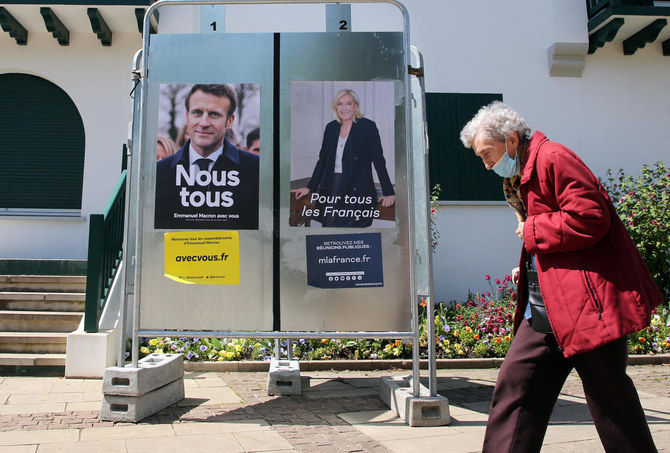
Macron is facing off against far-right challenger Marine Le Pen in France’s April 24 presidential runoff after 10 other candidates, including Melenchon, were eliminated in the first round.
Macron has mixed green credentials, something he hopes to improve on. Although he was associated with the slogan “Make The Planet Great Again,” in his first five-year term he capitulated to angry yellow vest protesters by scrapping a tax hike on fuel prices.
To cheers on Saturday, Macron said his next prime minister would be placed in charge of “ecological planning” ahead of a plan for France to become carbon neutral by 2050. He also promised more public transport nationwide to wean people off being dependent on cars.
Even though Macron come out on top in the first round of voting, the 44-year-old incumbent has publicly acknowledged that “nothing is decided” in the increasingly tight race to become France’s next leader. In Marseille, he targeted his rival Le Pen, who has gained increasing support in recent weeks.
“The far-right represents a danger for our country. Don’t just hiss at it, knock it out,” he said, citing the danger of over-confident voters abstaining from a ballot in the vital runoff vote.
Le Pen spent Saturday reaching out to voters in Saint-Rémy-sur-Avre, a village in the northwestern France, where she visited an antiques market.
While campaigning Friday, both candidates were grilled over their differing stances on Muslim religious dress in public spaces — Le Pen wants to ban headscarves in France, a country that has Europe’s largest Muslim population. Both Le Pen and Macron were confronted by women in headscarves who asked why their clothing choices should be caught up in politics.
Across France, protesters are railing against a host of issues ahead of the second and final presidential vote.
In the center of Paris on Saturday, environmental group Extinction Rebellion launched a three-day demonstration against what they call France’s inaction on climate issues. The activists say their objective is “to put climate issues back at the center of the presidential debate.”
Hundreds of activists from the environmental group XR are also asking both presidential candidates to make commitments to protect the environment.


![]()

Macron courts Marseille voters; Climate activists in Paris
Short Url
https://arab.news/99yrk
Macron courts Marseille voters; Climate activists in Paris
- Marseille's young voters are particularly engaged with climate issues — a point which Macron hoped to capitalize on in a rousing speech on the edge of the glistening sea
- To cheers on Saturday, Macron said his next prime minister would be placed in charge of “ecological planning” ahead of a plan for France to become carbon neutral by 2050


Latest updates


Recommended


© 2026 SAUDI RESEARCH & PUBLISHING COMPANY, All Rights Reserved And subject to Terms of Use Agreement.