PML-N's Hamza Shehbaz elected Punjab's new chief minister

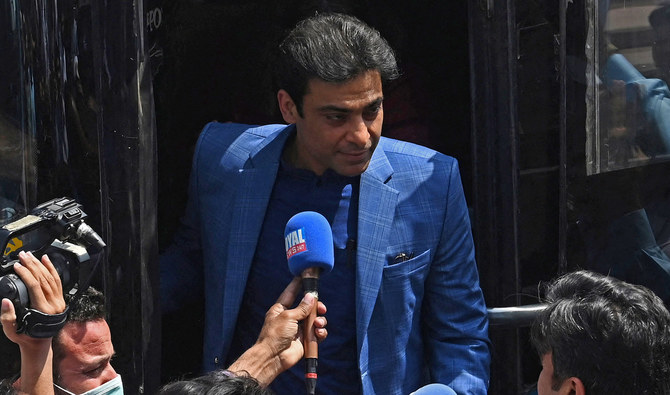
Hamza Shehbaz, son of Pakistan Prime Minister Shahbaz Sharif, arrives before the Chief Minister of Punjab vote at the provincial assembly in Lahore on April 16, 2022. (AFP)
Short Url
Updated 16 April 2022
Follow

PML-N's Hamza Shehbaz elected Punjab's new chief minister

  • Hamza Shehbaz received 197 votes to win Punjab chief minister election
  • Voting was marred earlier as clashes took place between PTI, PML-Q and PML-N lawmakers

ISLAMABAD: Pakistan Muslim League-Nawaz (PML-N) lawmaker Hamza Shehbaz was elected as Punjab's new chief minister on Saturday, after a chaotic session of the Punjab Assembly where legislators of the Pakistan Tehreek-e-Insaf (PTI) and Pakistan Muslim League-Quaid (PML-Q) scuffled with one another.  

The top post in Punjab was vacant since the resignation of former Punjab CM Usman Buzdar. He stepped down last month after former prime minister Imran Khan nominated Chaudhry Pervaiz Elahi for the new chief minister, in return for the PML-Q’s support in a no-confidence vote in the center.  Khan lost the vote held on April 10. 

The two candidates in the running were PML-Q’s Elahi, a former speaker of the Punjab Assembly, and Shehbaz, backed by the PML-N party and allies. 
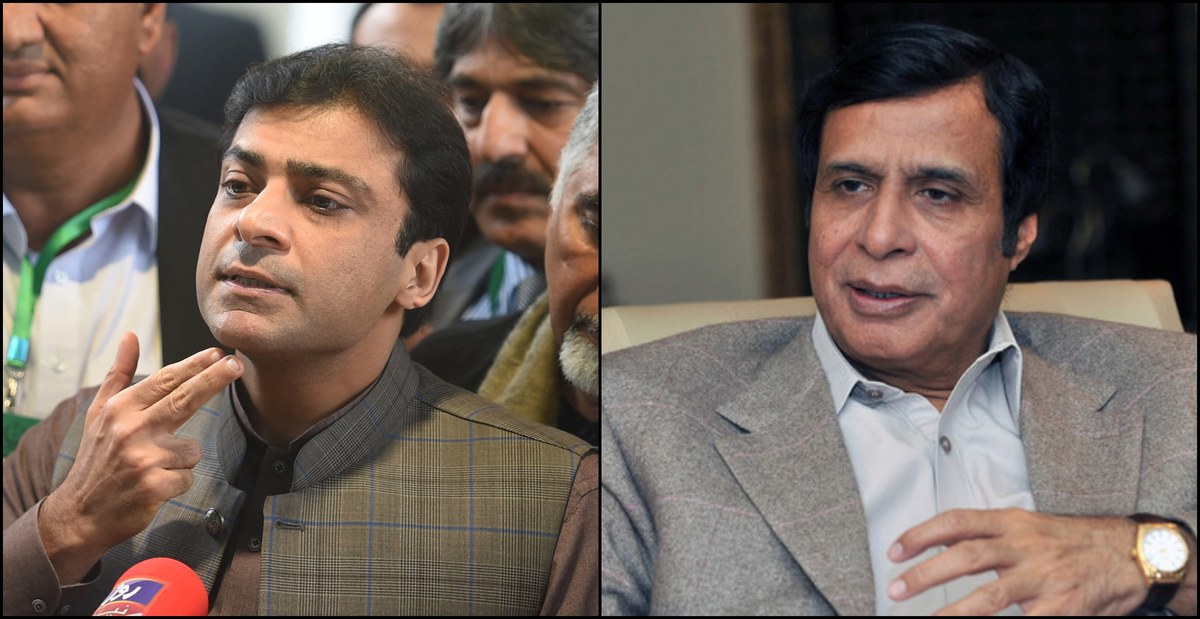


This combination of photos shows Pakistan Muslim League-Quaid nominee for Punjab chief minister Pervaiz Elahi (L) and Pakistan Muslim League-Nawaz nominee Hamza Shehbaz (R). (Photos by AFP)

Shehbaz polled 197 votes while his opponent, Elahi, failed to secure a single vote from the assembly. PTI and PML-Q lawmakers had boycotted the voting process after the ruckus. 

Visuals shared on news channels showed some lawmakers from the PTI and the PML-Q attacking Deputy Speaker Sardar Dost Muhammad Mazari as he arrived in the assembly hall to chair the session. Mazari was later shifted to his chamber by the assembly’s guards. 

“I will not go to the hospital despite violence and injuries [inflicted on me] and I will complete the process today as per the court’s orders,” Mazari said. 

Following the violence, the vote for the Punjab chief minister election was delayed. The speaker resumed after a couple of hours.

Reportedly, Elahi was also attacked when he arrived at the Punjab Assembly for the election. Speaking to Geo News over the phone, he accused PML-N lawmakers of attempting to "take his life." Elahi said PML-N lawmakers had hit him repeatedly on the chest, adding that he was a heart patient.
A footage of Elahi is being played on TV channels in which he could be seen being led by the assembly's guards to his seat, a cast slung over his arm as he used a nebulizer.
Elahi also accused Shehbaz of ordering the "attack" on him by PML-N lawmakers.

Prime Minister Shehbaz Sharif condemned the “attack” on the deputy speaker.   

“PTI/PMLQ MPAs [Member of Provincial Assembly] attack on Dy [deputy] Speaker inside Punjab Assembly must be condemned in strongest terms possible. This blatant display of violence & hooliganism is fascism, pure & simple,” said the prime minister via a tweet. “IK’s [Imran Khan] desperation & incitement to violence is rupturing our society. He is attacking democracy itself.” 

“We are inches away from [a] full-fledged civil unrest,” former information minister Chaudhry Fawad Hussain said in a tweet. 

He said ex-PM Khan has exercised utmost restraint, adding that “very soon even he won’t be able to stop this very angry mob and we [will] see country plunging into a civil unrest, imported leaders will not be able to leave the country,” Hussain added. 

The assembly session was first scheduled for April 3 and then called on April 6 on account of damage caused to the assembly hall allegedly by the protesting opposition lawmakers. 

The Punjab Assembly has 371 members. A candidate needs to secure at least 186 votes to be the next chief minister. 

Apart from the PML-N’s 165 seats in the provincial assembly, Shehbaz claimed he had the support of the requisite number of lawmakers belonging to other political factions. 

Khan’s Pakistan Tehreek-e-Insaf (PTI) has 183 members, while the PML-Q has 10 seats in the provincial legislature. However, lawmakers disgruntled with both parties decided to favor Shehbaz in the contest. 

The Lahore High Court earlier this week turned down a petition to hold early election for the position of Punjab chief minister, ruling the process would take place on April 16 as originally planned. 


Pakistan urges concessional finance for developing nations to boost clean energy security

Updated 11 January 2026
Follow

Pakistan urges concessional finance for developing nations to boost clean energy security

  • Pakistan has emerged as one of world’s fastest growing solar markets, with 12GWs of off-grid and 6GWs of net-metered capacity in 2025
  • PM’s aide says Islamabad remains committed to Paris Agreement, looks for continued support in building a resilient and low-carbon future

ISLAMABAD: Pakistan has urged international partners to scale up concessional financing for developing countries, the country’s Press Information Department (PID) said on Sunday, citing an aide to Prime Minister Shehbaz Sharif.

The call was made by Sharif’s coordinator on climate change, Romina Khurshid Alam, while delivering Pakistan’s national statement at the 16th International Renewable Energy Agency (IRENA) Assembly in Abu Dhabi.

Pakistan has emerged as one of the world’s fastest growing solar markets, with 12 gigawatts (GWs) of off-grid and over 6GWs of net-metered solar capacity by the end of 2025. Last fiscal year, renewables accounted for a historic 53 percent of total electricity generation, according to Alam.

The prime minister’s aide stressed that affordable funding for developing nations is critical to accelerating their transition to clean energy and strengthening energy security amid rising climate and economic challenges.

“Alam reaffirmed Pakistan’s target of achieving 60 percent renewables in the power mix by 2030,” the PID said in a statement.

“In her call to action, she urged IRENA and Member States to increase concessional finance for developing nations, treat technologies such as energy storage and green hydrogen as global public goods, and strengthen regional cooperation for shared energy security.”

IRENA is a global intergovernmental agency for energy transformation that serves as the principal platform for international cooperation, supports countries in their energy transition, and provides state of the art data and analyzes on technology, innovation, policy, finance and investment. Its membership comprises 170 countries and the European Union (EU).

The 16th session of the IRENA Assembly is taking place on Jan. 10-12 in Abu Dhabi and focuses on the theme of “Powering Humanity: Renewable Energy for Shared Prosperity.” The session has gathered global leaders and energy decision-makers to discuss strategies and underline necessary actions for the acceleration of renewable energy across countries, regions, and the world, driving economic inclusion, equity, and human well-being.

Alam shared that Pakistan is taking action against energy poverty through initiatives like the Punjab Solar Panel Scheme 2026, which provides free or subsidized systems to low-income households.

She highlighted how distributed solar kits have restored power and livelihoods in flood-affected communities and offer a replicable model for climate-resilient recovery.

“Pakistan remains fully committed to the Paris Agreement and looks to IRENA for continued technical and financial support in building a resilient, inclusive, and low-carbon future,” Alam said.

Adopted in 2015 to combat climate change, the Paris Agreement binds nations to hold “the increase in the global average temperature to well below 2°C above pre-industrial levels” and pursue efforts “to limit the temperature increase to 1.5°C above pre-industrial levels.”