

Sri Lankans abandon family holiday celebrations to join anti-government protests

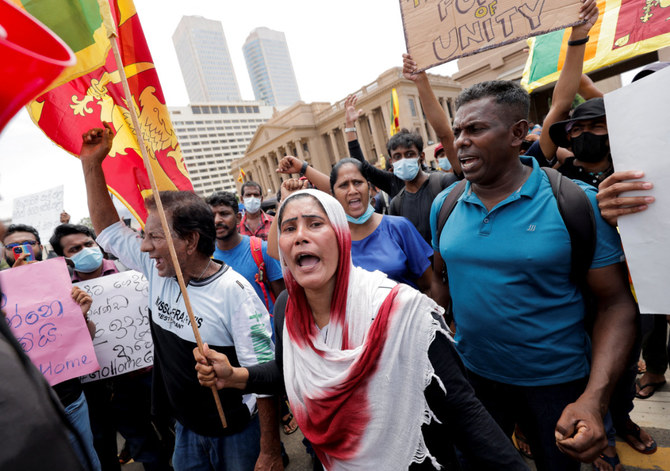
People shout slogans during a protest against Sri Lanka President Gotabaya Rajapaksa in Colombo on April 12, 2022 amid the country's economic crisis. (REUTERS/Dinuka Liyanawatte)
Short Url
Updated 14 April 2022
Follow

Sri Lankans abandon family holiday celebrations to join anti-government protests

  • Protesters set up a camp outside the president’s office
  • Country is enduring its worst economic crisis since independence in 1948

COLOMBO: A pot of milk boiled over outside the presidential office in Colombo on Thursday to the cheers of thousands of Sri Lankans who defied their annual tradition of returning home, wanting just one person to go: The country’s embattled leader.

Boiling a pot of milk is the most important ritual of Sri Lankan New Year. It is usually done with family members to attract prosperity. But this time, instead of enjoying the new year’s festivities in their hometowns, people remained in the capital to demand President Gotabaya Rajapaksa’s resignation, as they blame him for the country’s worst economic crisis since independence in 1948.

Mass protests against the president, known to many as Gota, began in Colombo last week.

Angry over skyrocketing inflation, stalled imports of fuel and medicines and hours of power cuts a day, residents have transformed the streets in front of Rajapaksa’s office into a protest camp dubbed “Gotagogama,” or “Gota go village.”

“We want President Gotabaya Rajapaksa to step down,” Malith Lakshan, who has been protesting at the site, told Arab News.

“We want him to step down, we want his family out of politics.”

The Rajapaksas are the country’s most influential political dynasty. The president’s elder brother, Mahinda Rajapaksa, is serving as prime minister.

Their younger brother, Basil Rajapaksa, was Sri Lanka’s finance minister until he resigned last week.

The prime minister said on Wednesday he was ready to meet the protesters, but he did not announce when.

“We won’t stop until they go,” Pathum Bandara, another demonstrator, said. “We will keep coming back here.”

A font designer, he is one of those who installed a board calling the protest site “Gotagogama.” The name has since reached other cities as well.

“We didn’t expect it to go viral,” he said with a laugh.

“Now there are Gotagogamas in Ratnapura, Badulla and even Kandy. We think this movement will spread across the country.”

Bandara believes the movement to oust the government is now unstoppable.

“It is coming from the people,” he added. “There is no organizer and no leader.”

Rajapaksa was elected president in 2019, mostly with the support of the country’s Sinhalese Buddhist majority. But now, even his electorate has turned its back on him, as the island nation of 22 million people is about to default on its debts and many can hardly afford three meals a day.

The protest site has seen an influx of all kinds of people offering their support and solidarity.

Artists, puppeteers and amateur musicians have been entertaining the crowds with their performances.

Gagana Atapattu, an artist manager, said he came to help a friend who was distributing bottles of water among demonstrators.

“I haven’t left since. People kept coming and handing over donations of water and food to sustain the protestors. How could I leave then?” he told Arab News.

“I have never seen anything like this before.”


Uganda army denies seizing opposition leader as vote result looms

Updated 5 sec ago
Follow

Uganda army denies seizing opposition leader as vote result looms

KAMPALA: Uganda’s army denied claims on Saturday that opposition leader Bobi Wine had been abducted from his home, as counting continued in an election marred by reports of at least 10 deaths amid an Internet blackout.
President Yoweri Museveni, 81, looked set to be declared winner and extend his 40-year rule later on Saturday, with a commanding lead against Wine, a former singer turned politician.
Wine said Friday that he was under house arrest, and his party later wrote on X that he had been “forcibly taken” by an army helicopter from his compound.
The army denied that claim.
“The rumors of his so-called arrest are baseless and unfounded,” army spokesman Chris Magezi told AFP.
“They are designed to incite his supporters into acts of violence,” he added.
AFP journalists said the situation was calm outside Wine’s residence early Saturday, but they were unable to contact members of the party due to continued communications interruptions.
A nearby stall-owner, 29-year-old Prince Jerard, said he heard a drone and helicopter at the home the previous night, with a heavy security presence.
“Many people have left (the area),” he said. “We have a lot of fear.”
With more than 80 percent of votes counted on Friday, Museveni was leading on 73.7 percent to Wine’s 22.7, the Electoral Commission said.
Final results were due around 1300 GMT on Saturday.
Wine, 43, whose real name is Robert Kyagulanyi, has emerged as the main challenger to Museveni in recent years, styling himself the “ghetto president” after the slum areas where he grew up in the capital, Kampala.
He has accused the government of “massive ballot stuffing” and attacking several of his party officials under cover of the Internet blackout, which was imposed ahead of Thursday’s polls and remained in place on Saturday.
His claims could not be independently verified, but the United Nations rights office said last week that the elections were taking place in an environment marked by “widespread repression and intimidation” against the opposition.

- Reports of violence -

Analysts have long viewed the election as a formality.
Museveni, a former guerrilla fighter who seized power in 1986, has total control over the state and security apparatus, and has ruthlessly crushed any challenger during his rule.
Election day was marred by significant technical problems after biometric machines — used to confirm voters’ identities — malfunctioned and ballot papers were undelivered for several hours in many areas.
There were reports of violence against the opposition in other parts of the country.
Muwanga Kivumbi, member of parliament for Wine’s party in the Butambala area of central Uganda, told AFP’s Nairobi office by phone that security forces had killed 10 of his campaign agents after storming his home.