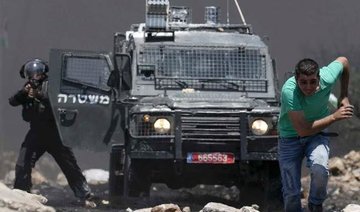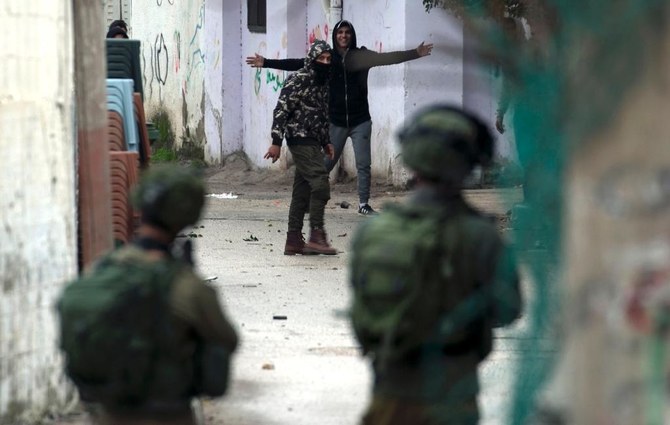

RAMALLAH: Three Palestinians were killed and 14 injured on Thursday by Israeli forces during their latest raids into the West Bank flashpoint district of Jenin.
At dawn, the Israeli forces stormed the towns of Yamoun and Kafr Dan in Jenin, where violent confrontations erupted. Six civilians were injured by bullets, three of them seriously.
In a clash near Jenin on Thursday morning “two youths died of injuries sustained in an Israeli attack,” the Palestinian Health Ministry said.
Hours later, the ministry announced the death of a 45-year-old Palestinian father of six who was “critically wounded by Israeli bullets” on Wednesday in Beita, south of Nablus.
Those attending the three funerals raised slogans denouncing the “crimes” committed by the Israeli occupying forces against the Palestinians.
Ramallah and Jenin observed a commercial strike on Thursday in protest against the killings.
Nabil Abu Rudeineh, the Palestinian presidential spokesman, said Palestine is “at a crossroads due to the dangerous Israeli escalation,” and accused Israel of “playing with fire through its provocative actions, chaos and daily hysteria against the Palestinians.”
Talking to Arab News, Palestinian security officials expressed deep concerns over the rapidly deteriorating security situation in the West Bank, especially as younger generations rushed to engage in the clashes.
Palestinians have endured spates of fatal shootings and indiscriminate detentions since the beginning of Ramadan, which have cast a pall of gloom over the Occupied Palestinian Territories.
April has witnessed a sharp escalation in cases of extrajudicial executions by Israelis. Fourteen civilians have been killed, dozens injured, and some 1,000 have been detained in the nightly West Bank raids.
Hussein Al-Sheikh, a member of the Fatah Central Committee, told the Voice of Palestine radio that the Israeli government has taken a clear decision to raise the pace of killings by instructing its army to kill without hesitation, pointing out that “what is happening is a real massacre that cannot be tolerated.”
Sheikh condemned aggression witnessed at Al-Aqsa Mosque, with continuous incursions by Israeli settlers and their attempts to worship in its courtyards.
He made an urgent appeal to national factions, including the Hamas movement, to sit together to achieve national unity, stressing that aggression can only be defeated with national unity.
The Israel Defense Forces said its raids are conducted to arrest wanted persons and confiscate weapons.
The Israeli army has raised the level of alertness as the Jewish Passover festival looms on the horizon. A decision is expected to be taken regarding the imposition of a complete closure on Palestinian territories.
The state of high alert has continued around the Gaza Strip front in light of the escalation of threats by the Palestinian factions.
“The purpose of the ongoing Israeli military and security activities in various parts of the West Bank these days is to prevent terrorist attacks against Israelis. It is interested in giving Israelis a sense of security to celebrate the upcoming Passover,” said Roni Shakid, who worked as a correspondent for a prominent Israeli newspaper, Yedioth Ahronoth, for three decades, and lived through the first and second intifadas.
He said: “Without the support from the Palestinian community violent armed attacks against Israeli citizens would not have happened.”
Shakid added that popular uprisings have become integral to the long Palestinian-Israeli conflict.
The new Palestinian generation, he said, is not aware of what happened in the intifadas of 1987-1993 and 2000-2003 and wants to put its name in the record of the Palestinian struggle.
Palestinian political analyst Ghassan Al-Khatib, the vice president of Birzeit University in the West Bank, told Arab News that the current Israeli government continues to oppress the Palestinians without the slightest consideration of its impact on the status of the Palestinian Authority.
“The situation will worsen, and no one knows where things will go, especially since Israel has focused on the economic solution and Palestinians see no hope for a political solution,” Al-Khatib said.
Meanwhile, the Israeli Ministry of Education has asked those in charge of educational programs in schools that belong to Palestinian Israelis not to include any material in the curricula that covers commemorating the Nakba — the destruction of Palestinian society and homeland in 1948, and the permanent displacement of a majority of the Palestinian Arabs.