

On Karachi visit, new PM calls for defunct train system to be revived under CPEC

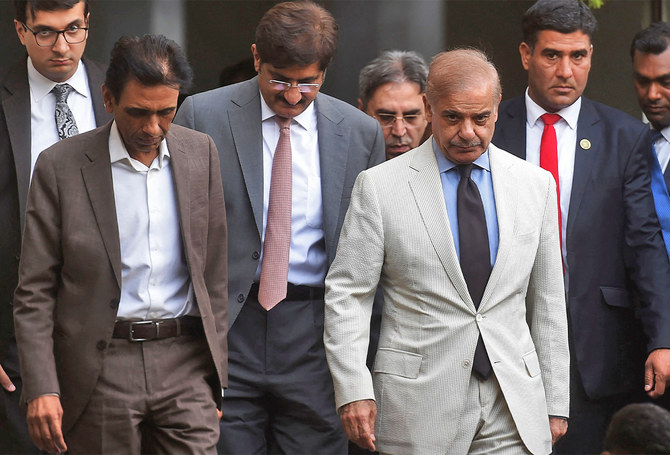
Pakistan's Prime Minister Shehbaz Sharif (2R) and leader of the Muttahida Qaumi Movement (MQM-P) and collation partners of the newly formed government Khalid Maqbool Siddiqui (L) leave after a meeting in Karachi on April 13, 2022. (AFP)
Short Url
Updated 13 April 2022
Follow

On Karachi visit, new PM calls for defunct train system to be revived under CPEC

  • Karachi Circular Railway declined in the mid-eighties and has been closed since 1999
  • Shehbaz Sharif discusses development projects, law and order with Sindh chief minister

KARACHI: Pakistan’s newly elected Prime Minister Shehbaz Sharif discussed various developmental projects with the top provincial administration officials of Sindh on Wednesday while mentioning the possibility of reviving the Karachi Circular Railway (KCR) by bringing it under the framework of the China-Pakistan Economic Corridor.
Sharif promised to resolve Karachi’s outstanding issues during a daylong visit to the city where he was received by Chief Minister Murad Ali Shah.
The new prime minister visited the mausoleum of Pakistan’s founding father Muhammad Ali Jinnah to pay his tribute and “reiterate observance of the golden principles of the Founder of the Nation aimed at progress and prosperity of the country,” a statement from his office said.
He also held a meeting with the leaders of his administration’s important ally, the Muttahida Qaumi Movement-Pakistan (MQM-P), at their headquarters in the city.
“We should strive to make the KCR, the public transport system, as part of the CPEC [China-Pakistan Economic Corridor],” he told the participants of his meeting with Shah, adding the authorities in Beijing had initially hinted at making it a mandatory part of the multibillion-dollar project.

Sharif added the “circumstances have changed,” and Pakistan was once again in a position to reach out to the Chinese government over the issue.
The prime minister also recognized the chief minister’s efforts to resolve the transportation issues of Karachi, saying the provincial government was doing its utmost to help its residents and the federal authorities would extend all possible support to it.
Commissioned in 1964, the KCR was originally designed to help the Pakistan Railways employees by facilitating their movement between their workplaces and residences in the city’s eastern neighborhoods.
The service remained popular until 1984 when the number of trains reduced, though it was the lack of maintenance and repair, along with a gap between expenditure and revenue, which led to its closure in 1999.
Pakistan’s former prime minister Imran Khan, who is scheduled to address a large public rally in Karachi on Sunday, did the ground breaking ceremony for the project’s revival last September, nearly a year after former railways minister Sheikh Rasheed Ahmed partially reactivated it but could not make it fully functional.
Sharif also said he wanted to import thousands of buses by facilitating investors to fulfil the transportation needs of Karachi.
He discussed the issue of clean drinking water for the city in detail and agreed to upgrade its capacity by 2024.
“If we resolve the water issue, we will obey the commandment of God,” he said.
Later, Sharif visited the MQM-P headquarters and held a meeting with its leadership, though he left for Islamabad without interacting with the media.
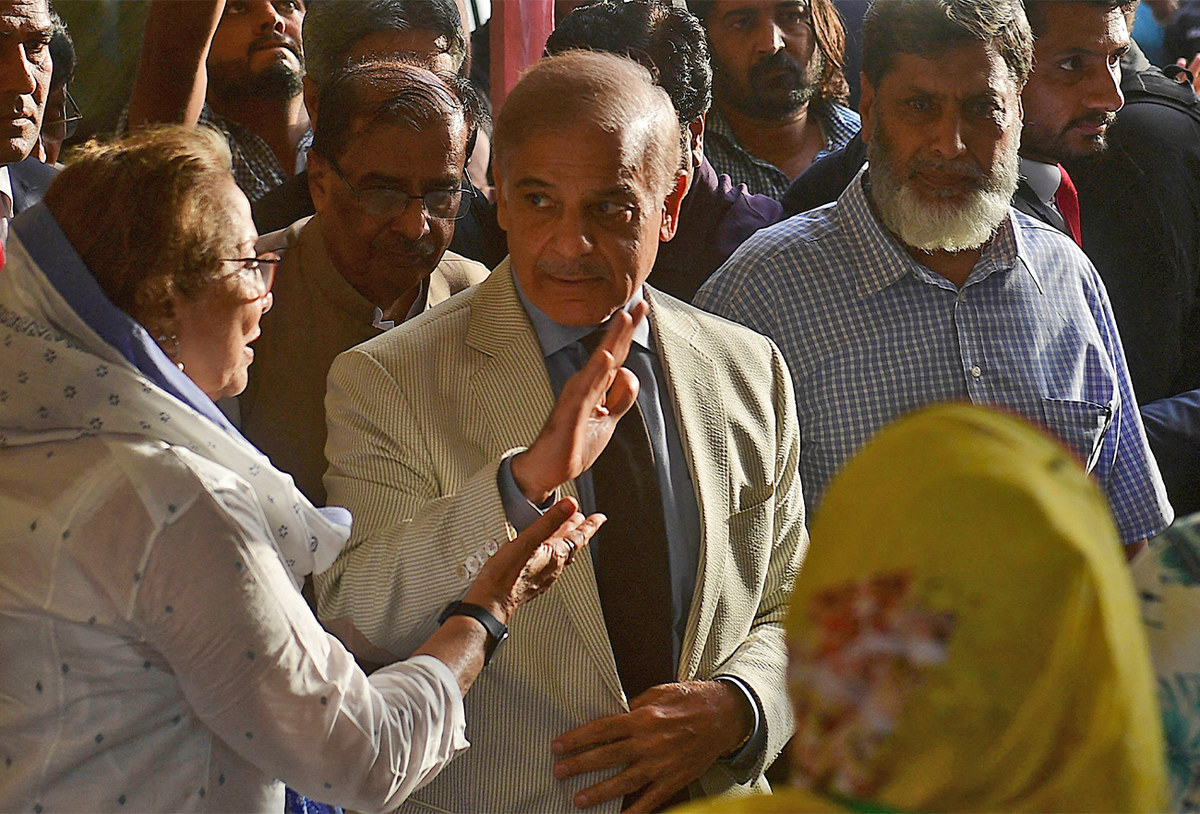


Pakistan's Prime Minister Shehbaz Sharif waves as he arrives to meet leaders of the Muttahida Qaumi Movement (MQM-P) and collation partners of the newly formed government during his visit in Karachi on April 13, 2022. (AFP)

Speaking to journalists, Khwaja Izhar-ul-Hasan, a senior MQM-P leader, said his party was not interested in federal ministries or the governor’s position in Sindh.
He added the MQM-P only desired to facilitate the federal and provincial authorities with the implementation of the agreements signed with them ahead of ex-PM Khan’s ouster.
Later, an official handout circulated by the party said the prime minister had agreed to excute the accord with the MQM-P as soon as possible.


Pakistan, Iraq agree on tighter coordination over pilgrims under new regulated travel system

Updated 4 sec ago
Follow

Pakistan, Iraq agree on tighter coordination over pilgrims under new regulated travel system

  • New system requires all Iraq-Iran pilgrimages to be organized by licensed groups under state oversight
  • Long-running “Salar” model relied on informal caravan leaders, leading to overstays and missing pilgrims

ISLAMABAD: Pakistan and Iraq this week agreed to closely coordinate on the management and security of Pakistani pilgrims, as Islamabad rolls out a new, tightly regulated travel system aimed at preventing overstays, undocumented migration and security breaches during religious visits to Iraq and Iran.

The understanding was reached during a meeting between Pakistan’s Interior and Narcotics Control Minister Mohsin Naqvi and Iraq’s Interior Minister General Abdul Amir Al-Shammari on Thursday evening, where both sides discussed measures to facilitate pilgrims while strengthening oversight, Pakistan’s interior ministry said.

The agreement comes as Pakistan dismantles its decades-old pilgrim travel model and replaces it with a centralized, licensed system after authorities confirmed that tens of thousands of Pakistani pilgrims had overstayed or gone missing abroad over the past decade, triggering concerns from host governments.

“You have, for the first time during your tenure, taken effective measures to organize pilgrim groups, which are commendable,” Al-Shammari told Naqvi, according to Pakistan’s interior ministry.

“All pilgrims included in the list provided by Pakistan’s Ministry of Interior will be allowed to enter Iraq,” he added, making clear that only travelers cleared under the new system would be permitted.

Naqvi said Pakistan would strictly enforce return timelines under the revised framework.

“Pilgrims traveling to Iraq will not be allowed to stay beyond the designated period,” he said, adding that relevant authorities in both countries would remain in close coordination.

Both interior ministers also agreed to strengthen information-sharing and joint mechanisms on security cooperation, counterterrorism and the prevention of human smuggling, officials said.

“The safety, dignity, and facilitation of Pakistani pilgrims is the top priority of the Government of Pakistan,” Naqvi said.

Al-Shammari said he would visit Pakistan soon to finalize a joint roadmap to further improve pilgrim facilitation, security coordination and broader bilateral cooperation, according to the interior ministry.

Pakistan’s government has overhauled its pilgrim travel regime this year, abolishing the long-running “Salar” system under which informal caravan leaders managed pilgrimages. The move followed official confirmation that around 40,000 Pakistani pilgrims had overstayed or disappeared in Iran, Iraq and Syria over the past ten years.

Under the new Ziyarat Management Policy, only licensed Ziyarat Group Organizers (ZGOs) are allowed to arrange pilgrimages, with companies held directly responsible for ensuring pilgrims return on time. Authorities have completed security clearance for 585 companies seeking registration, while scrutiny of applications remains ongoing.

Islamabad has also barred overland travel for major pilgrimages, including Arbaeen, citing security risks in Pakistan’s southwestern Balochistan province, meaning all travel to Iraq and Iran is now restricted to regulated air routes.

Tens of thousands of Pakistani pilgrims travel each year to Iraq and Iran to visit some of the most revered shrines in Shia Islam, including the mausoleums of Imam Ali in Najaf and Imam Hussain in Karbala in Iraq, and major religious sites in Mashhad and Qom in Iran. Pilgrimages peak during religious occasions such as Arbaeen, when millions of worshippers converge on Karbala from across the region. The scale of travel, often involving long stays and cross-border movements, has long posed logistical, security and migration-management challenges for Pakistani authorities and host governments alike.