

China’s top oil producer CNOOC prepares Western retreat over sanctions fear

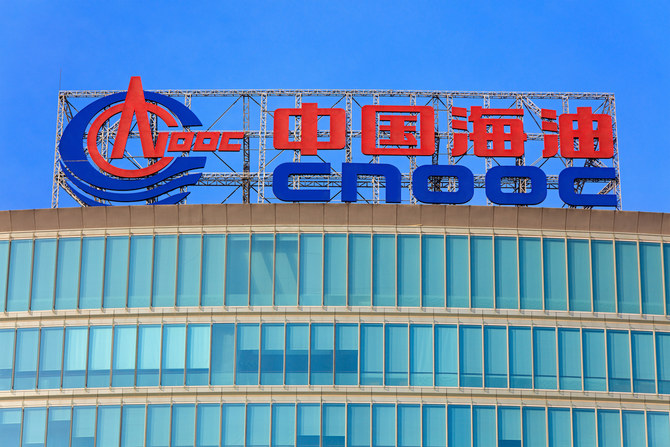
Last month, CNOOC had hired Bank of America to prepare for the sale of its North Sea assets. (Shutterstock)
Short Url
Updated 13 April 2022
Follow

China’s top oil producer CNOOC prepares Western retreat over sanctions fear

LONDON: China’s top offshore oil and gas producer CNOOC Ltd. is preparing to exit its operations in Britain, Canada and the US, because of concerns in Beijing the assets could become subject to Western sanctions, industry sources said.
Ties between China and the West have long been strained by trade and human rights issues and the tension has grown following Russia’s invasion of Ukraine, which China has refused to condemn.
The US said last week China could face consequences if it helped Russia to evade Western sanctions that have included financial measures that restrict Russia’s access to foreign currency and make it complicated to process international payments.
CNOOC did not immediately comment.
Companies periodically carry out reviews of their portfolios, but the exit being prepared would take place less than a decade after state-owned CNOOC entered the three countries via a $15 billion acquisition of Canada’s Nexen, a deal that transformed the Chinese company into a leading global producer.
The assets, which include stakes in major fields in the North Sea, the Gulf of Mexico and large Canadian oil sand projects, produce around 220,000 barrels of oil equivalent per day (boed), Reuters calculations found.
Last month, Reuters reported CNOOC had hired Bank of America to prepare for the sale of its North Sea assets, which include a stake in one of the basin’s largest fields.
CNOOC has launched a global portfolio review ahead of its planned public listing in the Shanghai stock exchange later this month that is aimed primarily at tapping alternative funding following the delisting of its US shares last October, the sources said.
The delisting was part of a move by former US President Donald Trump’s administration in 2020 that targeted several Chinese companies Washington said were owned or controlled by the Chinese military. China condemned the move.
CNOOC is also taking advantage of a rally in oil and gas prices, driven by Russia’s invasion of Ukraine on Feb. 24, and hopes to attract buyers as Western countries seek to develop domestic production to substitute Russian energy.
As it seeks to leave the West, CNOOC is looking to acquire new assets in Latin America and Africa, and also wants to prioritize the development of large, new prospects in Brazil, Guyana and Uganda, the sources said.

CNOOC is seeking to sell “marginal and hard to manage” assets in Britain, Canada and the United States, a senior industry source told Reuters.
All the sources spoke on condition of anonymity because of the sensitivity of the issue.
The industry source said last month that CNOOC’s top management, including chairman Wang Dongjin, found managing the former Nexen assets was “uncomfortable” because of red tape and high operating costs compared with developing nations.
CNOOC has faced hurdles operating in the US in particular, such as security clearances required by Washington for its Chinese executives to enter the country, the source added.


Oman’s Islamic banking assets rise to $24bn on credit growth 

Updated 5 sec ago
Follow

Oman’s Islamic banking assets rise to $24bn on credit growth 

JEDDAH: Oman’s Islamic banking assets climbed to about 9.2 billion Omani rials ($23.9 billion) by the end of October, underscoring steady expansion in the sultanate’s financial sector as credit growth remains robust. 

Assets held by Islamic banks and Islamic windows accounted for 19.5 percent of Oman’s total banking system, up 10.8 percent from a year earlier, the Oman News Agency reported. 

Oman’s banking sector performance reflects steady progress toward Vision 2040, which prioritizes economic diversification, private sector growth, and financial resilience. 

“As for the total financing provided by institutions engaged in this activity, it also rose by 10.4 percent, reaching around 7.4 billion Omani rials,” the ONA reported, adding that deposits with Islamic banks and Islamic windows grew 11.9 percent to roughly 7.3 billion rials by the end of October. 

Rising credit flows, particularly to non-financial corporates and households, are fueling the development of small and medium-sized enterprises and domestic investment in Oman, supporting efforts to reduce reliance on hydrocarbons and build a more diversified economy. 

“Total deposits held with ODCs registered a Y-o-Y significant growth of 7 percent to reach 33.3 billion rials at the end of August 2025. Total private sector deposits increased by 7.5 percent to OMR 22.4 billion,” the Central Bank of Oman said in a statement issued in October. 

The broader banking sector also saw solid credit growth in 2025. By the end of August, total credit across commercial banks increased by 8.6 percent year on year to 34.1 billion rials, driven mainly by lending to non-financial corporates and households, which accounted for 46.7 percent and 44.7 percent of total credit, respectively. 

Private sector lending alone rose by 6.5 percent, supporting SME activity and domestic investment. 

Meanwhile, aggregate deposits at conventional banks climbed 5.5 percent to 26.1 billion rials at the end of August, with private sector deposits accounting for 67 percent, or 17.5 billion rials, of the total. 

Islamic banking entities mirrored this momentum, with total financing reaching 7.3 billion rials and deposits standing at 7.2 billion rials by the end of August, underscoring steady expansion throughout 2025. 

Islamic banking in Oman was introduced after the Central Bank of Oman issued preliminary licensing guidelines in May 2011, allowing full-fledged Islamic banks and Islamic windows to operate alongside conventional institutions. 

The framework was formalized in December 2012 through a Royal Decree amending the Banking Law, mandating Shariah supervisory boards and authorizing the central bank to establish a High Shariah Supervisory Authority.