

Over 2,000 Indian Sikhs in Pakistan for Vaisakhi harvest festival starting today

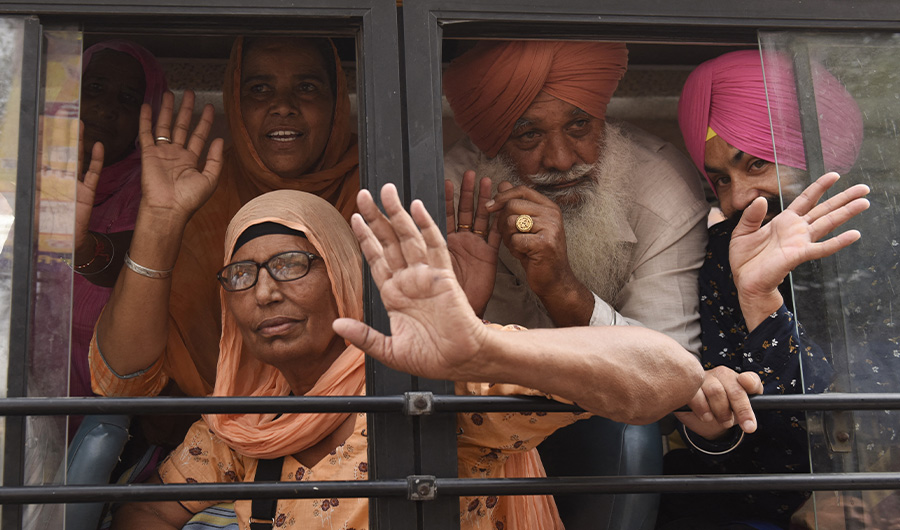
Sikh pilgrims wave from a bus before leaving to Pakistan for 'Baisakhi', a spring harvest festival for Sikhs and Hindus, in Amritsar on April 12, 2022. (AFP)
Short Url
Updated 13 April 2022
Follow

Over 2,000 Indian Sikhs in Pakistan for Vaisakhi harvest festival starting today

  • Main ceremony for critical day in Sikh religion to be held at Gurdawara Panja Sahib in Hasan Abdal tomorrow
  • Around 400 Railways policemen deployed for security of pilgrims, special commandos and snipers on duty

ISLAMABAD: Over 2,000 Sikh pilgrims entered Pakistan on Tuesday from the Wagah border crossing to attend the annual Vaisakhi harvest festival starting today, Wednesday.
The main ceremony of Vaisakhi, a New Year’s celebration as well as a critical day in the formation of the Sikh religion, will be held at the Gurdawara Panja Sahib shrine in the town of Hasan Abdal outside Islamabad tomorrow, Thursday, in which thousands of Sikhs will perform the cleansing ritual of ashnan, or bathing.
The shrine is one of Sikhism’s holiest sites and it is believed that the handprint of the founder of the religion, Guru Nanak, is imprinted on a boulder there. Vaisakhi is also meant to mark the day when Gobind Singh, the 10th and final prophet, established the discipline of Khalsa, through which the faithful can aspire to the ultimate state of purity.

Sikhs are a small minority in Muslim-majority Pakistan, but many Sikh holy sites ended up in the country after the 1947 partition from India following independence from Britain.


Sikh pilgrims shout slogans before leaving to Pakistan for 'Baisakhi', a spring harvest festival for Sikhs and Hindus, in Amritsar on April 12, 2022. (AFP)

Many Sikhs also see Pakistan as the place where their religion began: the founder of Sikhism, Guru Nanak, was born in 1469 in a small village near the eastern Pakistani city of Lahore.
“Whenever we come to Pakistan, the land of our gurus, we feel very happy and relaxed ... this time too, we have come here with a lot of love for the people of Pakistan,” Sardar Arvinder Singh, the leader of a Sikh group that arrived in Pakistan, told media at the Wagah border crossing, adding that he was thankful to the Pakistan government for issuing visas in such large numbers.
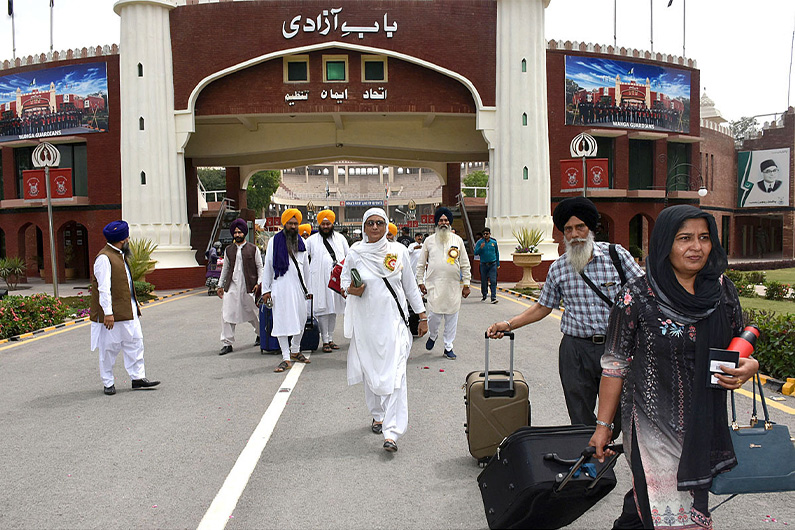


Sikh pilgrims arrive in Lahore, Pakistan for 'Baisakhi', a spring harvest festival for Sikhs and Hindus on April 13, 2022. (APP)

Delhi Gurdwara Management Committee chief Sardar Sukhbeer Singh said Pakistan and India shared the “same culture” and Sikhs always “felt comfortable” in Pakistan.


Sikh pilgrims queue to board a bus before leaving to Pakistan for 'Baisakhi', a spring harvest festival for Sikhs and Hindus, in Amritsar on April 12, 2022. (AFP)

“The arrangements made by the Pakistan government for us are impressive,” he added.
The Pakistan High Commission in New Delhi this year issued visas to 2,200 pilgrims out of whom 2,044, including women, crossed into Pakistan via Wagah to attend the festival on Tuesday. After having food at Wagah, the pilgrims left for Hasan Abdal on special buses and trains with escorts from the Railways Police, district police and other law enforcement agencies. They reached the town by 8pm.


Sikh pilgrims queue to board a bus before leaving to Pakistan for 'Baisakhi', a spring harvest festival for Sikhs and Hindus, in Amritsar on April 12, 2022. (AFP)

“Due to security issues, the pilgrims were not allowed to get off the trains on their way to Hasanabdal,” a spokesperson for Railways told media on Tuesday. “Similarly, they wouldn’t be allowed to get off the trains or other transport whenever they are traveling in Pakistan during their trip.”
Around 400 Railways policemen have been deployed for the security of the pilgrims.
“Special commandos and snipers have also been deployed at each railway station, especially Wagah, Lahore, Hasanabdal and Nankana Sahib,” Pakistan’s Dawn newspaper reported.


Pakistan saw 73% increase in combat-related deaths in 2025— think tank

Updated 8 sec ago
Follow

Pakistan saw 73% increase in combat-related deaths in 2025— think tank

  • Pakistan reported 3,387 deaths thus year, among them 2,115 militants and 664 security forces personnel, says think tank
  • Civilian deaths increased by 24% to 580 in 2025, compared to 468 in 2024, as Pakistan saw 1,063 militant attacks in 2025

ISLAMABAD: Combat-related deaths in Pakistan this year increased by 73%, with both security forces and militants suffering casualties in large numbers, a report published by an Islamabad-based think tank said on Sunday.

As per statistics released by the Pakistan Institute for Conflict and Security Studies (PICSS), combat-related deaths in 2025 rose 73% to 3,387, compared with 1,950 in 2024. These deaths included 2,115 militants, 664 security forces personnel, 580 civilians and 28 members of pro-government peace committees (combatants), the think tank said in a press release. 

“Militants accounted for about 62% of total combat-related deaths, and their 2,115 fatalities represented the highest annual militant death toll since 2015, when 2,322 militants were killed,” PICSS said. 

Compared to last year, militant deaths recorded a steep increase by 122% as the PICSS reported that 951 militants had been killed in 2024.

The think tank, however, said this year was also particularly bloody for Pakistani security forces. PICSS recorded 664 security personnel deaths in 2025, a 26% rise from 528 in 2024, and the highest annual figure since 2011, when 677 security forces personnel lost their lives. 

Civilian deaths also increased by 24% to 580 in 2025, compared with 468 in 2024, marking the highest annual civilian toll since 2015, when 642 civilians were killed. 

As per the PICSS report, at least 1,063 militant attacks took place in 2025, a 17% increase compared with 908 in 2024 and the highest annual total since 2014, when 1,609 militant attacks were recorded. 

The report also noted a 53 percent increase in suicide attacks this year, with 26 such incidents reported in 2025 compared with 17 in 2024. 

“PICSS noted an expanding trend in the use of small drones, including quadcopters, with 33 such incidents recorded during 2025, alongside increased use of unmanned aerial vehicles by security forces,” the report said. 

The report noted an 83% rise in arrests of suspected militants, with 497 arrested in 2025 compared to 272 in 2024. 

This 2025 figure is the highest annual total of suspected militants arrested since 2017, when 1,781 militants were either arrested or laid down their weapons.

“PICSS noted that most violence remained concentrated in Pashtun-majority districts of Khyber Pakhtunkhwa, including the tribal districts (erstwhile FATA), and in Balochistan,” it said. 

Pakistan has been grappling with a surge in militant attacks in its western provinces of Khyber Pakhtunkhwa and Balochistan, both bordering Afghanistan, this year. 

Islamabad blames Afghanistan for providing sanctuaries to militants it alleges use Afghan soil to carry out attacks against Pakistan. Kabul denies the charges.