

Daesh ‘Beatle’ was ‘aristocrat’ among fellow extremists, US court told

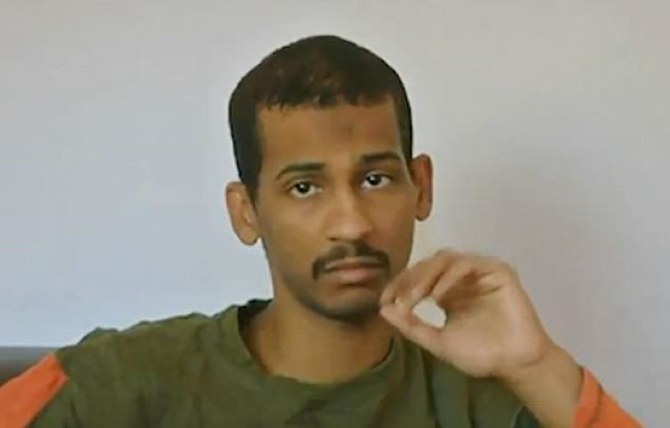
El Shafee Elsheikh carryied a Glock pistol — ‘a symbol of Daesh aristocracy.’ (Screengrab)
Short Url
Updated 12 April 2022
Follow

Daesh ‘Beatle’ was ‘aristocrat’ among fellow extremists, US court told

  • Omer Kuzu claims El Shafee Elsheikh was marked for seniority by ‘prized’ weapon, uniform
  • Kuzu says he met Elsheikh alongside fellow ‘Beatle’ Alexanda Kotey

LONDON: El Shafee Elsheikh, the former British national accused of being a member of the Daesh “Beatles,” was labeled as “Daesh aristocracy” by a former extremist at his trial in the US on Monday.

Elsheikh, 33, faces life in prison if convicted of playing a role in the kidnap and murder of four US citizens — aid workers Kayla Mueller and Peter Kassig, and journalists James Foley and Steven Sotloff — in Syria in 2017.

Omer Kuzu, 26, from Dallas, Texas, who fought in Syria and was captured by Syrian Democratic Forces in 2019, said Elsheikh had been a senior figure in the group.

He told the court in Alexandria, Virginia that he met Elsheikh on four separate occasions between 2015 and 2017, and that Elsheikh had gone by the alias Abu Thabit.

When asked to identify Abu Thabit, Kuzu pointed at Elsheikh, saying: “He’s right there with the blue button-up shirt and the beard and glasses.”

Elsheikh, who was born in Sudan but grew up in London, is suspected of being part of a four-strong group of prominent Daesh members known as the “Beatles” on account of their British accents.

He denies being a part of the four, and claims to have just been a “simple Daesh fighter,” admitting to having played a part in the kidnapping and killing of two British aid workers, David Haines and Alan Henning.

Kuzu added, though, that on one occasion he met Elsheikh in Raqqa in 2016, where Elsheikh was carrying a Glock pistol, a prized item “only carried by wealthy individuals, or people with a lot of experience or people who had a position in the hierarchy. It was a symbol of Daesh aristocracy.”

The Texan said that Elsheikh was also noted for seniority by his donning of military fatigues rather than casual wear. “His green military uniform and the fact he was very reserved also told me that he was no ordinary member,” Kuzu said.

He added that Elsheikh worked in IT for Daesh, which, given its importance for communication, was a task entrusted to a select few members. “You had to be trusted,” he said, adding that the role would not be entrusted to a “simple member.”

Kuzu also claimed that he met Elsheikh “with a very tall individual carrying an M4” in 2017, who he identified as Alexanda Kotey, another member of the so-called “Beatles” and who was captured alongside Elsheikh in 2018.

He added that the high status nature of the weapon, along with Kotey’s “air of importance” also singled him out as being a senior figure. “They seemed to be a duo or some sort of tag team,” Kuzu said.

Acting for the defense, Edward MacMahon asked Kuzu whether people with British accents working and fighting for Daesh had been common, to which Kuzu replied that there had been “a lot.”

Kuzu is now awaiting sentencing for conspiring to provide material support for terrorism, while Kotey, too, is awaiting sentencing after admitting to the charges relating to kidnap, detention and murder leveled against him by US authorities.

Mohammed Emwazi, the third member of the “Beatles,” was killed in a drone strike in Raqqa in 2015, while the fourth member, Aine Davis, was arrested in Turkey the same year.


US and Mideast countries seek Kyiv’s drone expertise as Russia-Ukraine talks put on ice

Updated 59 min 33 sec ago
Follow

US and Mideast countries seek Kyiv’s drone expertise as Russia-Ukraine talks put on ice

KYIV, Ukraine: The United States and its allies in the Middle East are seeking Ukraine's expertise in countering Iran's Shahed drones, according to Ukrainian President Volodymyr Zelenskyy.

Various countries, including the United States, have approached Ukraine for help in defending against the Iranian drones, Zelenskyy said late Wednesday. He said he has spoken in recent days with the leaders of the United Arab Emirates, Qatar, Bahrain, Jordan and Kuwait about possible cooperation.

Russia has fired tens of thousands of Shaheds at Ukraine since it invaded its neighbor just over four years ago, launching a swarm of more than 800 drones and decoys in its biggest nighttime barrage. Iran has responded to joint U.S.-Israeli strikes by launching the same type of drones at countries in the Middle East.

Ukrainian assistance in countering Iranian drones will be provided only if it does not weaken Ukraine's own defenses, and if it adds leverage to Kyiv's diplomatic efforts to stop the Russian invasion, according to the Ukrainian leader.

"We help to defend from war those who help us, Ukraine, bring a just end to the war" with Russia, Zelenskyy said. Later Thursday, Zelenskyy said he had received a U.S. request for support to defend against the drones in the Middle East and had given the order for equipment to be provided along with Ukrainian experts without providing further details.

"Ukraine helps partners who help our security and the protection of our people's lives," he added in a social media post.

Trump, in an interview Thursday with Reuters, said, "Certainly I'll take, you know, any assistance from any country."

Ukraine has battle-tested drone defenses

Ukraine has pioneered the development of cut-price drone killers that cost as little as $1,000, rewriting the air defense rule book and making other countries take notice.

European countries got a wake-up call last September on the changed nature of air defense when Poland scrambled multimillion-dollar military assets, including F-35 and F-16 fighter jets and Black Hawk helicopters, in response to airspace violations by cheap drones.

Ukrainian manufacturers have developed low-cost interceptor drones specifically designed to hunt and destroy Shaheds, and its rapidly expanding drone industry is producing excess capacity.

Zelenskyy announced earlier this year that Ukraine would begin exporting the battle-tested systems.

The European Union's top diplomat, Kaja Kallas, said before chairing a meeting of EU and Gulf foreign ministers via video link Thursday that the talks would look at how Ukraine's experience can help countries counter Iranian drones.

Middle East war delays Russia-Ukraine talks

The Iran war, now in its sixth day, has drawn international attention away from Europe's biggest conflict since World War II, and forced the postponement of a new round of U. S-brokered talks between Russia and Ukraine planned for this week, Zelenskyy said.

Western governments and analysts say the Russia-Ukraine war has killed hundreds of thousands of people, while there is no sign that yearlong U.S.-led peace efforts will stop the fighting any time soon.

"Right now, because of the situation around Iran, there are not yet the necessary signals for a trilateral meeting," Zelenskyy said. "But as soon as the security situation and the overall political context allow us to resume that trilateral diplomatic work, it will be done."

Zelenskyy thanked the United States for the return from Russia on Thursday of 200 Ukrainian prisoners of war. Russia's Defense Ministry also said it received the same number of prisoners from Ukraine and thanked the U.S. and United Arab Emirates for mediating.

Prisoner swaps have been one of the few tangible results of the talks. Vladimir Medinsky, a Russian negotiator, said on social media that a total of 500 prisoners from each side would be exchanged between Thursday and Friday.

Oleksandr Merezhko, the head of Ukraine's parliamentary foreign affairs committee, said Russian President Vladimir Putin is trying to drag out the negotiations so that he can press on with Russia's invasion while escaping further U.S. sanctions.

He urged the U.S. administration to look at the Russia-Ukraine war and the war in the Middle East as linked.

"In reality, Russia and Iran are close allies that act in concert — Iran supplies weapons and Russia helps Iran develop its defense industry. These are interconnected conflicts," Merezhko told The Associated Press.

Ukraine's army has recently pushed back Russian forces at some points along the roughly 1,250-kilometer (750-mile) front line, according to the Institute for the Study of War.

Localized Ukrainian counterattacks liberated more territory than Ukrainian forces lost in the last two weeks of February, the Washington-based think tank said this week, estimating the recovered land at about 257 square kilometers (100 square miles) since Jan. 1.