Iran imposes sanctions on 24 Americans as nuclear talks stall

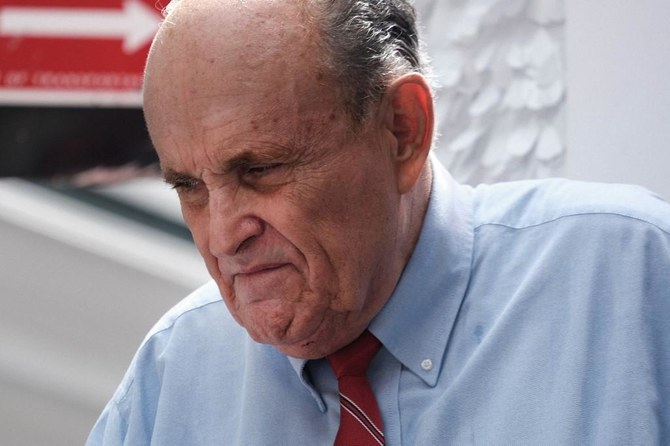
Former New York City Mayor Rudy Giuliani was among those included in Iran’s latest list of sanctioned US officials. (Getty Images via AFP)
Short Url
Updated 09 April 2022
Follow

Iran imposes sanctions on 24 Americans as nuclear talks stall

  • Almost all the people named were officials who served during Trump's administration
  • The Iranian Foreign Ministry accused the sanctioned Americans of supporting "terrorist groups and terrorist acts" against Iran

DUBAI: Iran said on Saturday it had imposed sanctions on 24 more Americans, including former Army Chief of Staff George Casey and former President Donald Trump’s attorney Rudy Giuliani, as months of talks to revive a 2015 nuclear deal have stalled.
Almost all the people named were officials who served during Trump’s administration, which imposed sanctions on Iranian officials, politicians and companies and withdrew the United States from Iran’s nuclear agreement with world powers.
In a statement carried by local media, the Iranian Foreign Ministry accused the sanctioned Americans — who also included several business figures and politicians — of supporting “terrorist groups and terrorist acts” against Iran, and Israel’s “repressive acts” in the region and against Palestinians.
Eleven months of indirect talks between Iran and the United States in Vienna on salvaging the 2015 deal have stalled as both sides say political decisions are required by Tehran and Washington to settle the remaining issues.
The sanctions let Iranian authorities seize any assets held by the individuals in Iran, but the apparent absence of such assets means the move will likely be symbolic.
Gen. Austin Scott Miller, former commander of US forces in Afghanistan, former US Commerce Secretary Wilbur Ross, and several former ambassadors are among the officials targeted by the new Iranian sanctions.
In a similar move announced in January, Iran imposed sanctions on 51 Americans, many of them from the US military, over the 2020 killing of General Qassem Soleimani in a drone strike in Iraq.
Last year, it imposed sanctions on Trump and several senior US officials.


Death toll rises to at least 10 in violence around Iran protests

Updated 11 sec ago
Follow

Death toll rises to at least 10 in violence around Iran protests

DUBAI: Violence surrounding protests in Iran sparked by the Islamic Republic’s ailing economy killed two other people, authorities said Saturday, raising the death toll in the demonstrations to at least 10 as they showed no signs of stopping.
The new deaths follow US President Donald Trump warning Iran on Friday that if Tehran “violently kills peaceful protesters,” the United States “will come to their rescue.” While it remains unclear how and if Trump will intervene, his comments sparked an immediate, angry response from officials within the theocracy threatening to target American troops in the Mideast.
The weeklong protests, have become the biggest in Iran since 2022, when the death of 22-year-old Mahsa Amini in police custody triggered nationwide demonstrations. However, the protests have yet to be as widespread and intense as those surrounding the death of Amini, who was detained over not wearing her hijab, or headscarf, to the liking of authorities.
The deaths overnight into Saturday involved a new level of violence. In Qom, home to the country’s major Shiite seminaries, a grenade exploded, killing a man there, the state-owned IRAN newspaper reported. It quoted security officials alleging the man carried the grenade to attack people in the city, some 130 kilometers (80 miles) south of the capital, Tehran.
Online videos from Qom purportedly showed fires in the street overnight.
The second death happened in the town of Harsin, some 370 kilometers (230 miles) southwest of Tehran. There, the newspaper said a member of the Basij, the all-volunteer arm of Iran’s paramilitary Revolutionary Guard, died in a gun and knife attack in the town in Kermanshah province.
Demonstrations have reached over 100 locations in 22 of Iran’s 31 provinces, the US-based Human Rights Activists News Agency reported.
Iran’s civilian government under reformist President Masoud Pezeshkian has been trying to signal it wants to negotiate with protesters. However, Pezeshkian has acknowledged there is not much he can do as Iran’s rial has rapidly depreciated, with $1 now costing some 1.4 million rials. That sparked the initial protests.