

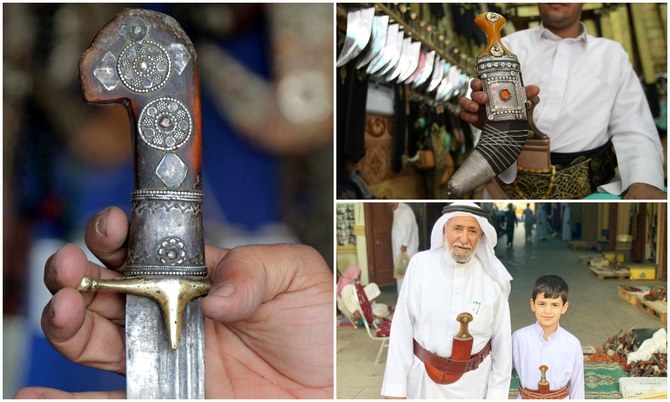


JEDDAH: The short, curved dagger known as a janbiya is one of the most recognizable symbols of Arab heritage among a large portion of the people in the Arabian Peninsula.
It is traditionally worn by men, attached to a belt around the waist, as the main accessory to their traditional clothing. Intricate carvings on the dagger’s hilt and sheath can provide clues to the owner’s social status and tribal background, revealing details of ancestral roots and information passed from one generation to the next that offer a fascinating insight into an era that has largely passed.
The origins of the small, curved, iron blades date back to pre-Islamic times, but in the modern era they have become a symbol of national pride, worn by men throughout the region as a tribute to a colorful tribal past that continues to resonate in the social traditions of today.
Such is the status of the janbiya as an emblem of tribal identity in parts of Saudi Arabia, Oman and Yemen that some examples can command a price of tens of thousands of dollars. The owner of a janbiya carefully protects it and wears it throughout his life; for many it becomes an indispensable part of their personality.
When Bedouin tribes roamed the vast expanses of the Arabian Peninsula, the dagger typically hung from the waist, accompanied by two ammunition belts crisscrossing the chest, and a sword at the hip.
The janbiya was an essential tool for self-defense and survival on the open road as groups of people moved, often under cover of night, from one camp to another.
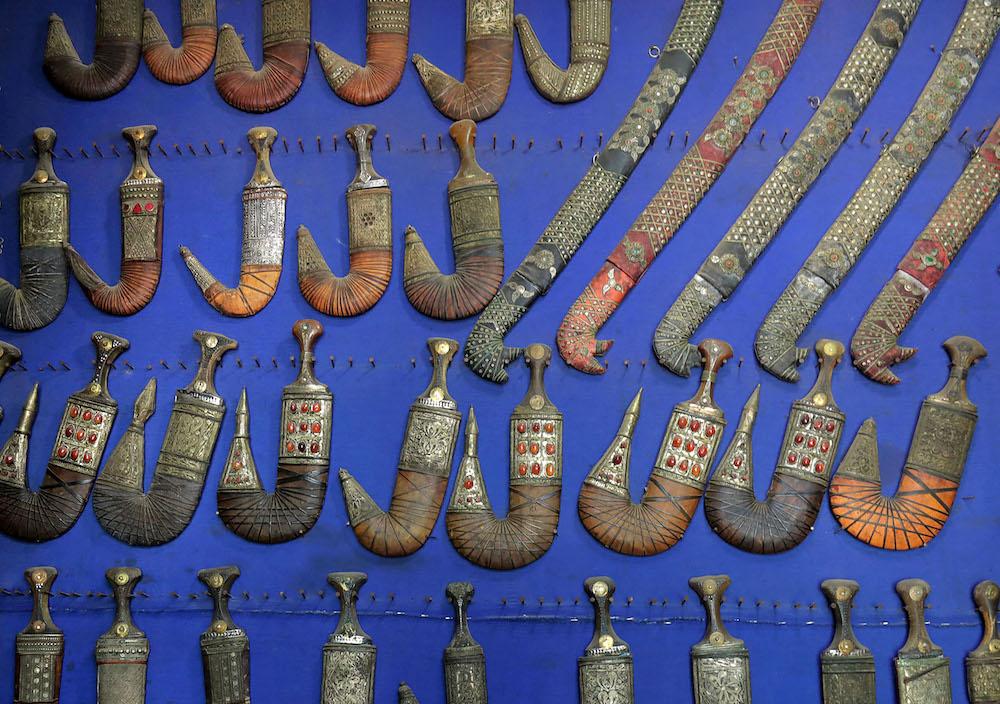
Traditional daggers, or the janbiya, on sale in Yemen's third city of Taiz. (AFP/File Photo)
At his small shop in Barahat Al-Qazzaz in central Taif, Hussein Abdullah Al-Malki, a 70-year-old dagger merchant, recalled the days, not so long ago, when the weapons were a more functional part of everyday life.
Men carried them with them wherever they went into the mountainous villages and valleys of the southern regions, where attacks by wolves and hyenas were a constant threat to inhabitants, he said, but added that the world is very different now.
“The janbiya was a necessity for our fathers to protect themselves,” Al-Malki told Arab News, alluding to times past when the men of the house were compelled to stand ready to protect their homes against thieves and defend their families.
The length and precise shape of the daggers vary across the region and even within Saudi Arabia, as do the features of the hilt, blade, sheath and belt. Some even resemble swords more closely than daggers.
With his expert eye honed by decades of experience, Al-Malki can quickly estimate the age of janbiya and its place of origin. The Emirati version, for example, is thinner, longer and more curved than those from other places such as Oman, Yemen and the Levant. In general, it is also smaller and the inscriptions found on it are completely different from those found anywhere else.
In Saudi Arabia the janbiya is now largely a ceremonial accessory, while in other parts of the region, including Yemen and Oman, it remains very much a part of everyday attire. Similarly, in Syria and Jordan, men in certain areas can be seen wearing the traditional dagger, known in those places as a shabriya.
One of the ceremonial uses for the janbiya can be seen when members of tribes or Arab leaders, including the royal families in the Gulf, wear it as an accessory while performing the ardah, the traditional sword dance that once served as a rousing call to battle.
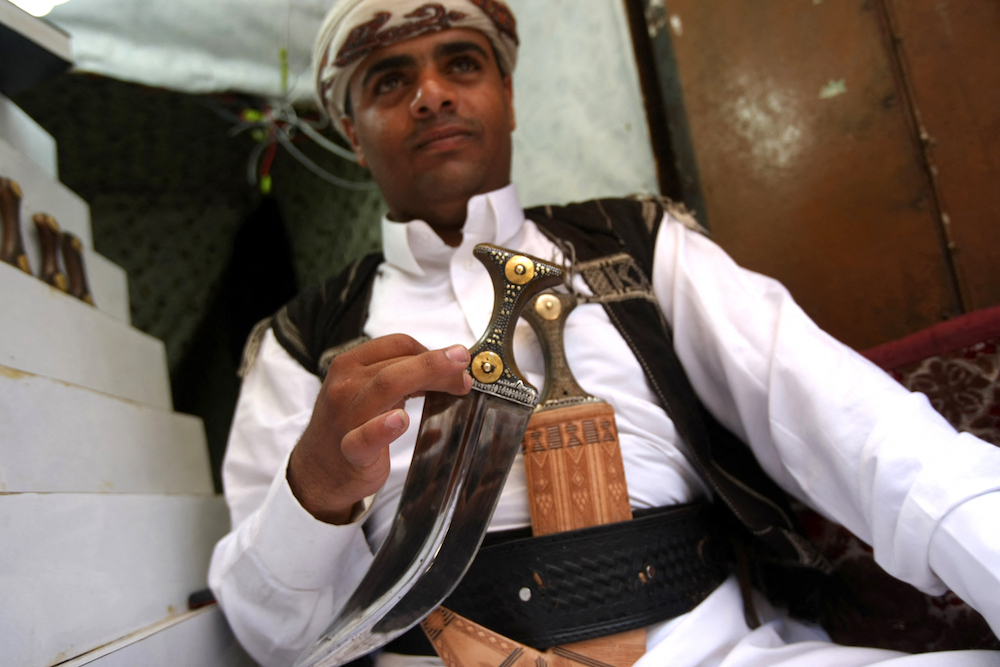
The janbiya is worn on the wasteline and is valued by its hilt, which is generally made of animal horn, telling the status of its owner, with the most expensive hilts made of rhino horn. (AFP)
In many families, janbiyas are precious family heirlooms handed down as a rite of passage to boys when they reach their teens, symbolizing the leaving behind of childhood.
Ibrahim Al-Zahrani, a historian and anthropologist, said the daggers now serve “as a symbol of courage and masculinity,” and to show pride in ancestral traditions.
While a lower-end janbiya costs as little as SR 20-50 ($5-13), more intricate and ornate ceremonial pieces can fetch tens of thousands of dollars. In Al-Janabi souq in Najran, one of the best-known markets in the Kingdom and renowned for its skilled janbiya craftsmen, daggers can cost SR 250,000 or more, depending on the materials.
For the most wealthy customers, the blades can even be fashioned from gold or silver, adorned with ornate inscriptions and decorations, while the belt can be woven from gold and silver threads using the most intricate craftsmanship.
Antique examples can fetch high prices at auction, particular those with notable former owners. A janbiya given more than a century ago as a gift to British intelligence officer T. E. Lawrence, better known as Lawrence of Arabia, set a record when it went on sale in 2015. The 30cm silver-gilt mounted dagger, presented to him for his role in the Arab victory over the Ottoman army at Aqaba in 1917, sold for $105,000 and was donated to the National Army Museum in the UK.
Salem Al-Yami, a retired teacher, said that the janbiya remains a powerful symbol of the region’s ancient heritage.
“The best daggers on the market are those with rhino horn grips and a silver-inlaid scabbard,” he told Arab News.
Daggers with hilts made of rhino horn are traditionally the most sought after because of their aesthetic beauty, durability and grip, but they have become more rare owing to the endangered status of the animal.
The wearing of the janbiya carries with it heavy social responsibilities and there can be a price to pay for any misuse, which is considered disrespectful to the father or grandfather from whom the dagger was inherited.
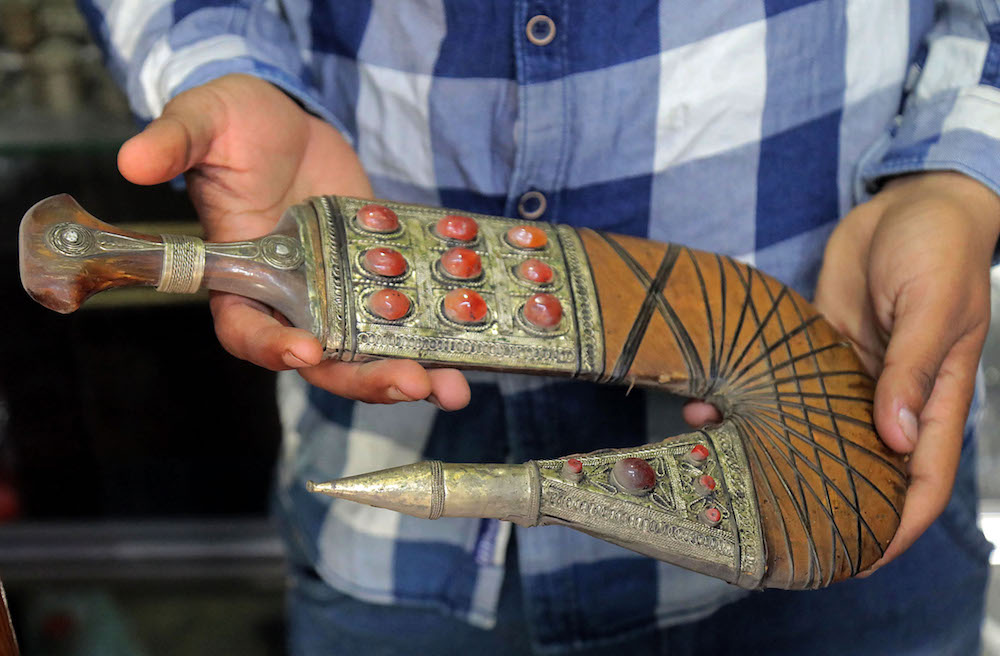
A Yemeni vendor displays a janbiya (above), an emblem of tribal identity in parts of the Arab world. (AFP)
“Using the janbiya in a hostile way in even a minor dispute can expose the offender to a tribal reprimand and strong social blame for encroaching upon his tribe’s traditions and customs,” Al-Yami said. Such behavior is deemed shameful and cowardly, especially when it is directed at an unarmed opponent.
The weapon is now considered an emblem of peace, said Jobara Al-Hothali, another dagger merchant in Taif, in contrast to its historical purpose and use.
During tribal rituals, for example, when two parties involved in conflict or a dispute are called to a reconciliation, they each lay down their daggers in a symbolic act of peace. In some cases, offenders can be forced to surrender their dagger to their victim as an act of reconciliation.
“In such a situation, the offender has no option but to respect the decision made,” Mohammed Musaifer, another dagger merchant, told Arab News.
“This is the worst punishment a tribe member can receive, as the janbiya represents a symbolic social value to its owner. However, reconciliation efforts continue, to persuade the other party to return the janbiya to its old owner, and conciliators normally succeed in keeping the peace.”


