Top US general opposes ‘terror’ delisting for Iran Guards elite force

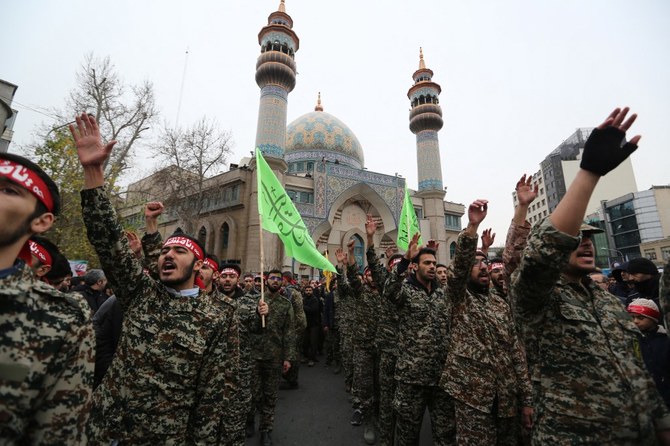
Iranian revolutionary guards take part in an anti-US rally to protest the killings of Iranian military commander Qasem Soleimani and Iraqi paramilitary chief Abu Mahdi Al-Muhandis. (File/AFP)
Short Url
Updated 07 April 2022
Follow

Top US general opposes ‘terror’ delisting for Iran Guards elite force

  • “I believe the IRGC Quds Force to be a terrorist organization, and I do not support them being delisted,” the top general said

WASHINGTON: The Pentagon’s top general said Thursday he was opposed to removing the elite Quds Force of Iran’s Revolutionary Guards from the US terror group list, one of Tehran’s conditions for restoring the 2015 Iran nuclear agreement.
“In my personal opinion, I believe the IRGC Quds Force to be a terrorist organization, and I do not support them being delisted from the foreign terrorist organization list,” Joint Chiefs Chairman General Mark Milley told a congressional hearing.
Iran has pressed for the removal of the State Department’s official “Foreign Terrorist Organization” designation of the Islamic Revolutionary Guard Corps as a condition for returning to the 2015 deal that sought to control its nuclear development and prevent it from acquiring a nuclear weapons capability.
The previous US administration of Donald Trump unilaterally abrogated the deal in 2018 and a year later slapped the FTO label on the Guards.
President Joe Biden has sought in negotiations to salvage the Joint Comprehensive Plan of Action, or JCPOA, as the 2015 deal is officially called.
But talks have stalled in the past month over a handful of final issues, including Iran’s demand over the terror designation.
The talks are led by the State Department and Milley and the Pentagon are not directly involved.
It was not clear whether Milley was suggesting an alternative of keeping the Quds Force designated while dropping the broader Revolutionary Guards from the list.
In a statement on the original designation, the State Department said: “The IRGC — most prominently through its Quds Force — has the greatest role among Iran’s actors in directing and carrying out a global terrorist campaign.”
It singled out specific acts by the Quds Force, including attempted bombings and assassinations inside the United States and other countries.
Privately, US officials have said removing the terror designation would not have much concrete impact, because the IRGC remains under a long list of economic and political sanctions.


UK foreign minister urges UN Security Council to confront ‘bitter truth’ of ‘catastrophically failing Sudan’

Updated 5 sec ago
Follow

UK foreign minister urges UN Security Council to confront ‘bitter truth’ of ‘catastrophically failing Sudan’

  • Yvette Cooper recounts harrowing stories of atrocities during the country’s civil war, including ‘point-blank executions of civilians’ and sexual violence against women and girls
  • The diplomatic momentum that secured the Gaza ceasefire must now be harnessed to secure peace in Sudan and ensure those guilty of atrocities are held to account, she says

NEW YORK CITY: Britain’s foreign secretary, Yvette Cooper, on Thursday called on the UN Security Council to confront “the bitter truth” that the world has been “catastrophically failing the people of Sudan.”
The UK is chairing the Security Council this month, and Cooper is serving as its president. Setting out the scale of the crisis in Sudan, which has been locked in civil war since April 2023, she cited a report by a fact-finding mission on atrocities in El-Fasher, commissioned by the UK, that was published on Thursday.
She highlighted its accounts of “indiscriminate shootings, point-blank executions of civilians in homes, streets, open areas or while attempting to flee the city.”
In one incident, Cooper said: “A pregnant woman was asked how far she was in her pregnancy. When she responded ‘seven months,’ he fired seven bullets into her abdomen, killing her.”
Hospitals, medical personnel and the wounded “were not spared,” she added, and survivors reported being raped in front of relatives, including children.
The report concluded that the atrocities “bear the hallmarks of genocide,” Cooper said. “El-Fasher should have been a turning point. Instead, the violence now is continuing.”
More than three months after the fall of the city, she said, reports of violations of international humanitarian law and human rights abuses persist. Aid agencies face barriers to access, while schools, hospitals, markets and humanitarian convoys, including those belonging to the World Food Programme, have come under attack.
Since the start of the month alone, she said, there have been reports of strikes on aid operations by both of the warring military factions, the Sudanese Armed Forces and the Rapid Support Forces.
Cooper described what she had witnessed firsthand during a recent visit to the border between Chad and Sudan, and warned that behind the statistics lie shattered lives.
“At the Chad-Sudan border, in a camp of over 140,000 people who have fled Sudan’s conflict, 85 percent of them are women and children,” she said.
A Sudanese community worker told her she believed “half, more than half, the women in the camp had been subjected to sexual violence,” Cooper revealed.
She recounted the case of “three sisters arriving at one of the Sudanese emergency response rooms, who had all been raped. The oldest sister was 13. The youngest was eight.
“There is a war being waged on the bodies of women and girls. The world must hear the voices of the women of Sudan and not the military men who are perpetuating this conflict; voices that ensure that this council confronts the bitter truth, because the world has been catastrophically failing the people of Sudan.”
She described the conflict as “the worst humanitarian crisis of the 21st Century,” with 33 million people in need of assistance, 14 million forced from their homes, and famine “stalking millions of malnourished children.”
It is also a regional security crisis and a migration crisis, Cooper added, as she warned of destabilization across the Horn of Africa and the Sahel, opportunities for extremist groups to exploit the instability, and the risk of increased migration affecting Europe.
Cooper commended US-led efforts to convene regional powers, including Egypt, the UAE and Saudi Arabia, to discuss peace plans, as well as support from the African Union and the EU.
“We will need pressure from every UN member state,” she said. “I urge all of those with influence on both the RSF and the SAF not to fuel further conflict, but instead to exert maximum pressure on them to halt the bloodshed.”
She warned that “the reason that the military men still convince themselves there is a military solution is because they can still obtain ever-more lethal weapons.”
Arms restrictions “need to be enforced and extended,” Cooper said, adding: “Now is the time to choke off the arms flows and exert tangible pressure for peace.”
She also called for greater accountability, saying it was time for more sanctions against the perpetrators. The UK has already sanctioned senior RSF commanders linked to atrocities in El-Fasher, she said, and joined the US and France in proposing that they be designated by the Security Council.
Recalling the diplomatic momentum behind efforts to secure a ceasefire in Gaza last year, Cooper said: “We need that same energy and determination to bring peace for Sudan so we can
secure an immediate ceasefire, humanitarian truce, and so that those responsible for atrocities are held to account.
“Let this be the time that the world comes together to end the cycle of bloodshed and to pursue a path to peace.”