

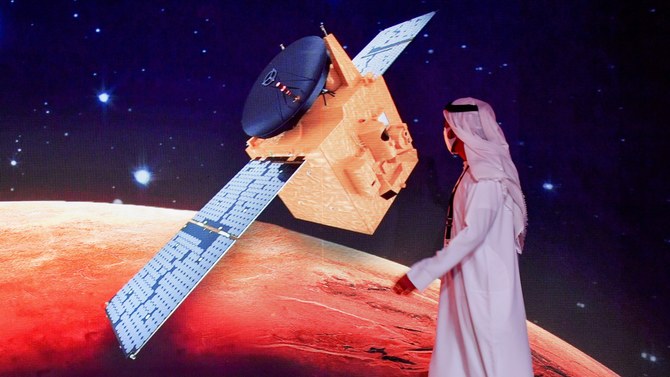

LONDON: The recent memorandum of understanding between the Saudi Space Commission and the UK’s Space Agency, which will see them develop a framework aimed at cooperation in the peaceful use of outer space, is the latest move in an ambitious regional space push.
Among those to get out in front on this is technology supplier SpaceChain, which added to operations in the UK and Asia with the March opening of an office in Abu Dhabi.
Its co-founder and Chief Commercial Officer Nick Trudgen told Arab News that the level of ambition in Saudi Arabia and the UAE was what drew the company to Abu Dhabi.
“We’ve always seen huge ambition in the UAE, and last year’s Mars mission spoke to that, getting everyone’s attention,” he said.
“I was in Saudi two weeks ago when the MoU with the UK was signed, and they share this level of ambition, and it’s coming from both the governments and the private sector as they look not to invest in their agencies but space itself,” he added.
“We have projects in the UK and with the European Space Agency. They have more talent, more technical ability, but here (the Middle East) you feel they have more ambitious plans than what we’re seeing in Europe.”
The UAE became only the third country after the US and Luxembourg to lay legal foundations promoting the exploration and exploitation of what Goldman Sachs termed trillion-dollar asteroids.
The UAE’s national point of contact for the Space Generation Council, Sahith Reddy Madara, told Arab News that deep-space asteroid-mining forms part of the UAE’s future strategy and plans.
“When we talk about the UAE, it has developed an incredibly detailed near-term, medium-term and long-term strategy,” Madara said.
“Mining is envisaged as a 20-year project, but before that we’ll see satellite launches and further research missions.
“Right now, it has its own Emirati interplanetary mission to Venus and also to the asteroid belt between Mars and Jupiter planned, with a launch scheduled for 2028.”
This more immediate focus speaks to the belief of Ray Harris, emeritus professor of geography at University College London, who said those looking out to space ignore some central benefits that could be had by the region in its push for the cosmos.
“The Middle East making itself a player on the cultural side, the World Cup for instance, is part of a wider issue of education, research and training,” he told Arab News.
“Space is a logical extension of this. Many countries around the world have had their own satellite missions, and Middle Eastern countries had been missing from this until rather recently, but now we’re seeing them make this push.”
While Harris questions the capacity to commercialize Earth observation, he does not rule out the possibility, noting one Saudi company having sought his help in monitoring whether an oil refinery was being developed in the most efficient manner.
“This is much quicker to achieve via satellite than checking on the ground,” he said. “And why isn’t remote sensing for environmental issues a mature sector? Few focus on monetizing satellites this way, but given the advances in the tech, with 31-cm pixel resolution, it can provide vital information on deforestation, river pollution, geological structures through which one can infer the location of oil, even monitoring major construction projects.”
Given the region’s financial clout, the wide range of environmental projects, and the dramatic price drops seen in satellite observation equipment and launch costs, Harris said the Middle East could be the one to make it work.
“And with their focus on the environment, this would further speak to government objectives to see their countries recognized for good global citizenship,” he added.
Trudgen concurs, saying SpaceChain already has a UAE-based partner conducting geo-data analysis on water security, and monitoring of ports and mangroves pointing to the potential benefits the region could find in targeting the remote sensing market.
But to really make a play of this, and the wider potentials offered by space, he said the region must not be complacent when it comes to the Janus-like reality of being an undeveloped market for the space industry.
This means countries can be nimbler in their approach to development, but it also means that in its burgeoning moment it is having to contend with an absence of domestic talent and the requisite levels of education.
“There aren’t the same number of high-quality universities (as in the West), so when it comes to a niche like space, it’s harder to find talent,” said Trudgen.
“I know they’re trying to upscale and build a potential workforce of engineers, and this is something they need to focus on to meet their ambitions.”
The SSC is all too aware of this, having founded scholarship programs to fund Saudi students’ attendance at the world’s best universities for space sciences and aerospace engineering.
Partnerships with the stalwarts of space are also assisting, with a NASA spokesperson telling Arab News that it has partnered bilaterally and multilaterally with countries in the region.
Madara said: “The Middle East knows it can’t outsource everything, including education, and while the region may be sending its best and brightest to international universities, the aim is to learn from them and foster faith in domestic institutions through the production of high-quality research. They have centuries on us, but we have the ambition.”
This ambition is regionally endemic, and how far it can go will become clearer with the release of the Saudi space strategy, expected within the year, and Oman’s soon after.


