In emergency move, Pakistan jacks up key interest rate by 2.5% to 12.25%

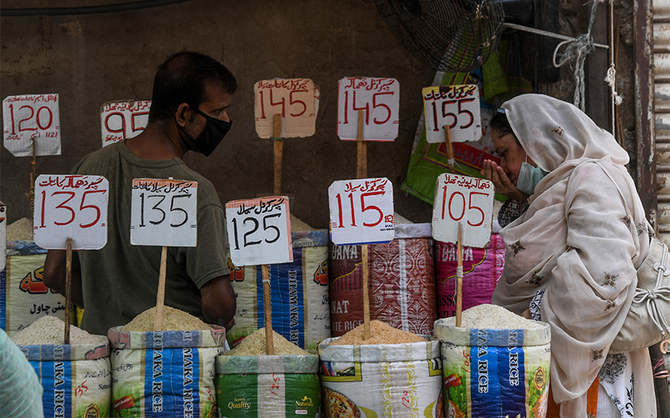
A woman checks the smell of rice at a market in Karachi, Pakistan, on June 10, 2020. (AFP/File)
Short Url
Updated 07 April 2022
Follow

In emergency move, Pakistan jacks up key interest rate by 2.5% to 12.25%

  • Decision has been taken due to rising inflationary pressure, external financial stability
  • SBP says heightened political uncertainty contributed to 5% depreciation in Pak rupee

KARACHI: Pakistan’s central bank on Thursday increased key interest rate by 250 basis points to 12.25 percent in an emergency meeting, citing inflation outlook deterioration and rising risks to external stability due to political uncertainty and the Russia-Ukraine war.

The State Bank of Pakistan had increased the policy rate by 100 basis points to 9.75 percent in December 2021. Since then, the rate has remained unchanged.

“The Monetary Policy Committee (MPC) noted that the (external and domestic) developments necessitated a strong and proactive policy response,” the SBP announced in a statement issued on Thursday while explaining the rationale behind its decision. “Accordingly, the MPC decided at its emergency meeting today, to raise the policy rate by 250 basis points to 12.25 percent.”

It added since the last MPC meeting on March 8, the outlook for inflation had deteriorated and risks to external stability had been exacerbated by the Russia-Ukraine conflict.

“Externally, futures markets suggest that global commodity prices, including oil, are likely to remain elevated for longer and the Federal Reserve is likely to increase interest rates more quickly than previously anticipated, likely leading to a sharper tightening of global financial conditions,” the statement continued.

The SBP noted the inflation out-turn in March 2022 surprised on the upside on the domestic front, with significant increase in core inflation in both urban and rural areas.

It maintained that timely demand moderating measures and strong exports and remittances had caused a shrinkage in the current account deficit that amounted to $0.5 billion in February, bringing it to its lowest level during the current fiscal year.

The central bank said heightened domestic political uncertainty had contributed to a five percent depreciation in the rupee along with a sharp rise in domestic secondary market and Pakistan’s Eurobond yields.

In addition, there had been a decline in the foreign exchange reserves with the SBP which was largely due to debt repayments and government payments pertaining to the settlement of an arbitration award related to a mining project.

The bank said some of this decline in reserves was also expected to be reversed as official creditors renewed their loans.

It also increased its inflation forecast from 9 to over 11 percent in the current fiscal year (FY22), saying the trend was likely to moderate in FY23.

The current account deficit is still expected to remain around four percent of the GDP in FY22. While it said the non-oil current account balance had continued to improve, the overall current account remained dependent on global commodity prices.

The bank said it was in the process of taking further actions to reduce inflationary pressure and current account deficit, adding this included interest rate increase on the export refinance scheme (EFS) and widening the set of import items subject to cash margin requirements.

It informed these items were mostly finished goods, including luxury items, and excluded raw materials.

The SBP statement also highlighted that Pakistan’s external financing needs for the current fiscal year had been fully met from identified sources.

It noted the increase in key interest rate, together with a reduction in domestic political uncertainty and prudent fiscal policies, should help ensure that Pakistan’s economic recovery from COVID-19 remained sustainable.


Pakistan, Saudi Arabia explore joint investment push in high-growth regions

Updated 29 min 10 sec ago
Follow

Pakistan, Saudi Arabia explore joint investment push in high-growth regions

  • Both sides discuss combining Pakistan’s production capacity with Saudi capital and regional market access
  • Government says Saudi side expressed interest in corporate farming in Pakistan, particularly in rice sector

KARACHI: Pakistan and Saudi Arabia are looking to jointly tap high-growth regional markets and align production and capital strengths, according to an official statement on Wednesday, following talks between Commerce Minister Jam Kamal Khan and Saudi Investment Assistant Minister Ibrahim Al-Mubarak in the Kingdom.

The two countries have long maintained close bilateral ties that have evolved into a multidimensional strategic partnership.

In October last year, the two countries launched an Economic Cooperation Framework aimed at shifting relations beyond aid toward sustainable trade, investment and development links. The framework followed the signing of a joint security agreement a month earlier, under which aggression against one would be treated as an attack on both.

“A key focus of the discussion was the joint exploration of regional markets, particularly Central Asia, Africa, and ASEAN, identified as high-growth regions offering significant opportunities for collaboration,” according to a statement circulated by Pakistan’s commerce ministry after the meeting.

“The two sides agreed that Pakistan and Saudi Arabia, by leveraging their respective strengths, can position themselves as complementary partners — combining Pakistan’s production capabilities with Saudi Arabia’s capital strength, market access, and regional connectivity,” it added.

The Saudi side expressed interest in corporate farming in Pakistan, particularly in the rice sector, with discussions covering mechanization, storage and logistics to enable consistent, long-term exports under structured arrangements.

Talks also covered broader cooperation in agriculture and food security, including rice, fodder, meat and other agri-products, with the potential involvement of Saudi financing institutions in supporting export-linked agricultural and infrastructure projects.

Corporate farming and mechanization were discussed as long-term solutions to productivity challenges in crops such as cotton, where declining yields and high manual input costs have hurt competitiveness, the statement said.

Human resource development emerged as another area of focus, with both sides noting shortages in mid-tier skills such as nurses, caregivers, technicians and hospitality staff.

The Saudi side expressed openness to replicating vocational “train-to-deploy” models in Pakistan that link training programs directly with overseas employment opportunities.

The meeting also examined opportunities in building materials, pharmaceuticals, sports goods, footwear and light manufacturing, with both sides agreeing to pursue sector-specific workshops and business-to-business engagements to translate policy alignment into tangible trade and investment flows.