

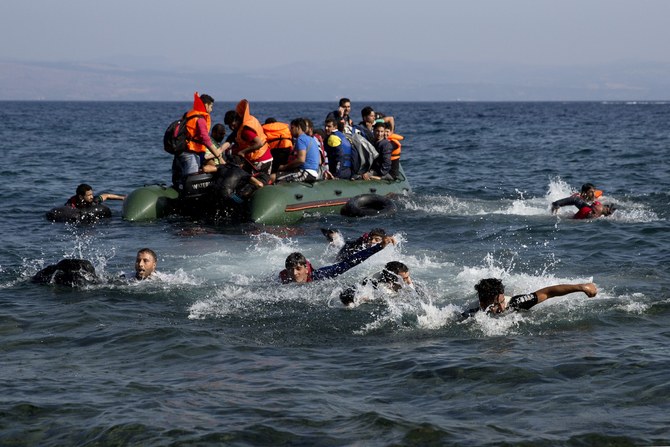

LONDON: Greek security forces are robbing and stripping asylum seekers before turning them over to third-country nationals to be expelled across the Turkish border, according to Human Rights Watch.
In a 29-page report published on Thursday, HRW urged the European Commission to commence legal proceedings against the Greek government for its treatment of asylum seekers and use of proxies in “illegal” pushbacks at its borders.
“Greece welcomes Ukrainians as ‘real refugees’ but conducts cruel pushbacks on Afghans and others fleeing war and violence,” said Bill Frelick, HRW’s refugee and migrant rights director.
“This double standard is a mockery of purported shared European values of equality, rule of law, and human dignity.
“The Commission should urgently open legal proceedings and hold the Greek government accountable for violating EU laws prohibiting collective expulsions.”
Compounding claims of double standards was the assertion of Greece’s Migration Minister Notis Mitarachi to Parliament on March 1 that Ukrainians are “real refugees.”
He later took to Twitter to double down on his assertion, tweeting that he “rightly described them” as “real refugees … that is what international law says, not the ideologies of the left,” inferring that those crossing the border with Turkey are not real refugees.
Based on the testimonies of 26 Afghan migrants and asylum seekers, the HRW report alleged that the violations were being committed by Greek police along the border with Turkey at the Evros River.
Of those interviewed, 23 said they were pushed back, with multiple testimonies that the process involved being stripped and robbed by police before being turned over to “masked men” who dumped them in the “frigid” river.
A 28-year-old former Afghan army commander and an 18-year-old Afghan told HRW that they had managed to talk with the masked men, identifying them as Arabs and Pakistanis.
The 28-year-old said: “The boat driver said, ‘We are … here doing this work for three months and then they give us … a document. With this, we can move freely inside Greece and then we can get a ticket for … another country’.”
Greek Maj. Gen. Dimitrios Mallios denied the report’s allegations, saying: “Police agencies and their staff will continue to operate in a continuous, professional, lawful and prompt way, taking all necessary measures to effectively manage refugee/migration flows.”
This is done “in a manner that safeguards on the one hand the rights of the aliens and on the other hand the protection of citizens especially in the first line border regions,” he added.
HRW said the Greek government “routinely denies” allegations of illegal pushbacks as either “fake news” or “Turkish propaganda.”
Pushbacks violate multiple human rights norms, including the prohibition of collective expulsion under the European Convention on Human Rights, the right to due process in the International Covenant on Civil and Political Rights, the right to seek asylum under EU asylum law and the EU Charter of Fundamental Rights, and the principle of nonrefoulement under the 1951 Refugee Convention.
Frelick said: “There can be no denying that the Greek government is responsible for the illegal pushbacks at its borders and using proxies to carry out these illegal acts does not relieve it of any liability.”


