- Opposition has called developments a “coup,” demanded full court hearing on ‘violation of constitution’
- President dissolves National Assembly on PM's advice after Khan dodges ouster through no-confidence
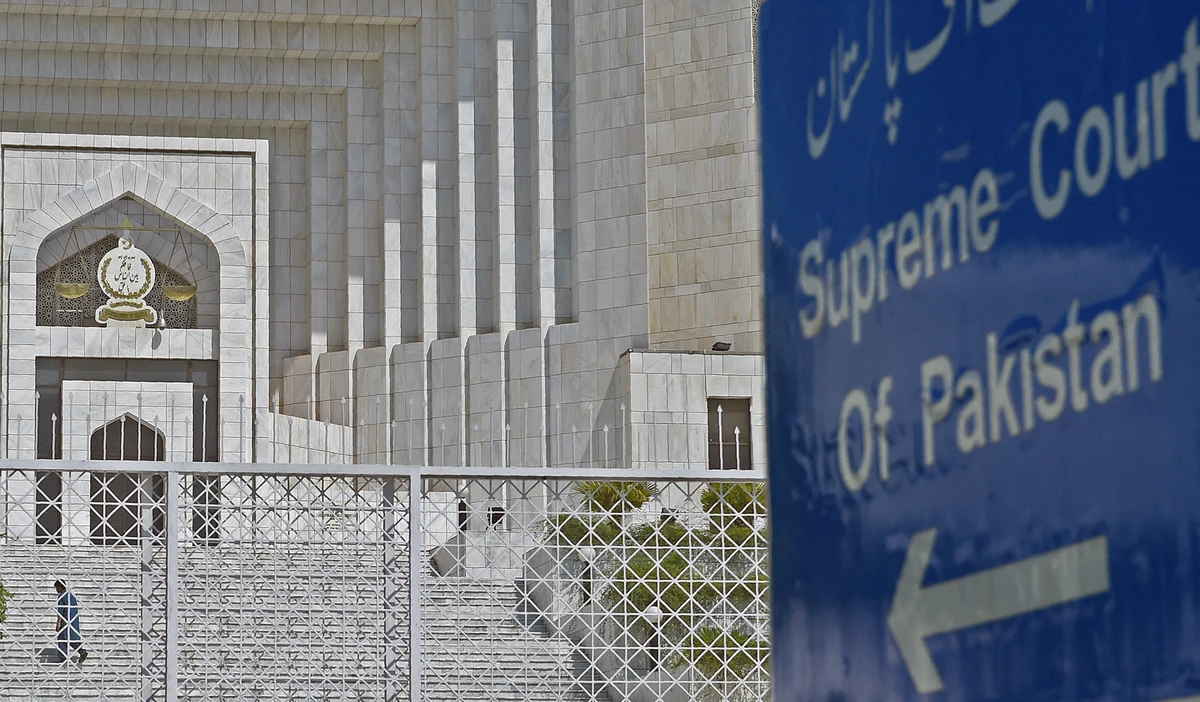
ISLAMABAD: The Pakistani Supreme Court's chief justice said on Sunday evening the court would hear tomorrow, Monday, the matter of a political and constitutional crisis arising after the deputy speaker of parliament blocked an opposition no-confidence motion that Prime Minister Imran Khan had widely been expected to lose, with the president of Pakistan subsequently dissolving the lower house of parliament.
The court said any directions given by the president and prime minister on Sunday would be subject to the court's orders, calling a hearing on Monday.
In an address to the nation after the parliament session in which the deputy speaker dismissed the no-trust move against Khan, the PM advised the president of Pakistan to dissolve assemblies. The National Assembly and the federal cabinet were subsequently dissolved. While a notification from the cabinet division said Khan had ceased to hold the office of the prime minister "with immediate effect," his former information minister said he would continue to perform the duties of the PM until the assembly elected a new prime minister.
In a joint statement, opposition parties condemned what they called the prime minister’s “coup” against the country’s constitution and called for a "full court hearing."
The opposition says the deputy speaker's dismissal of the no-trust motion without a vote and the subsequent dissolving of the National Assembly by the president are both unconstitutional.
The country’s top court took notice of the developments, and a three-judge bench, led by Chief Justice Umar Atta Bandial and comprising Justices Ijazul Ahsan and Muhammad Ali Mazhar, heard the matter in an emergency hearing on Sunday.
The chief justice observed before a packed courtroom that no state functionary should take any “extra-constitutional” steps.
"Public order should be maintained," Justice Bandial said.
The hearing was adjourned until Monday.
"FOREIGN CONSPIRACY"
Khan on Sunday “congratulated” the nation after the deputy speaker of the national assembly blocked voting on the no-confidence motion against him on the grounds that it was “unconstitutional.”
Khan has said the campaign to oust him through a no-trust vote was part of a foreign conspiracy orchestrated by the United States.
As Sunday’s session began, Information Minister Chaudhry Fawad Hussain said in light of the alleged foreign interference in domestic politics, the no-trust motion was against Article 5, which deals with obedience and loyalty to the state and constitution.
Deputy speaker Qasim Suri accepted Hussain's points as “valid,” and threw out the motion.
“We will not let such a [foreign] conspiracy succeed,” Khan said in an address to the nation after the parliament session. “I have just now sent my advice to the president of Pakistan to dissolve the assemblies.”
Khan then called on the public to prepare for elections: “No foreign government or corrupt people will decide [the fate of the nation].”
Talking to the media after the court hearing, former information minister Hussain said that Khan’s Pakistan Tehreek-e-Insaf (PTI) party would defend the speaker’s ruling in the court.
“Under Article 69 of the constitution, the Supreme Court does not have the authority to adjudicate on the ruling as this is the constitutional prerogative of the speaker,” he said.
He called on opposition parties to compete with the PTI in general elections instead of trying to get “justice from the court on technical grounds.”
“Political decisions are made by the public," he said, "not the courts.”
"RULE OF A DICTATOR"
Khan said later on Sunday his "evidence" of a foreign conspiracy had been accepted by the country's National Security Committee.
"When the country's highest national security body confirms this, then the [parliamentary] proceedings were irrelevant, the numbers were irrelevant," Khan said.
US officials on Sunday denied any involvement.
"There is no truth to these allegations," a State Department spokesperson told media, adding "we respect and support Pakistan's constitutional process and the rule of law."
Farrukh Habib, another former minister, said elections would be held in 90 days, although the decision rested with the president and the election commission.
Deputy Attorney General Raja Khalid, a top prosecutor, resigned from his post, saying the government's dissolving of parliament was unconstitutional.
"What has happened," he told local media, "can only be expected in the rule of a dictator."