From cricket hero to PM: Key events in Imran Khan’s career

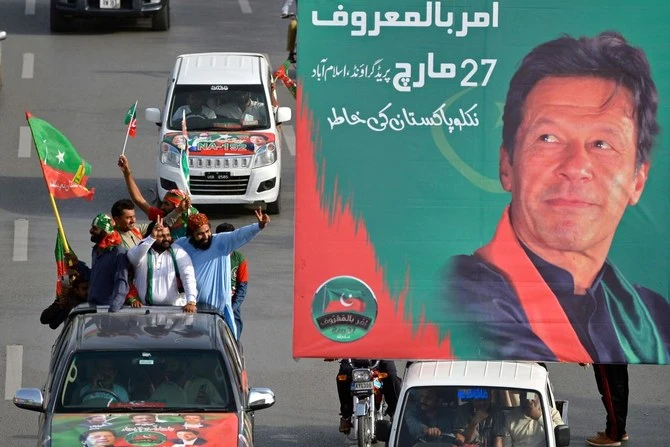
Supporters of the ruling Pakistan Tehreek-e-Insaf party arrive to attend a rally next to a billboard with a picture of Prime Minister Imran Khan in Islamabad on March 27, 2022. (AFP/File)
Short Url
Updated 10 April 2022
Follow

From cricket hero to PM: Key events in Imran Khan’s career

  • Khan entered politics when he retired from cricket after leading Pakistan to a Cricket World Cup victory in 1992
  • Serving as PM since 2018, he has been abandoned by coalition partners and faces a no-confidence vote on Sunday

ISLAMABAD: Imran Khan, the cricket legend turned politician, was removed as prime minister of Pakistan early on Sunday after losing a no-confidence vote in the National Assembly, bringing to a close a weeks-long campaign by a joint opposition to topple his government over accusations of poor governance and mismanagement of the economy.

Elected in 2018, the cricketing star-turned-politician was until not long ago seen as likely to defy the odds to become the only Pakistani prime minister to serve a full five-year term.

But after two coalition partners of Khan’s party abandoned him last week, the opposition finally had the votes needed to oust him from office.

Here is a timeline of key events in his political career:

Khan became a national hero by leading Pakistan’s team to a Cricket World Cup victory in 1992, after which he retired from cricket and entered politics, turning into an outspoken critic of government corruption.

1996: Pakistan Tehreek-e-Insaf

Khan founded his own political party, Pakistan Tehreek-e-Insaf (PTI), in 1996. In national elections held one year later, the PTI won less than 1 percent of the vote and failed to win any seats in parliament. It fared slightly better in the 2002 elections, winning a single seat that Khan filled.
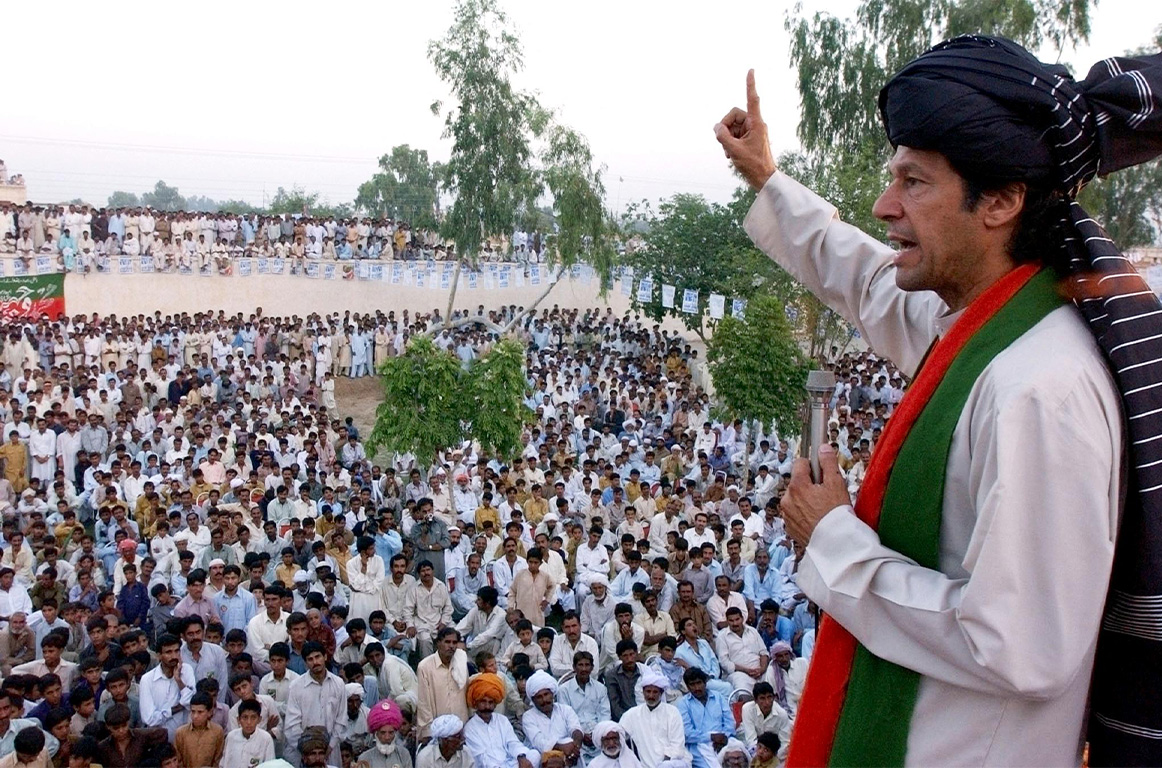


In this file photo, Pakistani Prime Minister and former cricket star Imran Khan address a big election rally in his hometown Essa Kheel, 03 October 2002. (AFP/FILE)

In 2007, Khan was among a group of politicians who resigned from the National Assembly, protesting Gen. Pervez Musharraf’s candidacy in the upcoming presidential election. When Musharraf declared a state of emergency, Khan was briefly imprisoned during a crackdown against the general’s critics. In 2008, PTI boycotted the national elections to protest Musharraf’s rule.

It was only a decade later that Khan’s party made a significant entrance into parliament, gaining support especially among the younger generation. Khan continued his criticism of corruption and economic inequality and held protests demanding the US stop firing missiles in Pakistan’s northwest during its military campaign in Afghanistan.

2013: Opposition leader

In the 2013 general election, PTI emerged as a serious player and became the second-largest party by popular vote, although still won less than half the number of seats won by the Pakistan Muslim League–Nawaz (PML-N) led by Nawaz Sharif. It also formed the provincial government in its northwestern Khyber Pakhtunkhwa province.
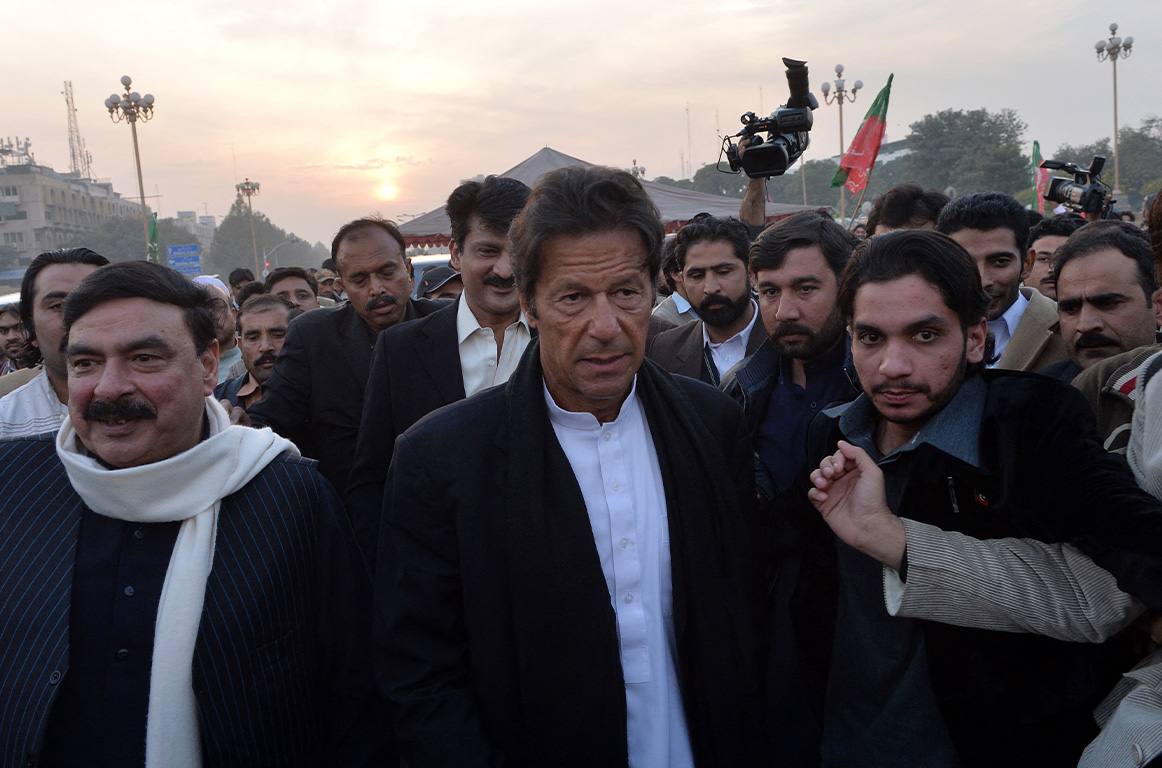


In this file photo, Pakistani Prime Minister Imran Khan (C) marches with legislators toward the Parliament house during a protest against the US drone strikes in Pakistan, in Islamabad on Dec 5, 2013. (AFP/FILE)

In 2014, Khan accused the PML-N of rigging the vote and led mass protests to pressure Sharif to step down. In 2016, the Supreme Court agreed to open an investigation, which disqualified Sharif from holding public office in 2017.

In elections held the following year, Khan ran on a platform of fighting corruption and poverty.

2018: Premiership

With a promise of bringing in a new class of clean politicians and lifting millions of people out of poverty, Khan was seen as an agent of change by voters disillusioned with the old political order, and his party swept to election victory in July 2018.

But he was also widely viewed as a candidate whose ascent to power was made easier by the tacit support of the powerful Pakistani military, although both the army and PTI denied any collusion.
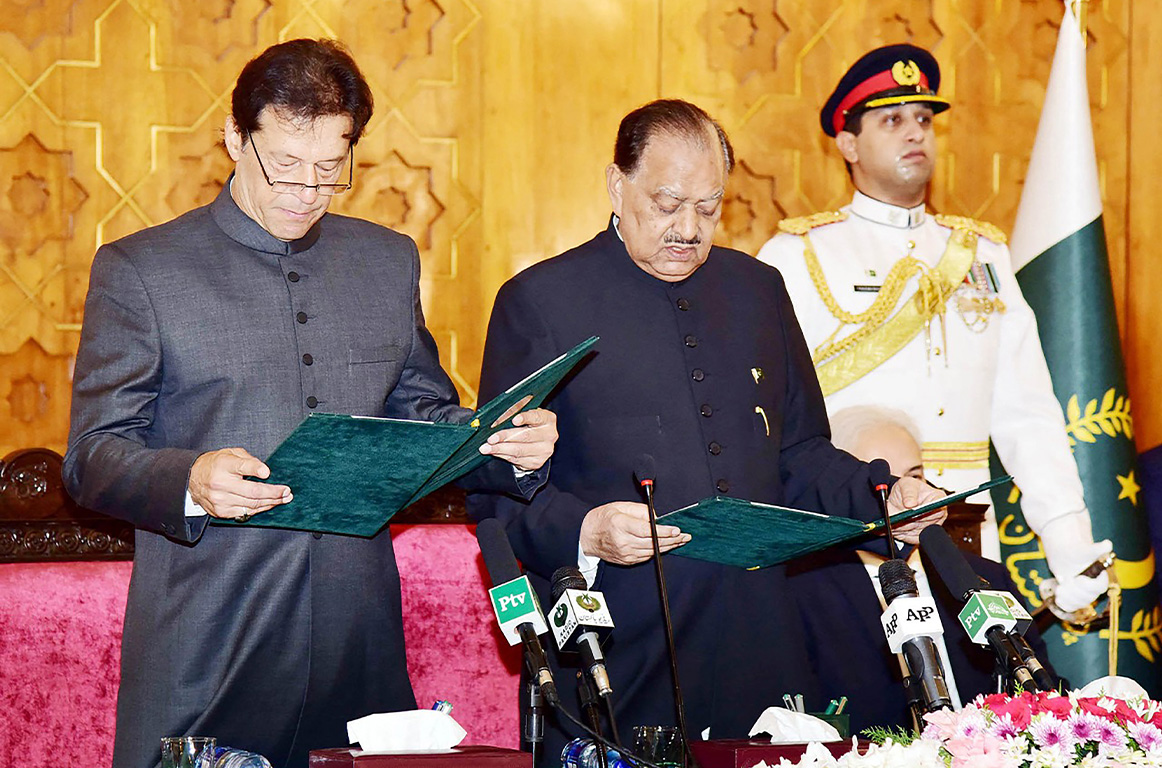


In this file photo President of Pakistan Mamnoon Hussain (C) takes an oath from newly appointed Prime Minister Imran Khan (L) during a ceremony in Islamabad on August 18, 2018. (AFP/FILE)

The PTI won a plurality of seats in the National Assembly, allowing Khan to seek a coalition with independent members of the parliament. He became prime minister on August 18, 2018.

As prime minister, Khan faced a mounting balance-of-payments crisis, forcing him to seek foreign aid from “friendly countries,” which he later received in the form of loans and investment from China, Saudi Arabia, and the United Arab Emirates.

The COVID-19 pandemic aggravated Pakistan’s economic woes and Khan lost public support over rocketing inflation and foreign debt.

2020: Joint opposition against Khan
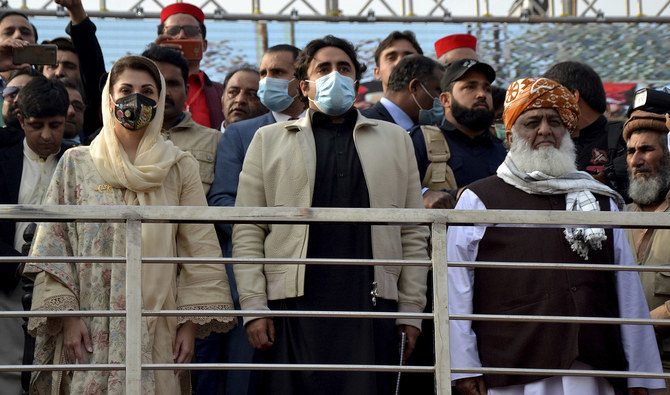


Maulana Fazal-ur-Rehman (R), Bilawal Bhutto Zardari (C), Maryam Nawaz Sharif (L) leaders of the Pakistan Democratic Movement, an alliance of opposition parties, attend a rally in Peshawar on Nov. 22, 2020. (AFP/File)

In late 2020, the major opposition parties formed a coalition, the People’s Democratic Movement (PDM), saying their aims was to increase the independence of civilian government from the military establishment. During protests and rallies, PDM members accused Khan of being a puppet of the army, mismanaging the economy, and called on him to step down.

2021: Drift with military
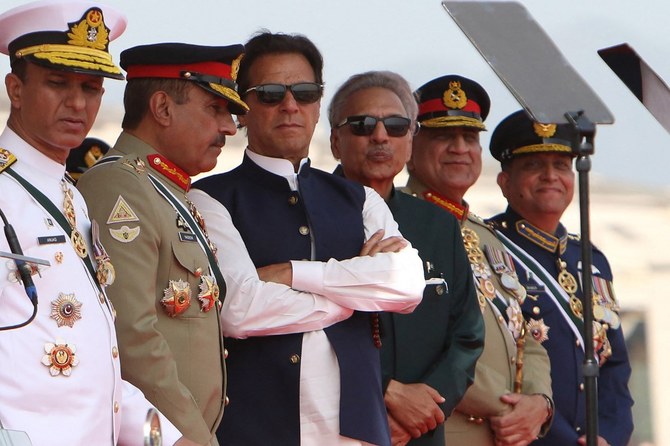


Pakistan’s Prime Minister Imran Khan, center left, and President Arif Alvi, center right, watch air force fighter jets perform during the Pakistan Day parade in Islamabad on March 23, 2022. (AFP)

Khan fell out with the military establishment in late 2021 after a failed attempt by him to influence its top posts.

2022: No-confidence motion

As frustrations rose over sustained inflation, the opposition in March put forward a no-confidence motion against Khan.
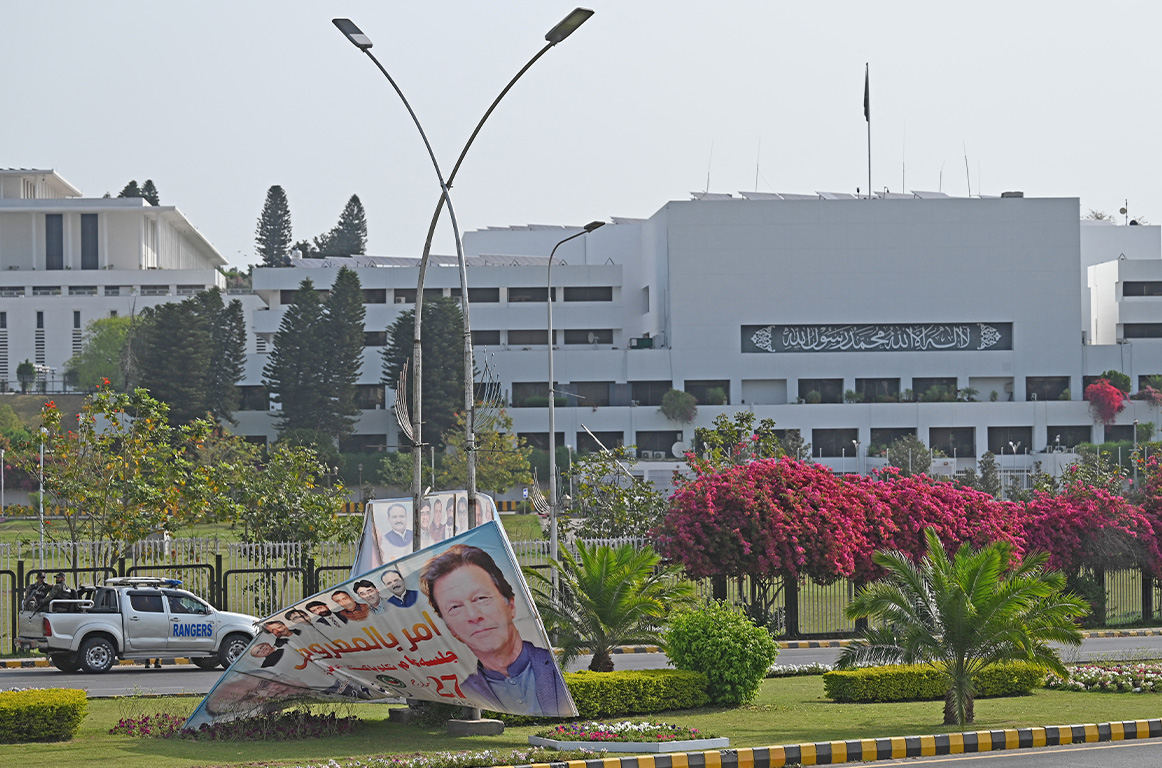


Security personnel patrol in front of the Parliament House building in Islamabad on April 3, 2022. (AFP)

Khan’s ouster would likely mean another round of instability in the nuclear-armed South Asian country of 220 million people, which struggles with double-digit inflation and dwindling foreign reserves.
Nearly 25% of Pakistan’s primary schools enrolling girls operate as single-teacher ones— report

Updated 13 sec ago
Follow

Nearly 25% of Pakistan’s primary schools enrolling girls operate as single-teacher ones— report

  • Pakistan needs over 115,000 more teachers in primary schools enrolling girls to meet global benchmark of one teacher per 30 students, says report
  • Sixty percent of Pakistani primary schools enrolling girls are overcrowded, while 32% lack clean drinking water or toilets, says Tabadlab report

ISLAMABAD: Nearly 25% of Pakistan’s primary schools that enrolls girls operate as single-teacher ones, a report by a leading think tank said this week, calling on the government to devolve teacher recruitment powers, upskill underutilized teachers and introduce reforms to hire and promote faculty members. 

Pakistan faces an acute education crisis which is reflected in the fact that it has the world’s second-highest number of out-of-school children, an estimated 22.8 million aged 5-16 who are not in educational institutions, according to UNICEF. 

While poverty remains the biggest factor keeping children out of classrooms, Pakistan’s education crisis is exacerbated by inadequate infrastructure and underqualified teachers, cultural barriers and the impacts of frequently occurring natural disasters. 

According to “The Missing Ustaani,” a report published by Islamabad-based think tank Tabadlab and supported by Malala Fund and the Pakistan Institute of Education (PIE), Pakistan needs over 115,000 more teachers in primary schools with girls’ enrolment to meet the basic international benchmark of ensuring one teacher per 30 children. Currently, the average Student-to-Teacher Ratio (STR) across Pakistan’s primary schools with girls’ enrolment is 39:1, it said. 

“Approximately 60% of these schools are overcrowded, necessitating the recruitment of over 115,000 additional teachers nationwide,” the report said on Monday. “Compounding this, nearly 25% of primary schools with girls’ enrolment operate as single-teacher schools, placing immense pressure on the quality of education.”

It said the situation is more dire in Pakistan’s poverty-stricken southwestern Balochistan province, where nearly 52% of the schools are single-teacher only ones while the percentage decreases slightly in the southern Sindh province to 51 percent. 

The report said while the STR improves to 25:1 at the middle school level, acute shortages of subject specialists emerge as the top-priority concern for quality education in these schools.

“Furthermore, around 32% of primary schools with girls’ enrolment and 18% of middle schools face ‘critical infrastructural shortages’— lacking clean drinking water or toilets in addition to high STRs— which significantly affects girls’ attendance and learning, particularly during adolescence,” the report said. 

The report cited a set of priority recommendations to address Pakistan’s systemic teacher deployment challenges and improve educational equity for girls. 

It urged the government to devolve recruitment authority to school or cluster levels to enable timely, context-specific hiring. It also called upon authorities to reform teacher transfer and promotion policies to introduce school-specific postings with minimum service terms. 

This, it said, would reduce arbitrary transfers and improving continuity in classrooms. The report advised authorities to upskill surplus or underutilized primary teachers to support instruction at the middle school level, helping address subject-specialist shortages.

“Together, these reforms offer a pathway toward a more equitable, efficient, and responsive teaching workforce— one capable of improving learning outcomes and ensuring that every girl in Pakistan has access to a qualified teacher,” the report said. 

To tackle Pakistan’s education crisis, Prime Minister Shehbaz Sharif declared an ‘education emeregency’ in September 2024, stressing the importance of education for all.