

Ukrainians and Europeans accuse Russians of committing atrocities

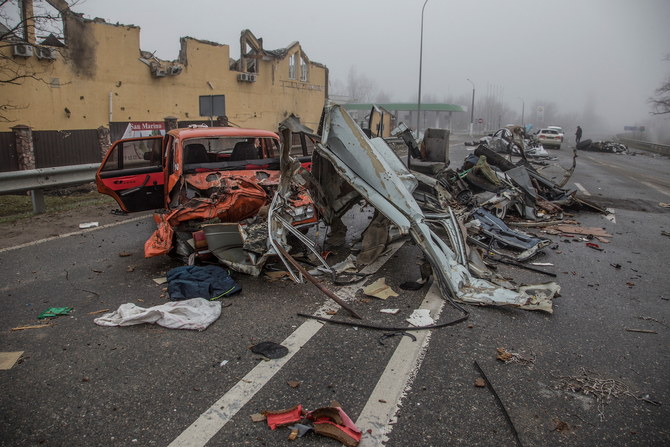
Squashed civilian cars are seen on a street, as Russia's attack on Ukraine continues, in the town of Bucha, in Kyiv region, Ukraine April 1, 2022. (Reuters)
Short Url
Updated 03 April 2022
Follow

Ukrainians and Europeans accuse Russians of committing atrocities

  • Russia has pulled back forces that had threatened Kyiv from the north to regroup for battles in eastern Ukraine
  • An aide to Zelensky said Ukrainian troops had found the bodies of women who had been raped and set alight

LVIV/ODESA: Ukrainian and European officials expressed outrage on Sunday at what they said were atrocities committed by Russian forces near Kyiv before they withdrew from the region to focus their attacks elsewhere.
The mayor of Bucha, a town 37 km (23 miles) northwest of the capital, said on Saturday that 300 residents had been killed during a month-long occupation by the Russian army. Victims were seen by Reuters in a mass grave and still lying on the streets.
Ukraine said on Saturday its forces had retaken all areas around the capital, reclaiming complete control of the region for the first time since Russia launched its invasion on Feb 24.
Russia has pulled back forces that had threatened Kyiv from the north to regroup for battles in eastern Ukraine. There was no Russian comment on the claim that the Kyiv region was entirely in Ukrainian hands and Reuters could not verify this.
Russia has previously denied targetting civilians and rejected allegations of war crimes in what it calls a “special military operation” in Ukraine.
The Kremlin and the Russian defense ministry did not reply to requests for comment when asked on Saturday about the bodies found in Bucha. The defense ministry did not immediately respond when asked about this again on Sunday.
An aide to Ukrainian President Volodymyr Zelensky said on Sunday that Ukrainian troops had found the bodies of women who had been raped and set alight as well as the bodies of local officials and children.
“There are murdered men whose bodies bear signs of torture. Their hands were tied and they were killed by shots to the back of the head,” Oleksiy Arestovich told Ukrainian television.
Sergey Nikiforov, a spokesman for Zelensky, told Britain’s BBC: “I have to be very careful with my wording, but it looks exactly like war crimes.”
Senior European officials said any potential war crimes should be investigated.
“Shocked by news of atrocities committed by Russian forces. EU assists Ukraine in documenting war crimes,” European Union foreign policy chief Josep Borrell said on Twitter, adding all cases needed to be pursued by the International Court of Justice.
Britain’s Foreign Secretary Liz Truss said there was “increasing evidence of appalling acts by the invading forces in towns such as Irpin and Bucha and said London would fully support any investigation by the International Criminal Court.

Missile strikes
Missiles struck near Ukraine’s southern port of Odesa on Sunday with Russia saying it had destroyed an oil refinery used by the Ukrainian military.
In Odesa, the city council said “critical infrastructure facilities” were hit. No casualties were reported.
Russia’s defense ministry said strikes by its military destroyed an oil refinery and three fuel storage facilities near Odesa. It said the facilities were used to supply Ukrainian troops near the city of Mykolaiv.
Odesa, on the Black Sea, is the main base for Ukraine’s navy. It has been targeted by Russian forces seeking a land corridor to Transdniestria, a Russian-speaking breakaway province of Moldova which hosts Russian troops.
Dmytro Lunin, governor of the central Poltava region, said the Kremenchug oil refinery, 350 kilometers (220 miles) northeast of Odesa, had been destroyed in a separate rocket attack on Saturday.
Two blasts were heard in the Russian city of Belgorod near the border with Ukraine on Sunday, two witnesses told Reuters, days after Russian authorities accused Ukrainian forces of striking a fuel depot there.

Evacuation, peace talks 
Evacuation efforts in Mariupol and nearby Berdyansk, both on Ukraine’s southern shores, were due to continue with a convoy of buses being prepared with help from the Red Cross.
The ICRC abandoned earlier attempts due to security concerns. Russia blamed the ICRC for the delays.
Mariupol is Russia’s main target in Ukraine’s southeastern region of Donbas, and tens of thousands of civilians there are trapped with scant access to food and water.
There was little sign of a breakthrough in efforts to negotiate an end to the five-week war, although Russia’s chief negotiator, Vladimir Medinsky, said talks were due to resume on Monday.
Medinsky said a draft deal was not ready for any meeting between Russian President Vladimir Putin and Ukraine’s Zelensky.
On Saturday, Ukrainian negotiator David Arakhamia raised hope for negotiations with Russia, saying enough progress had been made for direct talks between the two.
Medinsky said that while Ukraine was showing more realism by agreeing to be neutral, renouncing nuclear weapons, not joining a military bloc and refusing to host military bases, there had been no progress on other key Russia demands.
“I repeat again and again: Russia’s position on Crimea and Donbas remains UNCHANGED,” he said on Telegram, adding talks via videoconference would continue on Monday.
Russia annexed Crimea from Ukraine in 2014 and has recognized declarations of independence by the self-proclaimed republics of Luhansk and Donetsk in the Donbas area of eastern Ukraine which rose up against Kyiv’s rule.


Uganda’s presidential election experiences hours of delays at some polling stations

Updated 7 sec ago
Follow

Uganda’s presidential election experiences hours of delays at some polling stations

  • Some polling stations remained closed for up to four hours after the scheduled 7 a.m. start time due to “technical challenges“
  • The East African country of roughly 45 million people has 21.6 million registered voters

KAMPALA, Uganda: Uganda’s presidential election was plagued by widespread delays Thursday in addition to a days-long Internet shutdown that has been criticized as an anti-democratic tactic in a country where the president has held office since 1986.
Some polling stations remained closed for up to four hours after the scheduled 7 a.m. start time due to “technical challenges,” according to the nation’s electoral commission, which asked polling officers to use paper registration records to ensure the difficulties did not “disenfranchise any voter.”
President Yoweri Museveni, 81, faces seven other candidates, including Robert Kyagulanyi, a musician-turned-politician best known as Bobi Wine, who is calling for political change.
The East African country of roughly 45 million people has 21.6 million registered voters. Polls are expected to close at 4 p.m. Thursday, according to the electoral commission. Results are constitutionally required to be announced in 48 hours.
Impatient crowds gathered outside polling stations expressing concerns over the delays Thursday morning. Umaru Mutyaba, a polling agent for a parliamentary candidate, said it was “frustrating” to be waiting outside a station in the capital Kampala.
“We can’t be standing here waiting to vote as if we have nothing else to do,” he said.
Wine alleged there was electoral fraud occurring, noting that biometric voter identification machines were not working at polling places and claiming there was “ballot stuffing.”
“Our leaders, including Deputy President for Western Region, arrested. Many of our polling agents and supervisors abducted, and others chased off polling stations,” Wine wrote in a post on social media platform X.
Museveni told journalists he was notfied biometric machines were inoperable at some stations and he supported the electoral body’s decision to revert to paper registration records. He did not comment on the allegation of fraud.
Ssemujju Nganda, a prominent opposition figure and lawmaker seeking reelection in Kira municipality, told The Associated Press he had been waiting in line to vote for three hours.
Nganda also noted biometric machines were malfunctioning, in addition to the late arrival of balloting materials, and predicted the delays likely would lead to apathy and low turnout in urban areas where the opposition has substantial support.
“It’s going to be chaos,” he said Thursday morning.
Nicholas Sengoba, an independent analyst and newspaper columnist, said delays to the start of voting in urban, opposition areas favored the ruling party.
Museveni serving Africa’s third-longest presidential term
Uganda has not witnessed a peaceful transfer of presidential power since independence from British colonial rule six decades ago.
Museveni has served the third-longest term of any African leader and is seeking to extend his rule into a fifth decade. Some critics say removing him through elections remains difficult, but the aging president’s authority has become increasingly dependent on the military led by his son, Muhoozi Kainerugaba.
Museveni and Wine are reprising their rivalry from the previous election in 2021, when Wine appealed to mostly young people in urban areas. With voter turnout of 59 percent, Wine secured 35 percent of the ballots against Museveni’s 58 percent, the president’s smallest vote share since his first electoral campaign three decades ago.
The lead-up to Thursday’s election produced concerns about transparency, the possibility of hereditary rule, military interference and opposition strategies to prevent vote tampering at polling stations.
Uganda’s Internet was shut down Tuesday by the government communications agency, which cited misinformation, electoral fraud and incitement of violence. The shutdown has affected the public and disrupted critical sectors such as banking.
Heavy security deployed
There has been heavy security leading up to voting, including military units deployed on the streets this week.
Amnesty International said security forces are engaging in a “brutal campaign of repression,” citing a Nov. 28 opposition rally in eastern Uganda where the military blocked exits and opened fire on supporters, killing one person.
Museveni urged voters to come out in large numbers during his final rally Tuesday.
“You go and vote, anybody who tries to interfere with your freedom will be crushed. I am telling you this. We are ready to put an end to this indiscipline,” he said.
The national electoral commission chairperson, Simon Byabakama, urged tolerance among Ugandans as they vote.
“Let us keep the peace that we have,” Byabakama said late Wednesday. “Let us be civil. Let us be courteous. Let’s be tolerant. Even if you know that this person does not support (your) candidate, please give him or her room or opportunity to go and exercise his or her constitutional right.”
Authorities also suspended the activities of several civic groups during the campaign season. That Group, a prominent media watchdog, closed its office Wednesday after the interior ministry alleged in a letter that the group was involved in activities “prejudicial to the security and laws of Uganda.”
Veteran opposition figure Kizza Besigye, a four-time presidential candidate, remains in prison after he was charged with treason in February 2025.