



JEDDAH: Ramadan features many new shows highlighting the work of talented local and Arab actors, but none has proven to be more iconic and beloved in Saudi Arabia and internationally than “Tash Ma Tash.”
The hit comedy series was a staple in every Saudi household during Ramadan between 1992 and 2011. It has had an enduring influence on Saudi television productions and gained popularity worldwide with its insight into social issues facing society.
The show ran over 18 seasons and starred Saudi duo Nasser Al-Qasabi and Abdullah Al-Sadhan and a further 109 renowned actors and actresses from the Kingdom, Jordan, Syria, Iraq, Egypt, and Lebanon. Several leading directors from the Arab world were involved in its production, including the late Saudi director Abdul Khaleq Al-Ghanim, who directed 13 seasons.
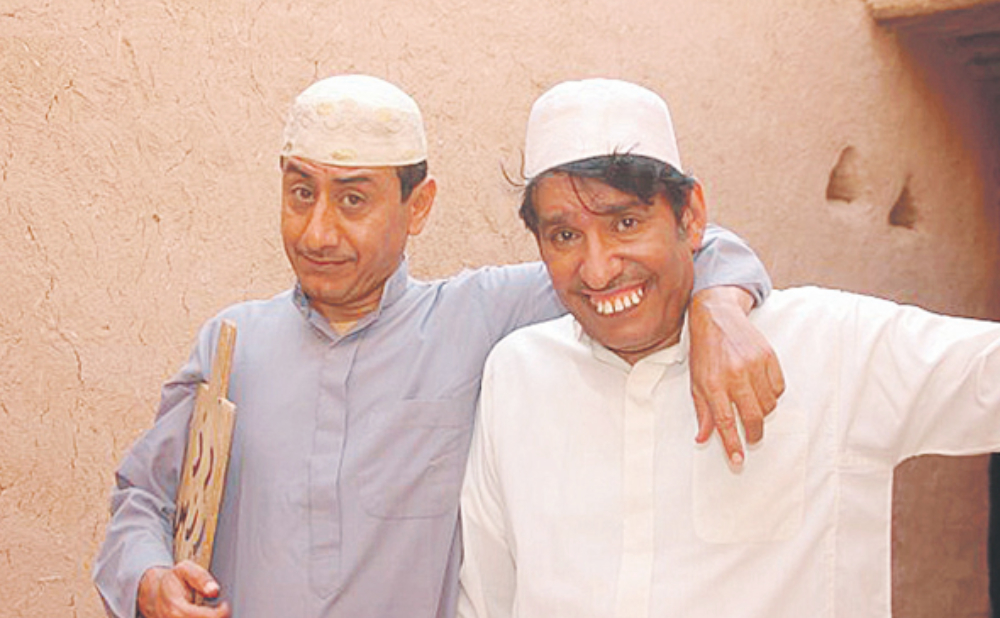
The iconic comedy show’s stars Nasser Al-Qasabi and Abdullah Al-Sadhan. (Supplied)
Thirteen seasons were broadcast on the first Saudi channel Al Saudiya, and the rest on MBC, starting usually around 7:30 p.m. when families would finish their iftar and eagerly wait for it to start.
Ahmed Al-Ash’ari, a 36-year-old Saudi mechanical engineer from Jeddah, said that the series represented the most intimate times with his family. “Once it was show time, as a kid I used to rush to turn on the TV.”
HIGHLIGHT
Several leading directors from the Arab world were involved in its production, including the late Saudi director Abdul Khaleq Al-Ghanim, who directed 13 seasons.
The character of Saeedan, the Bedouin teenager who falls in love with the charming Jasmine and tries hard to reach her is “one of my favorites,” Al-Ash’ari said.
“The series was pretty much like ‘Friends’ as it (highlighted) many social problems, including bold, positive, controversial, and negative ones, which were associated with generations of Saudi society,” he said. The “fun of watching the show” lay in the surprising storylines based on real issues and played by actors quite skillfully, which kept viewers “eager for more,” he said.
In an interview with Arab News, Nawwaf Al-Sadhan, the 32-year-old son of Abdullah Al-Sadhan, said that “Tash Ma Tash” was an iconic TV show that became “part of our daily routine during Ramadan as it highlighted problems related to Saudi society in a comic format, and I can assure you that it is stuck in the minds of Saudi society till today.”
Al-Sadhan said that his father’s fame did not change the way he perceived him. “He is so spontaneous in real life too, and I used to watch the series with my family, including my father, like any normal viewer. I can tell you that he has the same personality you see on TV.”
Famous Saudi actor Abdulelah Al-Sinani was an important part of the show because he acted in 12 seasons. He is credited with creating awareness about theater and acting in the Kingdom.
He told Arab News that “Tash Ma Tash” included many Saudi artists looking to build their profiles in the Arab world. The unprecedented success of the series, and because it ran for so long, certainly boosted the careers of many. No other series has been as successful, he said.
Al-Sinani said the government’s introduction of Vision 2030 has changed the face of art in the country, with a greater focus on education and training at colleges, and not a total reliance on innate talent.
After a glorious career of 18 years on television, Al-Qasabi has now launched a drama series “Al-Asouf,” dealing with the old Saudi state and the political, historical, and social background. This Ramadan will see it begin its third season.
Al-Sinani, who also stars in “Al-Asouf,” said the series has been a great success. He said “Al-Asouf” has shown that Saudi viewers have refined their taste and become more selective as consumers. The Kingdom’s television production was “on the verge (of a) renaissance” with its focus on all aspects of Saudi society. And “we are confident that we have created a special impact within the international and Arab drama (world),” Al-Sinani said.
Al-Sinani was discovered by Saudi actor and producer Muhammad Al-Ali, who is considered one of the founders of drama and theater in Saudi Arabia. The Mohammed Al-Ali theater, with a 600-seat capacity, has been built in Riyadh’s Boulevard to honor his career and showcase his plays.
Al-Ali, who helped Al-Sinani develop his television career, is known for the famous 1985 Saudi drama series “The Return of Aswid,” which also featured Al-Qasabi and Al-Sadhan.


