Thais eye switch to electric vehicles as petrol prices soar

1 / 2
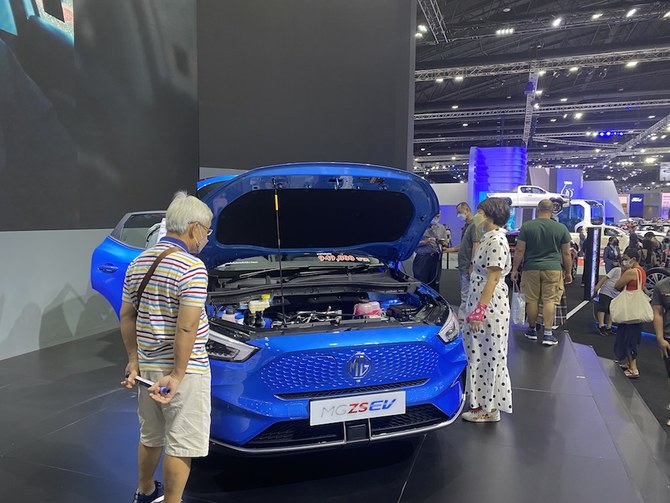
Visitors eye an electric car model from MG Motor at the Bangkok International Motor Show on April 2. (AN Photo/Asia Bureau)
2 / 2
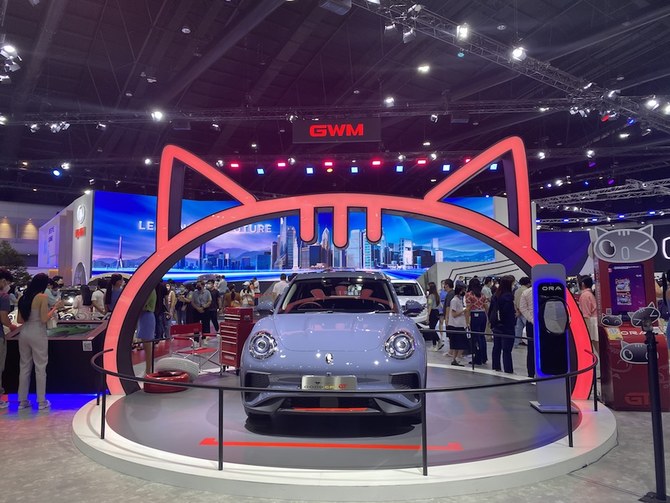
A car model on display at the Great Wall Motors booth at the Bangkok International Motor Show on April 2. (AN Photo/Asia Bureau)
Short Url
Updated 02 April 2022
Follow

Thais eye switch to electric vehicles as petrol prices soar

  • Thailand has issued incentive packages for EV industry amid plans to become a regional production hub
  • One electric car company, MG Motor, took 1,000 pre-orders and said EVs are its top seller

BANGKOK: Soaring fuel prices in Thailand have sparked a sales boom in electric vehicles, or EVs, as the Bangkok International Motor Show revealed before wrapping up on Sunday. 

More than a million people visited the show, with organizers saying there had been a 20 percent increase in orders for electric vehicles compared with last year. 

Much like its regional neighbors, the Southeast Asian country has been slow to embrace electric vehicles, but the Bangkok government has started embracing the alternative to fuel-powered transport and earlier this year announced subsidies for some EVs. 

The turnaround comes at a time when Thai consumers face soaring energy prices, with the government shielding the nation’s low-income groups by freezing retail diesel prices on March 22. Gasoline prices rose above 40 baht ($1.20) per liter on average on Saturday, 50 percent higher than last year. 

Grand Prix International, organizer of the Bangkok motor show, said Thais are turning to EVs due to global changes and increasing fuel prices. 

“Overall, EV is quite a big trend. Not long before the motor show the government announced measures to reduce the tax for affordable-priced EVs,” Anothai Eamlumnao, Grand Prix International chief operating officer, told Arab News. 

“Oil is expensive now and the global trend is changing to electric cars.” 

Eamlumnao said there is a 20 percent increase in electric car orders at the show. The event, which also features other types of vehicles, is expected to translate to about 15 billion baht ($448 million) in total spending. 

Government spokesman Thanakorn Wangboonkongchana said in a statement that Thailand aims to cut carbon dioxide emissions, transform half of its total auto production to EVs by 2030, and become a production base for cleaner vehicles in the region. 

Officials are offering support for more Thais to buy electric cars, and the government in February issued incentive packages that include tax and duty exemption on some EV models. 

MG Motor, one of the companies taking part in the Bangkok motor show, recorded about 1,000 pre-orders and said EVs were its top seller this year. 

But with the trend in its early days in Thailand, interested customers are still testing the waters.

Worrachat Tangfurat, a 41-year-old programmer who visited the motor show on Saturday, said he would wait for Thailand’s EV market to grow before making a purchase. 

“I am interested in an EV because I think it will help save a lot on fuel,” Tangfurat told Arab News. 

“But I am still studying the model and the industry, and want to wait for the market to become bigger because right now I think there are still not enough  charging stations.” 

Sasitorn Panijaren, 29, is also considering making the switch, but will wait for more variety to become available in the country. 

“I am thinking about buying an electric car in maybe the next two or three years because I think it will reduce spending on fuel,” Panijaren told Arab News. 


More than 200 political prisoners in Venezuela launch hunger strike

Updated 3 sec ago
Follow

More than 200 political prisoners in Venezuela launch hunger strike

GUATIRE: More than 200 Venezuelan political prisoners were on hunger strike Sunday to demand their release under a new amnesty law that excludes many of them.
The inmates at the Rodeo I prison, about 40 kilometers (25 miles) east of capital Caracas, shouted to their loved ones as part of the protest, an AFP journalist witnessed.
“Freedom!,” “release us all!” and “Rodeo I on strike” were among the cries from the prisoners that were audible from outside the facility.
The amnesty law was approved by Venezuela’s congress on Thursday as part of a wave of reforms encouraged by the United States after it ousted and captured former president Nicolas Maduro on January 3.
The hunger strike, which began Friday night, came about after inmates complained they would not benefit from the law because it excludes cases involving the military, which are the most common ones at that facility.
“Approximately 214 people in total, including Venezuelans and foreigners, are on hunger strike,” said Yalitza Garcia, mother-in-law of a prisoner named Nahuel Agustin Gallo.
Gallo, an Argentine police officer, is accused of terrorism, another category that is excluded.
“They decided Friday to go on hunger strike because of the scope of the amnesty law, which excludes many of them,” said Shakira Ibarreto, the daughter of a policeman arrested in 2024.
On Sunday, a team from the International Committee of the Red Cross (ICRC) visited the Rodeo I prison.
“This is the first time they have allowed us to approach that prison,” Filippo Gatti, the ICRC’s health coordinator for Venezuela, told family members. “It’s a first step, and I think we’re on the right track.”
Not all the inmates at the prison were joining the hunger strike, the relatives said.

- Amnesty law criticized -

The amnesty law was engineered by interim leader Delcy Rodriguez under pressure from Washington after US commandos attacked Venezuela on January 3, snatched Maduro and his wife and took them to the United States for trial on drug trafficking charges.
Opposition figures have criticized the new legislation, which appears to include carve-outs for some offenses previously used by authorities to target Maduro’s political opponents.
The law also excludes members of the security forces convicted of activities related to what the government considered terrorism.
But the amnesty extends to 11,000 political prisoners who, over nearly three decades, were paroled or placed under house arrest.
More than 1,500 political prisoners in Venezuela have already applied for amnesty under the bill, the head of the country’s legislature said Saturday.
Hundreds of others had already been released by Rodriguez’s government before the amnesty bill was approved.
On Sunday, a handful of inmates were released from Rodeo I, carrying release papers in their hands. They were greeted with applause.
“I’m out, I love you so much, my queen! I’m doing well,” Robin Colina, one of the freed prisoners, said excitedly into a mobile phone.
Armando Fusil, another released prisoner, told AFP: “Right now there are quite a few people on hunger strike because they want to get out.”
The 55-year-old police commissioner from the western state of Maracaibo said he was “arrested for no reason” in October 2024.
He said loved ones came to visit him every Friday since his arrest, taking a nearly 40-hour trip just for a little bit of face time each week.
Now, they’re coming to pick him up for good.
“We all help each other,” Fusil said about his fellow detainees. “It’s created a beautiful brotherhood.”
The NGO Foro Penal, dedicated to the defense of political prisoners, reported 23 releases on Sunday.
Maduro ruled Venezuela between March 2013 and January 2026, silencing opposition and activists under his harsh leftist rule.
Maduro and his wife are in US custody awaiting trial. Maduro, 63, has pleaded not guilty to drug trafficking charges and declared that he is a prisoner of war.