

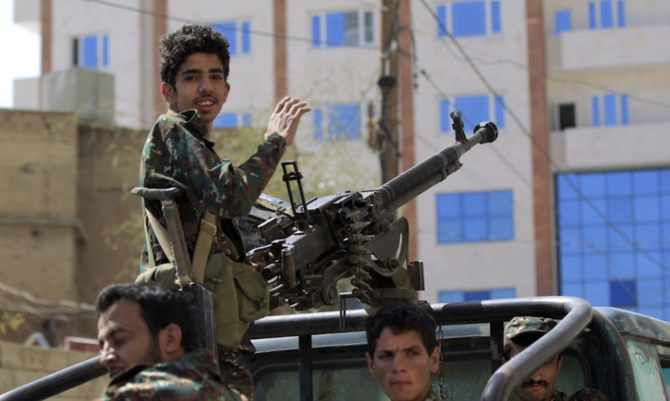

RIYADH: Fighting has largely stopped in Yemen’s key battlefields as rival factions stick to the UN-brokered humanitarian truce, local military officials told Arab News on Saturday.
The UN’s Yemen envoy Hans Grundberg on Friday announced that the Iran-backed Houthis and the internationally recognized government agreed to a two-month truce coming into effect on Saturday, the first day of Ramadan.
The parties agreed to halt ground, air and cross-border strikes, allow oil tankers to enter Hodeidah seaport, permit flights to depart and land at Sanaa airport, and lift the siege of Taiz.
Local officials said that fighting and shelling between government troops and the Houthis have largely subsided in the central province of Marib and outside the city of Taiz, amid reports that the Houthis are still amassing forces in Marib.
“Fighting has stopped in Marib. There is a limited exchange of mortar and heavy gun fire and the enemy is deploying forces,” a military official who spoke on condition of anonymity told Arab News, adding that army troops and allied tribesmen were bracing for Houthi violations of the truce.
FASTFACT
Thousands have been killed since early last year in the province of Marib when the Houthis resumed a major offensive to seize control of the energy-rich city of Marib.
Thousands of combatants and civilians have been killed since early last year in the province of Marib when the Houthis resumed a major offensive to seize control of the energy-rich city of Marib, the Yemeni government’s last bastion in the northern part of the country.
Despite aggressive missile, drone and ground attacks on the city, the Houthis failed to take control of the city and suffered thousands of casualties.
Yemeni experts believe that the Houthis, who have long rejected many similar calls for a truce, were forced into accepting the latest UN-brokered ceasefire after failing to invade Marib.
In the city of Taiz, key battlefields were quiet on Saturday as the Houthis and army troops halted hostilities for the first time in years, but residents called on the Iran-backed militia to immediately lift its stranglehold on the city.
Col. Abdul Basit Al-Baher, a military officer, told Arab News by telephone that government forces stuck to the truce as the Houthis also halted shelling and attacks on the densely populated city. “There is relative calm on all fronts here in Taiz,” Al-Baher said.
The Houthis have laid siege to Taiz, Yemen’s third-largest city, for more than seven years, after failing to take control of the city’s downtown.
They positioned forces on the outskirts of the city, barring people from leaving or crossing into the city, and gunning down those who moved close to their positions.
Al-Baher said the siege should be lifted, in concert with the truce, because it has stifled the city and pushed thousands of people to the brink of famine. “The truce (is) meaningless if the siege of Taiz is not lifted. Siege is a form of warfare,” he said.
“The Houthis blocked Taiz’s roads with large rocks and sandbags and planted a huge number of landmines.” They were targeting all living things, including cats and dogs, he said.


