

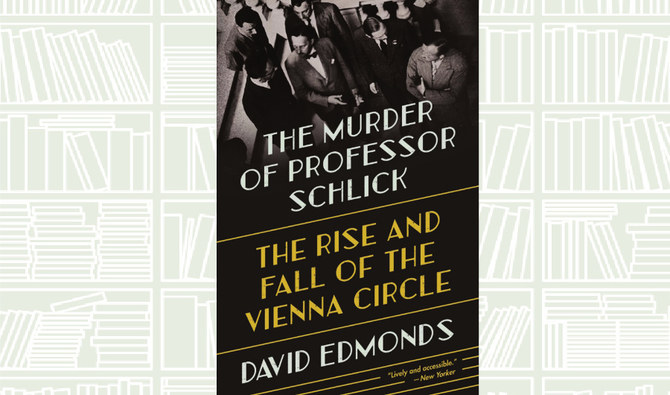
What We Are Reading Today: The Murder of Professor Schlick

Short Url
Updated 02 April 2022
Follow

What We Are Reading Today: The Murder of Professor Schlick

Author: David Edmonds

On June 22, 1936, the philosopher Moritz Schlick was on his way to deliver a lecture at the University of Vienna when Johann Nelbock, a deranged former student of Schlick’s, shot him dead on the university steps. Some Austrian newspapers defended the madman, while Nelbock himself argued in court that his onetime teacher had promoted a treacherous Jewish philosophy. David Edmonds traces the rise and fall of the Vienna Circle—an influential group of brilliant thinkers led by Schlick—and of a philosophical movement that sought to do away with metaphysics and pseudoscience in a city darkened by fascism, anti-Semitism, and unreason.
The Vienna Circle’s members included Otto Neurath, Rudolf Carnap, and the eccentric logician Kurt Godel. On its fringes were two other philosophical titans of the 20th century, Ludwig Wittgenstein and Karl Popper. The Circle championed the philosophy of logical empiricism, which held that only two types of propositions have cognitive meaning, those that can be verified through experience and those that are analytically true. For a time, it was the most fashionable movement in philosophy.


What We Are Reading Today: A Capital’s Capital

Updated 16 February 2026
Follow

What We Are Reading Today: A Capital’s Capital

Authors: Gilles  Postel-Vinay and Jean-Laurent Rosenthal

Successful economies sustain capital accumulation across generations, and capital accumulation leads to large increases in private wealth. In this book, Gilles Postel-Vinay and Jean-Laurent Rosenthal map the fluctuations in wealth and its distribution in Paris between 1807 and 1977. 

Drawing on a unique dataset of the bequests of almost 800,000 Parisians, they show that real wealth per decedent varied immensely during this period while inequality began high and declined only slowly. 

Parisians’ portfolios document startling changes in the geography and types of wealth over time.

Postel-Vinay and Rosenthal’s account reveals the impact of economic factors (large shocks, technological changes, differential returns to wealth), political factors (changes in taxation), and demographic and social factors (age and gender) on wealth and inequality.

Before World War I, private wealth was highly predictive of other indicators of welfare, including different forms of human capital, age at death, and access to local public goods.