

Ramadan rituals’ welcome return in Makkah and Madinah after two years

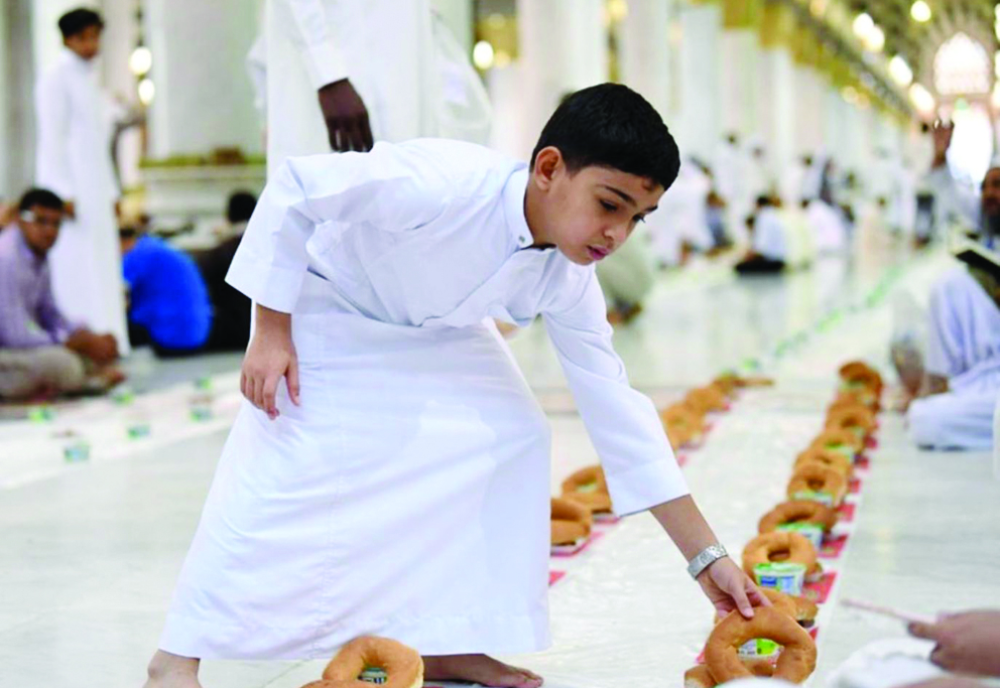
In Ramadan this year, worshippers will again enjoy being part of communal iftar sufras at the two Grand Mosques in Makkah and Madinah. (Supplied)
Short Url
Updated 02 April 2022
Follow

Ramadan rituals’ welcome return in Makkah and Madinah after two years

  • Communal itikaf and iftar allow secluded prayers and meals for breaking the fast
  • 2,000 permits have been issued to those wanting to donate food for worshipers

JEDDAH: After two years of COVID-19 restrictions, the two holy mosques in Makkah and Madinah will again allow customary communal Ramadan rituals including itikaf or secluded devotion, and iftar suppers — a return to normalcy welcomed by citizens and residents.

The decision was announced on March 22 by Sheikh Abdulrahman Al-Sudais, head of the General Presidency for the Affairs of the Two Holy Mosques, on Twitter @ReasahAlharmain: “We are glad to announce the return of Itikaf in Haramain (two sanctuaries). It will be applied according to specific criteria, and permits will be available through the official website of the presidency soon.”

Itikaf takes place over the last 10 days of Ramadan when worshippers go into seclusion and devote their time to prayer and reading the Qur’an. It starts from the sunset of the 20th day of Ramadan and ends when the Eid moon is sighted. In itikaf, worshipers live and sleep in the mosques and only leave for ablutions.

HIGHLIGHTS

• For some Saudi families, providing iftar meals at the same spot in the precincts of the mosques, have been passed down through the generations.

• The distribution of iftar meals was allowed last year in Ramadan but this year on Jan. 13, Sheikh Abdulrahman Al-Sudais announced the return of communal iftar sufras at the two mosques.

• Those families, who received their permits, said that they start preparing for iftar two weeks prior to Ramadan, which is part of the enjoyment.

Layla Nagadi, a 59-year-old Jeddah resident, has been observing itikaf for over 15 years. “Nothing equals itikaf in Makkah, where you can dedicate the last 10 days of Ramadan for worship only.”
“I was very happy when Al-Sudais announced the return of itikaf this year, I will be among the first people to apply.”

Before COVID-19, worshipers were welcomed at the two holy mosques for iftar by philanthropists who provide iftar sufras or meals at specific locations. The distribution of iftar meals was allowed last year in Ramadan but this year on Jan. 13, Al-Sudais announced the return of communal iftar sufras at the two mosques.

Two thousand permits have been issued to those interested in this form of charity. For some Saudi families, providing iftar meals at the same spot in the precincts of the mosques, have been passed down through the generations.

Shatha Jaylan, 30, from Madinah, told Arab News that she and her family have provided iftar for years near the Al-Rawda door. “We have been serving iftar meals in (the) Madinah haram for nine years in the ladies’ section. It is a collaboration between my father and my aunty as they both really appreciate the spirituality of (the) haram during the holy month of Ramadan.”

Those families, who received their permits, said that they start preparing for iftar two weeks prior to Ramadan, which is part of the enjoyment. “We provide yoghurt, shouraik bread, duggah (Madini mixture of condiments), different types of dates such as rutab and sukkary, Zamzam water bottles, Saudi coffee, and tea.”

“I (personally) used to serve iftar for visitors for three years in a row every Ramadan season; we used to prepare everything in the morning so we could bring (it all to the) haram by Asr prayer to avoid the peak hour,” Jaylan said. “It is really important to get everything set up so visitors can enjoy their meals.”

Jaylan said that like other people providing meals, she also hires workers to help with the preparation and serving, usually unemployed people seeking work. However, this year Jaylan said her family would not organize any meals so that others could be given a chance to do so.

“Once we heard the announcement of the return of iftar meals we were extremely happy, however, we did not renew our membership this year as there were new rules and regulations that were a bit different,” she said. “Providing iftar, gaining hasanat, going to (the) haram every day might sound nice and fun, but it is a huge responsibility.”

“My aunt, cousins, and I used to stay in (the) haram from (the) afternoon till (the) evening every day for one month. It is not easy as once the visitors leave, we (had) to collect the plastic mats, leftovers, and disposable utensils. It is a big effort, but one honest dua from visitors wipes all the tiredness away,” she added.

Meanwhile, the general presidency is set to launch several programs to provide services for worshipers during Ramadan. Over 12,000 workers will be serving in Makkah’s grand mosque, with the third expansion used at full capacity.

Crowd control measures have been instituted, with prayer areas designated for people with disabilities and the elderly.


National program identifies 165 native plants for afforestation efforts in Asir

Updated 29 December 2025
Follow

National program identifies 165 native plants for afforestation efforts in Asir

  • The survey is part of broader plans focused on restoring degraded land, using native vegetation 

JEDDAH: Saudi Arabia’s National Afforestation Program has identified more than 165 species of native plants suitable for afforestation in the Asir region, highlighting the ecological diversity of one of the Kingdom’s most environmentally varied areas, the Saudi Press Agency reported.

The findings form part of broader national efforts to expand vegetation cover, address land degradation, and support sustainability goals linked to the Saudi Green Initiative and Vision 2030.

According to the program, the identified species are distributed across a wide range of natural environments in Asir, including mountainous terrain, highlands, slopes, valleys, plains, rocky landscapes, and coastal areas stretching from the Red Sea to Tihama.

The species belong to numerous plant families, including Fabaceae, Anacardiaceae, Burseraceae, Capparaceae, Ebenaceae, Euphorbiaceae, Malvaceae, Myrtaceae, Oleaceae, and Primulaceae, among others.

Plants suitable for afforestation range from large and small trees to perennial and annual shrubs, herbs, succulents, bulbs, and climbing plants. 

Among the most notable species identified are the grey mangrove, mastic tree, mooring or ben tree, juniper, sycamore fig, wild olive, henna, wild jasmine, hawthorn, and arak.

The Saudi Arabian Botanical Society described the announcement as an important step in protecting plant diversity and strengthening the ecosystem conservation in the Kingdom. 

Munirah bin Hamad Al-Hazani, founder and president of the society, said that prioritizing native species is central to sustainable afforestation.

“Focusing on the cultivation of native plants adapted to diverse environments forms the cornerstone of sustainable afforestation projects, as it plays a pivotal role in enhancing vegetation cover, combating land degradation, and conserving natural and financial resources,” she told Arab News.

Al-Hazani added that long-term success depends on cooperation between government bodies and the nonprofit sector, alongside community involvement and environmental awareness programs.

The National Afforestation Program has increasingly emphasized community participation, working with government agencies, private companies, and nonprofit organizations to support planting initiatives and environmental education. Its approach includes promoting volunteerism and discouraging harmful environmental practices, while focusing on the use of native plants adapted to local conditions.

Parallel efforts are underway in other regions of the Kingdom to support vegetation restoration through research and infrastructure development. In Jouf, often referred to as the Kingdom’s food basket, the King Salman bin Abdulaziz Royal Reserve Development Authority has established a Central Nursery and a Wild Seeds Research and Production Station to address the growing demand for reliable sources of native seeds and seedlings.

The project was launched in 2023 under the directive of Prince Abdulaziz bin Saud bin Naif, the minister of interior and chairman of the authority’s board of directors. 

Since then, the facilities has become a key component of vegetation restoration efforts within the reserve.

The authority has focused on building operational capacity by recruiting and training specialists to manage cultivation and research activities. The research and production station includes 14 mother-seed production fields containing over 400,000 trees and shrubs. 

Planting began in late 2024, with more than 30 native plant species represented, selected for their role in the reserve’s natural ecosystem. 

The facility also includes two seed storage units with a combined capacity of 3,000 kilograms. Seeds are collected annually from multiple sites within the reserve and used for seedling production habitat rehabilitation.

The Central Nursery spans 6,000 square meters and includes 30 greenhouses spanning 1,500 square meters, as well as two shade houses used during summer months. A plant hardening facility, designed to prepare seedlings for natural environmental conditions, covers 10,000 square meters and is divided into seven sections. The nursery’s annual production capacity reaches 1.5 million seedlings, representing more than 15 native plant species. 

Together, these initiatives underscore the growing role of native plant research and propagation in Saudi Arabia’s afforestation strategy, particularly as the Kingdom works to balance environmental restoration with long-term sustainability goals.