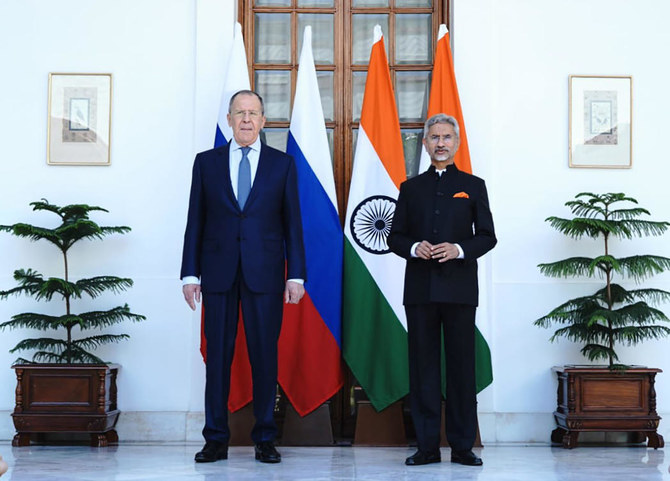
NEW DELHI: Russian Foreign Minister Sergei Lavrov began meetings with India’s leaders in New Delhi on Friday after seeing his Chinese counterpart earlier in the week, as Moscow tries to keep the Asian powers on its side amid Western sanctions.
Lavrov’s mission to shore up support from a country Moscow has long regarded as a friend comes a day after senior US and British officials held talks in New Delhi to persuade the Indian government to avoid undermining sanctions imposed after Russia invaded Ukraine in late February.
US Secretary of State Antony Blinken also spoke by telephone with India’s foreign minister, Subrahmanyam Jaishankar, late on Thursday to discuss “the worsening humanitarian situation in Ukraine” and other matters.
India and China are the only major countries to have not condemned Russia’s actions. After Lavrov visited China this week, Beijing said it was “more determined” to develop bilateral ties with Russia.
“We appreciate that India is taking this situation in the entirety of facts and not just in a one-sided way,” Lavrov said in his opening remarks during a meeting with Jaishankar.
“We continue to implement projects in the areas of energy, science and technology, outer space, pharmaceutical industry.”
Jaishankar said bilateral relations had been expanded but that they would have detailed discussions about the ongoing “difficult international environment.”
“India, as you are aware, has always been in favor of resolving differences and disputes with dialogue and diplomacy,” he said.
Apart from India’s heft as Asia’s third-largest economy, it is currently also a non-permanent member of the United Nations Security Council, giving it extra diplomatic weight.
Speaking in the Indian capital on Thursday, US Deputy National Security Adviser for International Economics, Daleep Singh said Washington would not set any “red line” for India on its energy imports from Russia but did not want to see a “rapid acceleration” in purchases.
British Foreign Minister Liz Truss also said Britain respected India’s decision to buy discounted Russian oil, while advocating stringent sanctions on Russia relating to the ports, gold and energy sectors.
India has bought millions of barrels of crude oil from Russia at a discount since the war erupted, justifying the purchases as beneficial for its citizens and something that even European countries are doing.
India has also contracted to buy sunflower oil from Russia at a record high price after supplies from Ukraine stopped due to the war.
Defense analysts say New Delhi can ill-afford to alienate Russia, which has been its biggest arms supplier for decades.
Lavrov was due to meet Indian Prime Minister Narendra Modi before departing on Friday evening.
Indian and Russian officials are expected to discuss a rupee-rouble payments mechanism to maintain trade as dollar-based transactions become difficult due to the sanctions, Reuters has reported.
The US official Singh gave Washington’s view on Thursday, saying: “We would not like to see mechanisms that are designed to prop up the rouble or to undermine the dollar-based financial system, or to circumvent our financial sanctions.”


![]()

Russia’s Lavrov lobbies India after Western emissaries make case for sanctions
Short Url
https://arab.news/whjjc
Russia’s Lavrov lobbies India after Western emissaries make case for sanctions
- India and China are the only major countries to have not condemned Russia’s actions
- Apart from India’s heft as Asia’s third-largest economy, it is currently also a non-permanent member of the UN Security Council


Latest updates


© 2026 SAUDI RESEARCH & PUBLISHING COMPANY, All Rights Reserved And subject to Terms of Use Agreement.