DUBAI: There’s never been a Marvel character quite like Dr. Michael Morbius before. Nor has there been an actor quite like Jared Leto in the lead role of a Marvel movie before. The Academy Award-winner chooses his roles very carefully — only appearing in eight films in the last 10 years. When he does pick a part, though, he arguably commits more fully than any actor alive today. Leto is a famed practitioner of the ‘method’ approach, disappearing fully into the character from the start of filming until it’s all over.
“He’s quite an immersive actor, Jared. He has his own process. In fact, I didn’t meet him until the first day that we shot together and, even though we were together for months, I still never really met him as Jared, only as Michael,” his co-star Matt Smith, star of “Doctor Who” and “The Crown,” tells Arab News.
For “Morbius,” Leto’s process took him from a sickly doctor on the brink of death, searching for a cure, into a vampiric creature who fights his darkest urges to become an unlikely hero.
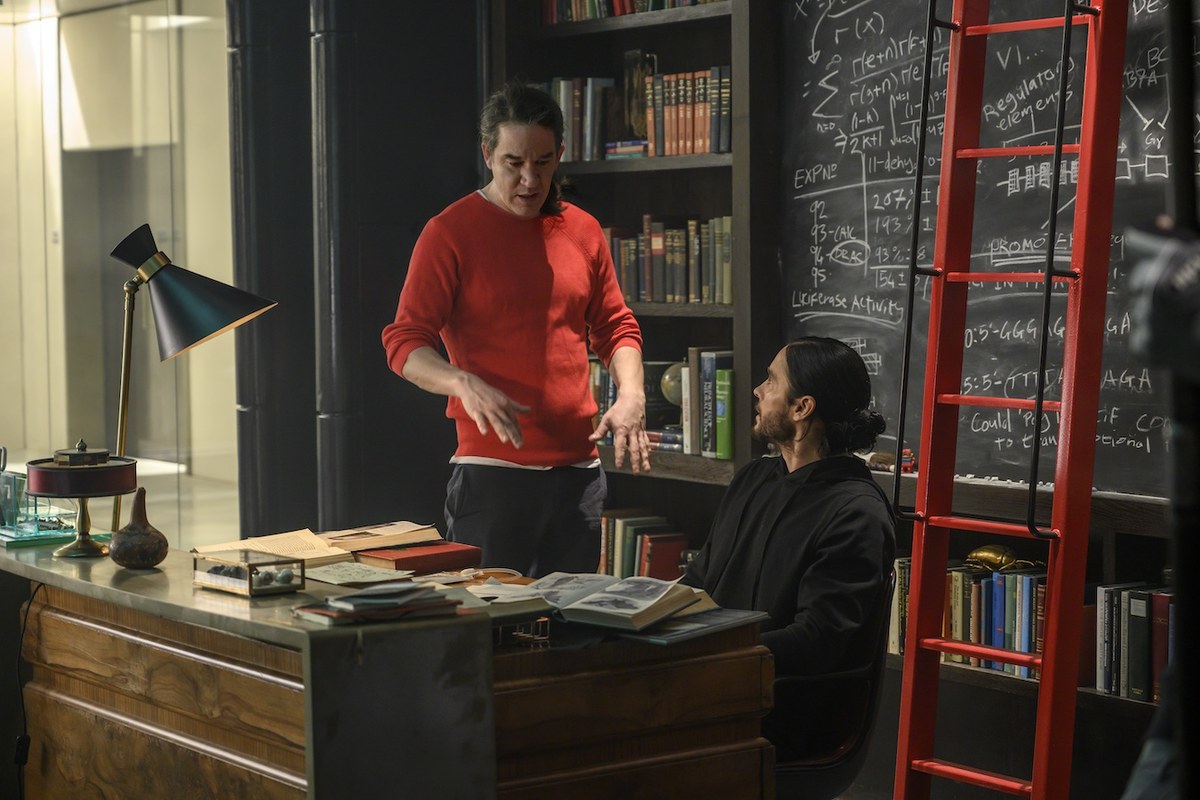
Director Daniel Espinosa and Jared Leto. (Supplied)
“I’m attracted to roles where there’s an opportunity to transform — physical transformation, but also mental, emotional… any and all,” says Leto. “I played Dr. Michael Morbius from his most frail, to his most powerful, to his most monstrous. There’s a lot of range in there, so that was really fun to tackle. Not only does the movie have action, stunts, and fighting, but the role itself was taxing. Whenever he’s fighting the affliction, he’s caught in a crossroads between different parts of the character. It’s like a withdrawal process, a full-body experience.”
Leto’s commitment also forced his co-stars to up their game, they say.
“You have to match his energy. It forces you to. You stay in character as well. You have no other way to communicate. You can’t be like, ‘Hey, what are you going to do tonight?’ I would call him Dr. Morbius. He would call me Martine. And the conversations that we would continue to have were very much about the material,” says Adria Arjona, the film’s female lead.
“There’s no small talk, which was good. We just dove right in — straight into the work with an insane focus — which I found entertaining and enjoyable,” Smith, who plays the film’s villain Milo, echoes.
The process made Arjona bolder than she ever had been before.
“Because I was in character, I had the confidence to mess around with him too. Because Martine does, though I would never do that as myself to Jared. Then the more we spoke, the more little things started to arise,” Arjona continues.

Adria Arjona is the film’s female lead. (Supplied)
Even the film’s director Daniel Espinosa had to alter his directing style to suit Leto’s process — unable to speak to him as a filmmaker usually does to their star.
“It turns you into a bit of a weirdo. As a director, you want to follow every person’s process. For this, I had to become a bit like his subconscious whispering into his ear. I would softly say things behind him like, ‘Maybe you should rise up a bit earlier in the scene.’ It put me in a strange position, but I felt it was my duty to follow his process, as it’s their creativity on display, not mine,” says Espinosa.
For the director, who refers to himself as ‘Sweden’s second-biggest comic-book fan,’ the chance to helm a Marvel film was a dream he never thought he’d be able to realize, as most films in the Marvel Cinematic Universe exist in a style so different from the one he forged in films such as the 2017 sci-fi horror “Life” with Jake Gyllenhaal, or the 2012 thriller “Safe House” with Denzel Washington.
“I never knew how I would make this jump, because I don’t fit in with the kind of quasi-comedies that most Marvel pictures ultimately are. The idea to do something that had a sub-element of horror ignited the twin passions I’ve had for both comic books and horror since I was a kid,” Espinosa explains.
The chance to play a Marvel superhero marks a move in a lighter direction for Leto, who has famously gravitated almost exclusively to dark material for the better part of his career. As Morbius finds himself headed towards somewhere more hopeful by the end of the film, so too does Leto himself.
“I don’t feel that same attraction to darker material that I did when I was younger,” Leto says. “I probably wouldn’t want to spend that kind of time anymore — and I don’t want roles that could bruise my psyche. Luckily, there’s a lot of other things to explore.”
Perhaps rumors of a team-up with Tom Holland’s Spider-Man will prove true, then.