


TROSTYANETS/LVIV: President Vladimir Putin threatened on Thursday to halt contracts supplying Europe with a third of its gas unless they are paid in Russian currency, his strongest economic riposte so far to crushing Western sanctions over his invasion of Ukraine.
European governments rejected Putin’s ultimatum for Friday, with the continent’s biggest recipient of Russian gas, Germany, calling it “blackmail.” Moscow did, however, offer a mechanism for buyers to obtain roubles via a Russian bank.
The energy showdown has huge ramifications.
Europe wants to wean itself off Russian energy but that risks further inflating soaring fuel prices. Russia has a huge revenue source at stake even as it reels from sanctions.
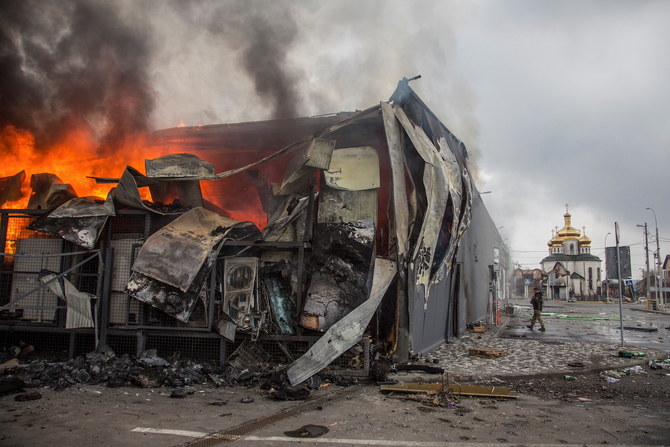
Putin’s five-week invasion of Ukraine has killed thousands, pulverised residential buildings, left masses of terrified people cowering in basements, and uprooted about a quarter of the 44 million population from their homes.
Facing stiff resistance from Ukraine’s military and a militant Western stance, Putin has played one of his biggest cards in the demand on European energy buyers.
“They must open rouble accounts in Russian banks. It is from these accounts that payments will be made for gas delivered starting from tomorrow,” he said on Thursday, adding that Europe had until now been getting some gas for free because it was paying in euros then freezing them.
“If such payments are not made (in roubles), we will consider this a default on the part of buyers, with all the ensuing consequences ... existing contracts will be stopped.”
Energy crash?
Western companies and governments say that would be a breach of contracts in euros or dollars, but they were anyway preparing for a potential full-blown energy crisis.
However, the order signed by Putin does allow them to send foreign currency to a so-called “K” account at Russia’s Gazprombank, which would then return roubles for the buyer to make payment for the gas.
“Russia would have to physically halt gas flows to EU 27 (European Union member states) to force the issue, marking a major escalation not even performed at the height of the Cold War. It would mark another major financial blow to Russia’s coffers,” said analysts at Fitch Solutions.
Putin sent troops on Feb. 24 for what he calls a “special military operation” to demilitarise and “denazify” Ukraine.
But at talks this week, Moscow said it would scale back offensives near the capital Kyiv and north as a goodwill gesture and focus on “liberating” the southeastern Donbas region.
Kyiv and its allies say Moscow is simply trying to regroup following losses after a Ukrainian counter-offensive that has recaptured suburbs of the capital plus strategic towns and villages in the northeast and southwest.
US and European officials say Putin has been misled by generals about his military’s dire performance.
Ukraine’s President Volodymyr Zelensky praised “our defenders” who had resisted aerial bombardments and pushed armored columns back. Now, he said, Russia was building up forces for new strikes on the Donbas, which it demands Ukraine cede to pro-Moscow separatists.
“The children are shaking”
The war has been particularly fierce in the besieged Black Sea port of Mariupol, which links a strategic corridor between Donbas and the Russian-annexed Crimea peninsula.
The mayor’s office estimates 5,000 people have died.
Tens of thousands have been trapped for weeks with scant food, water and other supplies in the city that once housed 400,000 people but has been pulverised by bombardment.
The International Committee of the Red Cross (ICRC) was sending an aid convoy and Ukraine dispatched 45 buses in hopes of evacuating people on Friday.
In a Russian-held part of Mariupol, people climbed out of cellars to appear, ghostlike, among the ruins. One man named Pavel placed a bowl and spoon as a tribute on a makeshift grave in a patch of grass, marked with a plain wooden cross.
“Our friend. March 16. Driving in a car. A bullet hit him in the throat. He was dead in five minutes,” he said.
Elsewhere, there was evidence of Ukraine’s successful counter-attack in Trostyanets, an eastern town. Burnt-out Russian tanks and abandoned ammunition littered muddy roads while dazed civilians and a few Ukrainian soldiers roamed.
“We spent 30 days in the basement, with small children. The children are shaking, even still,” said a woman named Larisa.
“They don’t understand what has happened.”
Ukraine’s state nuclear company said most of the Russian forces that occupied the Chernobyl nuclear station had left the defunct plant, possibly concerned over radiation.
Western countries say Putin’s real aim was to swiftly topple Ukraine’s government, and that its failure is a strategic catastrophe, bringing economic ruin and diplomatic isolation.
Britain piled on more sanctions, including on state media organizations behind the RT broadcaster and Sputnik news agency. “Putin’s war on Ukraine is based on a torrent of lies,” Foreign Secretary Liz Truss said.
The United States also imposed fresh sanctions, targeting Russia’s technology sector, a sanctions evasion network and what it called “malicious cyber actors.”
With the war exacerbating fuel prices around the world, US President Joe Biden was to release 1 million barrels of oil a day for the next six months from the US Strategic Petroleum Reserve, the largest release ever, to try to bring down gasoline costs.


