

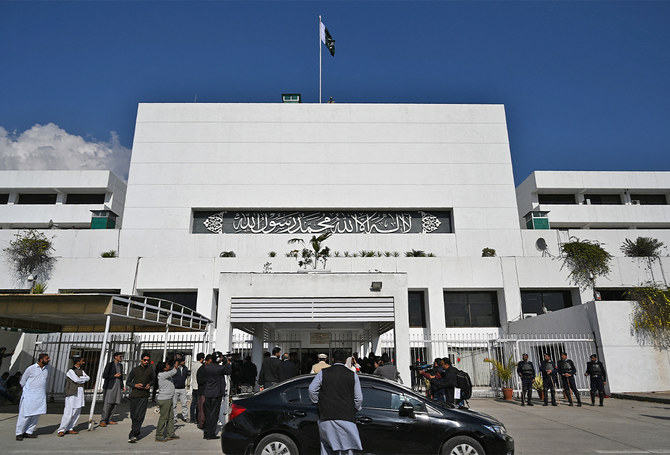
Parliament adjourns session on no-trust vote against Pakistan prime minister

In this file photo, Pakistani media personnel gather outside the Parliament building during a joint session in Islamabad on February 28, 2019. (AFP/File)
Short Url
Updated 31 March 2022
Follow

Parliament adjourns session on no-trust vote against Pakistan prime minister

  • Khan lost majority in parliament after a key ally quit ruling coalition on Wednesday
  • Opposition tabled a no-confidence motion against him, voting on which should take place by April 4

ISLAMABAD: A key Pakistani parliament session to debate a no-confidence motion against Prime Minister Imran Khan was adjourned to April 3, minutes after it began on Thursday.

Khan, a former cricket star, is facing his toughest political challenge since assuming office in 2018 as the opposition tabled a no-confidence motion against him in the National Assembly on Monday, amid accusations he has mismanaged the economy and governed poorly.

While a vote on the motion is to be held within seven days of its tabling, Khan has already lost his majority in parliament after a key government ally said on Wednesday they had struck a deal with the opposition and subsequently quit Khan’s ruling coalition.

Thursday's National Assembly session was suspended by Deputy Speaker Qasim Suri after he opened the floor for questions but opposition leaders insisted instead that he call for the no-trust vote.

“I think nobody is interested in the question hour, therefore the house is adjourned till Sunday," Suri said amid chants "go Imran go."

Shahid Khaqan Abbasi, former prime minister and current lawmaker from the opposition Pakistan Muslim League-Nawaz party, told Arab News after the announcement that the deputy speaker was "playing a partisan role."

"They have time till Sunday to conduct the voting,” he added.

During Thursday's session, the opposition alliance had on its side 175 lawmakers in the 342-member National Assembly, or three votes more than the number required to topple Khan’s administration.

The joint opposition alliance said it would not allow Khan to escape the no-trust vote.

“There is no safe passage or backdoor passage for Khan now,” Bilawal Bhutto Zardari, chairman of the Pakistan Peoples Party, said during a press conference with other opposition leaders. “We have proved our majority in the house."

Shehbaz Sharif, leader of the opposition in the National Assembly, rejected any possibility of withdrawing the not-trust motion against the prime minister.

“The prime minister has left with no legal and moral authority to cling to his position after we have shown 175 members in the house,” he said.

The opposition alliance has nominated Sharif, president of the PML-N, for the coveted premiership slot after Khan’s exit.

The speaker of the National Assembly has to carry out the vote no sooner than three days and no later than seven days after the motion is tabled. The vote must take place by April 4.


Pakistan positions itself as ‘bridge builder’ to ease Middle East tensions as PM visits Saudi Arabia

Updated 5 sec ago
Follow

Pakistan positions itself as ‘bridge builder’ to ease Middle East tensions as PM visits Saudi Arabia

  • Islamabad says it is engaging regional capitals to keep diplomatic channels open amid Iran conflict
  • Foreign Office says Pakistan policy on Afghanistan unchanged amid cross-border militant attacks

ISLAMABAD: Pakistan is positioning itself as a bridge builder to help ease rising tensions in the Middle East, with Prime Minister Shehbaz Sharif traveling to Saudi Arabia for talks focused on regional peace and security, the Foreign Office said on Thursday.

Sharif left earlier in the day for what officials described as a brief visit to the Kingdom at a time when the region is facing heightened volatility after the United States and Israel launched airstrikes against Iran. Subsequently, Tehran said it was targeting American military bases in Gulf states, prompting condemnations from these countries, which said several strikes had hit civilian infrastructure.

The spillover of the conflict in the region has complicated diplomatic efforts aimed at calming the situation, but the Foreign Office spokesperson, Tahir Andrabi, said Pakistan had been in regular contact with capitals across the region since the crisis erupted and is trying to keep channels of communication open.

“And we are playing the role of a bridge builder in a sense that our principal position on issues with respect to sovereignty, international law and the UN Charter and with respect to dialogue and diplomacy is respected in all regional capitals,” Andrabi said during the weekly press briefing.

He said Prime Minister Sharif’s visit to Riyadh should be seen as part of ongoing coordination between Pakistan and Saudi Arabia on regional stability.

“The Prime Minister’s visit to Saudi Arabia is part of the coordination between Pakistan and Saudi Arabia on matters of regional peace and security and ending violence and hostilities,” he said.

“The Prime Minister’s visit should also be seen in the broader context of Pakistan’s efforts to advocate and facilitate an early cessation of hostilities and violence in the region, with the aim of paving the way for dialogue and diplomacy.”

Islamabad has condemned both the strikes on Iran and the retaliatory attacks launched from Iranian territory against Gulf states, urging all sides to show restraint and resolve their differences through diplomatic means.

“As you know, Pakistan had condemned the unwarranted attacks against the Islamic Republic of Iran,” Andrabi said, warning that such actions risk further destabilizing an already tense region. At the same time, he added, Pakistan had also condemned attacks carried out from Iran against Gulf states including Saudi Arabia, Bahrain, Jordan, Kuwait, Qatar and the United Arab Emirates, calling them violations of sovereignty.

He said Pakistan has remained diplomatically engaged since the crisis began. Deputy Prime Minister and Foreign Minister Ishaq Dar has spoken with his counterparts from several countries in the region to discuss the evolving situation.

The prime minister also held a telephone conversation on Wednesday with Iranian President Masoud Pezeshkian, during which the two leaders discussed regional developments.

Andrabi said Pakistan’s position was firmly rooted in international law and the principle that disputes should be resolved through dialogue.

PAK-AFGHAN CLASHES

Separately, the Foreign Office said Pakistan’s policy toward Afghanistan remains unchanged despite continued tensions over cross-border militant attacks.

“There is no qualitative change in our relations, in our way of how we engage with Afghanistan,” Andrabi said.

Pakistan has repeatedly accused the Afghan authorities of harboring militant groups and facilitating their cross-border attacks, an allegation denied by Kabul.

The two countries have witnessed fierce border clashes amid mounting tensions, with Pakistan saying it has targeted militant hideouts inside Afghanistan.

“We have emphatically communicated to the Afghan side and to our interlocutors that we need verifiable assurances from the Afghan side that their territory will not be used for terrorism against Pakistan,” Andrabi said.

“Since those assurances have not been received, we will continue with our existing policy with respect to that country.”

He said Pakistan reserved the right to respond to attacks originating from Afghan territory.

“We are under attack ... and in exercise of our right to self-defense, we do reserve the right to respond to these attacks.”