

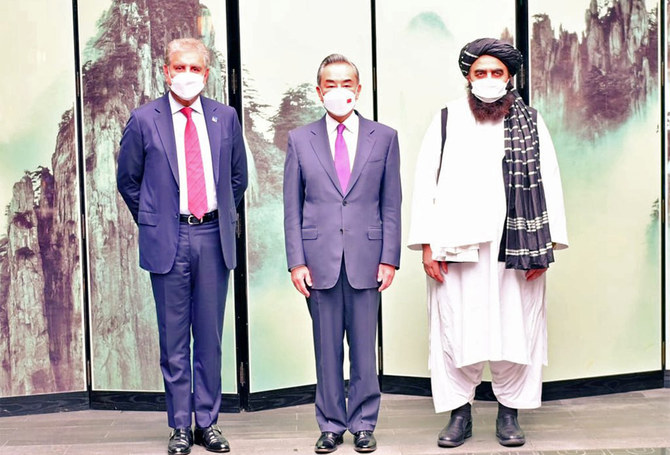

ISLAMABAD: Pakistan’s foreign minister Shah Mahmood Qureshi said on Wednesday a sovereign and stable Afghanistan was necessary for regional peace while applauding the positive role played by neighboring countries through their continued engagement with Kabul.
Qureshi is currently visiting China to attend the third ministerial meeting of Afghanistan’s neighboring states from March 29 to 31. He also held one-on-one meetings with his Chinese, Russian, Afghan and Iranian counterparts and held discussions on wide-ranging issues.
“The Foreign Minister said that Pakistan welcomed the international community’s continued engagement with Afghanistan to advance the goals of a sovereign, stable and economically strong Afghanistan contributing to regional peace and stability,” said an official statement issued by the foreign office after Qureshi held a meeting with Amir Khan Muttaqi of Afghanistan in Huangshan, China.
He acknowledged the Afghan interim government’s steps to ensure internal stability in the country while stressing the importance of responding to the international community’s expectations for political inclusivity.
He also stressed the importance of respecting the rights of all Afghans while ensuring girls’ education and action against terrorist outfits.
In his meeting with the Iranian foreign minister Dr. Hossein Amir Abdollahian, Qureshi expressed the hope for an early session of the Joint Economic Commission to boost trade between the two countries.
“The Foreign Minister also underscored the importance of earliest completion of border markets in the context of enhanced bilateral economic cooperation,” said the foreign office of Pakistan.
Qureshi also shared Pakistan’s “principled position” on the situation in Ukraine, including cessation of hostilities, provision of humanitarian assistance and efforts for a solution through dialogue and diplomacy, during his conversation Russian foreign minister Sergey Lavrov.
“He expressed the hope that talks between Russia and Ukraine would succeed in finding a diplomatic solution. The Foreign Minister also conveyed Pakistan’s readiness to reinforce efforts for a diplomatic solution including through the OIC platform,” the statement said.
He also told his Chinese counterpart Wang Yi in a separate meeting that Pakistan’s relations with China was the “cornerstone” of its foreign policy while reaffirming the government’s resolve to further deepen the Pakistan-China strategic partnership.
He maintained the mutual understanding between the two sides was leading to high-quality development during the second phase of the multibillion-dollar China-Pakistan Economic Corridor (CPEC), adding the two countries were cooperating in diverse areas like industrial development, agricultural modernization and information technology.
The foreign minister also thanked China for hosting the meeting on Afghanistan, emphasizing deeper engagement to promote peace, stability and development in Pakistan and facilitate regional connectivity by extending CPEC to Afghanistan.


