

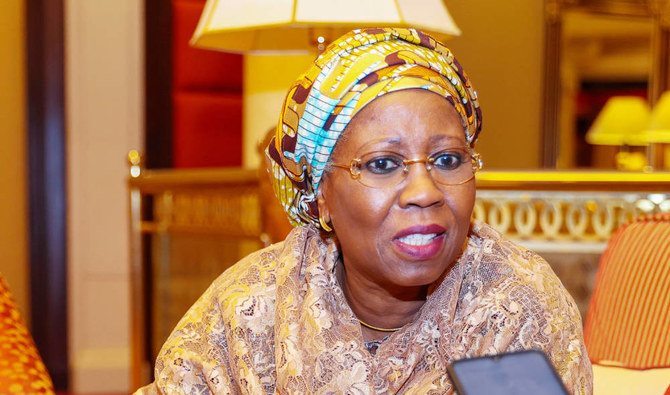

RIYADH: Nigerian Minister of State for Industry, Trade, and Investment Mariam Yalwaji Katagum said on Monday that bilateral relations between Saudi Arabia and Nigeria are excellent, detailing how both countries support each other at international forums.
Katagum was in Riyadh for the Global Entrepreneurship Congress 2022. She praised the summit, saying it left attendees feeling energized and inspired by the extraordinary global gathering of startup champions and policymakers to help rebuild the post-pandemic global economy.
The GEC, being held under the patronage of Crown Prince Mohammed bin Salman, kicked off on Sunday amid a boom for startups in the region, where several high-profile venture capital funds and angel investors are flocking to do business.
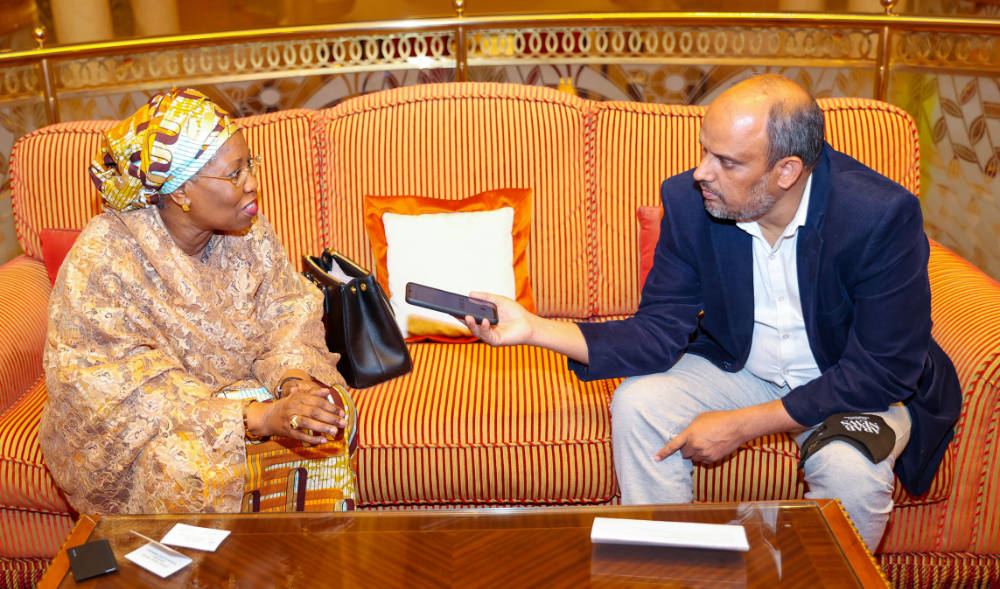
Nigerian Minister of State for Industry, Trade and Investment Mariam Yalwaji Katagum speaking to Arab News. (AN photo by Saad Soud Aldossari)
Running until March 30, the GEC focuses on making it easier for entrepreneurs to start and scale a business. Top CEOs and a successful star cast of serial businessmen are among the speakers to help steer entrepreneurs through the onslaught of the business and health issues that have impaired the global economy during the COVID-19 pandemic.
In an exclusive interview with Arab News, Katagum said: “I am here for the annual summit, where countries from around the world come to look at issues concerning entrepreneurship. We know the entrepreneurs, particularly the Micro, Small and Medium-sized Enterprises (MSMEs) are the engines of economic growth in every country, so it’s very important that we look at issues concerning the entrepreneurs, and how governments can help them.”
MSMEs are crucial for achieving the UN’s Sustainable Development Goals (SDGs), which were launched in 2015 as a blueprint to achieve a better and more sustainable future for all.
“This annual event is being held this year in Riyadh. There will be a lot of takeaways from this summit, so I expect people will go back to their countries and will begin to look at what are the areas that we need to improve upon, particularly in terms of networking,” said the Nigerian minister.
“Most of the startups are (launched by) young people who have a lot of creative energy. So we have to put in place policies and frameworks, including providing access to finance and market, because an entrepreneur could have all the ideas, but you need the right policy, on ground you need finance and also technology, and then, of course, access to the markets,” she added.
On her Riyadh visit, Katagum said: “In gathering like this … to share ideas and best practices, countries were able to indicate what it is that they are doing in terms of policy for entrepreneurship, what is the rule of technology, how can we assist and enable them to network with similar entrepreneurs, even large industries in other countries.”
Commenting on Saudi-Nigerian bilateral trade, she said: “We have an excellent relationship with Saudi Arabia. Nigeria has diversified away from oil and gas, so we are looking at agro products. Just last week, I inaugurated a technical committee to look at halal certification so that Nigeria has a lot to offer countries such as Saudi Arabia where halal food is consumed. We need to put in place the right certification so that our products are exported here.”
Commenting on changes since the advent of the COVID-19 pandemic, Katagum said “there has been improvement in e-commerce between the two countries. Now that our borders are opening, there will be a lot more commerce between us, at least we will have a lot of learning as to how Saudi Arabia is effectively utilizing gas, and now our focus is on non-oil products.”
She underlined that Saudi Arabia and Nigeria share good bilateral relations: “We have excellent bilateral relations between the two countries. At international fora, I know Saudi Arabia gives us all the support they can, and vice versa, Nigeria is always supporting Saudi Arabia.”
She added that in November last year, the Nigeria-Gulf Arab countries business council was inaugurated, including representation from all Arab countries.
Rather than having just a general business council, Katagum said that Lagos appointed Nigerian ministers responsible for certain critical sectors such as power, water, housing and agriculture at the Dubai expo. They gathered investors and subsequently started having sectoral meetings and deep dives to see the real interests of investing countries.
“Very soon we will come to Saudi Arabia and will do that sectoral deep dives and get investors, those who are interested to make investment from both sides in Saudi Arabia and Nigeria,” she added.
On the sidelines of the GEC, she held a meeting with South African Minister of Social Development Lindiwe Zulu to strategize on how African countries can ensure that they are able to effectively utilize the platform that the GEC has provided. They also discussed how they can integrate the activities and initiatives of the GEC network into the Africa Agenda 2063 by the African Union.
Agenda 2063 is Africa’s blueprint and master plan for transforming Africa into the global powerhouse of the future. The continent’s strategic framework aims to deliver on its goal for inclusive and sustainable development and is a concrete manifestation of the pan-African drive for unity, self-determination, freedom, progress and collective prosperity.
“I also had a meeting with Dilawar Syed, the special representative of the US Department of State’s Office of Commercial and Business Affairs. Our discussions were very fruitful in the sense that we have an understanding of areas that they want to assist,” the minister said.
“We are able to highlight from the perspective of Nigeria, what kind of initiatives the government has put in place like the economic sustainability plan which is basically to help reduce effects of COVID-19. And some of the key programs that we think are very successful like the MSME survival fund, the issues of housing, issues of social investment, and how, when we both go back to our countries, reflect further and decide on key initiatives that we want to take forward,” she added.
“So it’s not that we have a big basket of aspirations, we want to be more specific, things that will actually make a change in our countries,” said the minister.
Katagum arrived in Riyadh on Monday morning and departed on Tuesday for Dubai to attend the World Government Summit and the World Women Leadership Conference.


