

Six Pakistani troops among eight UN peacekeepers killed in helicopter crash in DR Congo

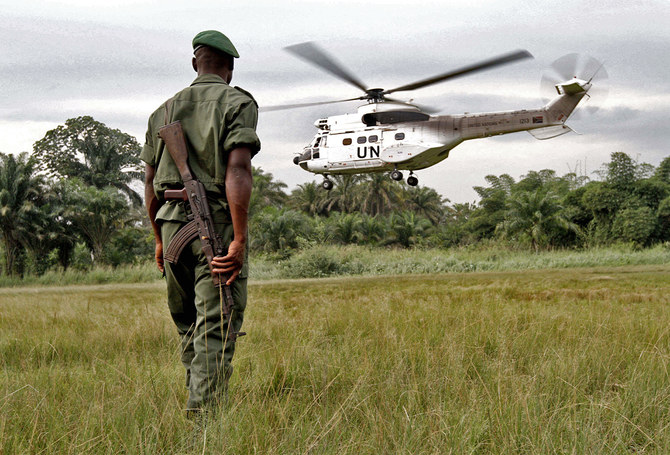
A soldier of the Congolese Defense Forces watches a UN helicopter from MONUSCO take off in northeastern Democratic Republic of Congo on September 3, 2010. (AFP/File)
Short Url
Updated 29 March 2022
Follow

Six Pakistani troops among eight UN peacekeepers killed in helicopter crash in DR Congo

  • The exact cause of crash of the helicopter undertaking a reconnaissance mission is yet not known
  • Pakistani PM expresses 'deep sense of shock and grief' while paying tribute to global peace efforts

ISLAMABAD: Eight United Nations peacekeepers were killed in a helicopter crash in Democratic Republic of Congo on Tuesday, the Pakistani military's media wing said.

"While undertaking a reconnaissance mission in Congo, 1 PUMA Helicopter crashed. Exact cause of crash is yet to be ascertained," the statement said.

It added that six Pakistani troops were among those killed.

Earlier Tuesday, the UN Stabilization Mission in the DR Congo (MONUSCO) said in a tweet Tuesday that it had "lost contact" with one of its helicopters which was on a reconnaissance mission in the region.

"The causes of this disappearance are not yet known. Research is ongoing," the mission said.

Pakistan's Prime Minister Imran Khan expressed his "deep sense of shock and grief," his office said, paying tribute to the global peace effort by the country's armed forces.

Sources in civil society groups in the region said fighting resumed Tuesday morning between government troops and the rebels from M23, also known as the Congolese Revolutionary Army.

M23 was defeated by the army in 2013 but has resurfaced since November and been accused of staging several raids on military strongholds around Rutshuru.


Pakistan law minister urges media caution on foreign policy debate amid Middle East tensions

Updated 10 sec ago
Follow

Pakistan law minister urges media caution on foreign policy debate amid Middle East tensions

  • Azam Nazeer Tarar says constitutional limits must be respected when discussing diplomatic matters
  • He says people can express themselves but sensitive external issues fall outside freedom of expression

ISLAMABAD: Federal Minister for Law and Justice Azam Nazeer Tarar urged journalists on Tuesday to exercise caution when discussing the country’s foreign policy, saying constitutional limits must be respected as regional tensions rise following the escalating conflict in the Middle East.

Tarar said citizens have the right to receive accurate information and express their views, but warned that public debate on sensitive diplomatic matters could cross constitutional boundaries and trigger legal consequences.

His remarks come as tensions in the Gulf have intensified after coordinated strikes by the United States and Israel against Iran on Feb. 28, followed by retaliatory Iranian attacks targeting American bases and infrastructure in several Arab states.

The crisis has complicated diplomatic balancing for countries such as Pakistan that maintain ties across the region.

“Journalism is such a profession, and particularly given the way information flows today, it is the right of every person living in Pakistan that correct information should reach them, and every individual also has the right to express what is in their heart,” Tarar told the media.

“However, we cannot ignore constitutional limits and restrictions,” he said, adding that criticism often arises when authorities register criminal cases or initiate prosecution after those limits were crossed.

The minister said debate that frames Pakistan’s foreign policy choices in binary terms — such as whether the country stands with Iran or Gulf states — risks undermining delicate diplomatic relations.

He maintained even the Constitution of Pakistan does not permit people to casually comment on such issues, adding that the public should trust the state in managing these matters.

“Your constitution, which is the fundamental document and the social contract with the state, the agreement between the state and its citizens about how life is to be conducted here, also obliges you to exercise great caution in such discussions and commentary, as they do not fall within the bounds of freedom of expression,” he said.

The remarks come amid debate in the country about limits of online free speech, as authorities frequently invoked the Prevention of Electronic Crimes Act (PECA) to pursue cases related to digital content.

Critics say the law has been used to curb dissent and intimidate journalists and activists, while the government maintains it is necessary to combat misinformation, cybercrime and threats to national security.

Tarar said legal action should not automatically be viewed as excessive if authorities enforce constitutional limits.

“Every profession also has a basic responsibility to conduct itself within the limits of the law,” he added.