PM Khan 'strictly' orders ruling party lawmakers to abstain from no-confidence vote

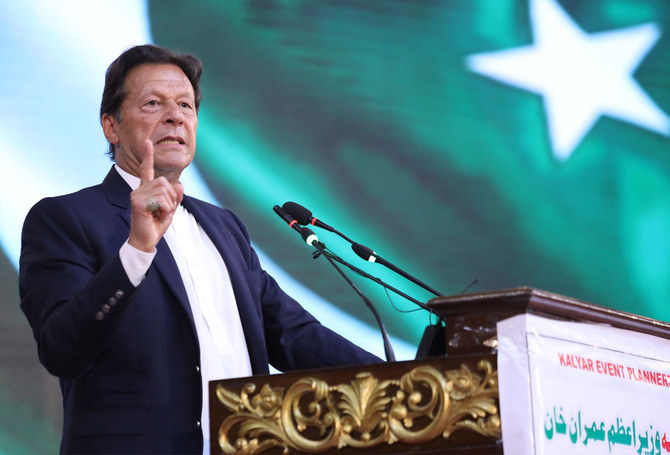
The file photo shows Pakistan Prime Minister Imran Khan speaking during PTI party convention in Islamabad, Pakistan, on March 9, 2022. (PTI/Twitter)
Short Url
Updated 30 March 2022
Follow

PM Khan 'strictly' orders ruling party lawmakers to abstain from no-confidence vote

  • The prime minister says any violation of his instructions will be treated as ‘express defection’
  • Over a dozen PTI lawmakers have said they want to attend the session, vote according to ‘conscience’

ISLAMABAD: Prime Minister Imran Khan on Tuesday stopped lawmakers belonging to the ruling Pakistan Tehreek-e-Insaf (PTI) party from attending the National Assembly session wherein a no-confidence resolution against him will be put to a vote.
Khan is facing his toughest political challenge since assuming office in 2018 as the opposition tabled the no-confidence motion against him in the national assembly on Monday. A debate on the resolution will start on March 31.
With more than a dozen PTI lawmakers demanding to attend the session and vote “according to their conscience,” the prime minister issued specific instructions to his party members to abstain from voting in a detailed letter while reminding them of Article 63-A of the constitution that deals with disqualification of lawmakers in the case of defection and violation of party policy.
“All the members of the Parliamentary Party of Pakistan Tehreek-e-Insaf in the National Assembly of Pakistan shall abstain from voting/ not attend the meeting of the National Assembly on the date when the said resolution is setout on the agenda of the National Assembly for voting,” the document said.


It maintained that only “duly designated” parliamentarians of the ruling party would speak on its behalf during the debate over the motion.
“All members are required to adhere to these directions in true letter & spirit and keep in mind the intent behind the provision of Article 63-A of Constitution of Pakistan, 1973,” it continued.
The letter stopped all PTI members from violating these instructions or extending any favor related to the no-trust vote to any other group or parliamentary party.
“Every / any violation of these directions shall be treated as express defection in terms of Article 63-A,” it warned.
The government has already submitted a presidential reference in the Supreme Court of Pakistan, seeking the interpretation of Article 63-A, after at least 13 PTI lawmakers indicated they could vote against the prime minister.
The reference requested the court to give its opinion on whether a defector should be disqualified for life from electoral activity or public office and if his or her vote, after defecting, should be counted in a parliamentary motion.


Pakistan president to visit Bahrain today to enhance trade, defense, security cooperation

Updated 5 sec ago
Follow

Pakistan president to visit Bahrain today to enhance trade, defense, security cooperation

  • Asif Ali Zardari to meet Bahrain’s king and crown prince, discuss regional issues of mutual interest, says state media
  • Trade volume between Pakistan, Bahrain has increased from $500 million to $1 billion in recent years, says Pakistan’s FO

ISLAMABAD: President Asif Ali Zardari is scheduled to visit Bahrain today, Tuesday, for a four-day visit aimed at strengthening cooperation between the two nations in trade, defense and security, state media reported. 

Zardari will lead a high-level delegation during his visit to Bahrain from Jan. 13-16, Pakistan’s foreign ministry said on Monday. The president will hold talks with King Hamad Bin Isa Al Khalifa and Prince Salman bin Hamad Al Khalifa during his visit on bilateral, regional and international issues of mutual interest.

“The visit seeks to reinforce Pakistan’s longstanding cooperation with the brotherly Gulf nation while expanding opportunities for collaboration in trade and economic partnership, defense and security and people-to-people ties,” state broadcaster Radio Pakistan reported. 

Pakistan enjoys cordial relations with all Gulf Cooperation Council (GCC) countries, including Bahrain. Islamabad and Manama established diplomatic ties in October 1971 after the Gulf country gained independence. 

The trade volume between the two countries in recent years has ranged between $500 million to around $1 billion, according to Pakistan’s foreign ministry. Major exports from Pakistan to Bahrain include meat, vegetables, rice, tobacco and textile. Imports from Bahrain, on the other hand, include petroleum products, ferrous wastes and scrape and aluminum. 

Pakistan and Bahrain have established a Joint Ministerial Commission (JMC) at the level of the foreign ministers to discuss trade and economic ties, take decisions mutually and supervise the implementation of these decisions. So far, only two sessions of the JMC have been held, the last in Bahrain in July 2021.

Zardari’s visit also takes place amid increasing economic engagement between the two nations following the Pakistan-Bahrain Investment Summit in May 2025. Both sides signed contracts worth $13 million during the summit.