

BEIRUT: The motives behind the horrific quadruple murder in Lebanon of a mother and her three daughters are still unclear.
The killings in Ansar, committed 20 days ago by Hussein Jamil Fayyad but discovered last week, are being described as the most serious murders in recent years in Lebanon.
Basma Abbas, along with her daughters Rima, Tala and Manal, were slain in a premeditated attack, leading to a surge of public anger in the country and calls for the two killers to be executed.
A funeral ceremony on Sunday morning in Ansar was attended by the father of the girls and Abbas’ ex-husband, Zakaria Sawafi, who also serves as the town mayor.
Sawafi helped in the discovery of the crime after he raised the alarm following the disappearance of his daughters.
Together with Ansar residents, Sawafi pushed for the arrest of a suspect who was last seen with the four victims on the last day they were seen alive. However, after being arrested, that suspect was released following an investigation.
According to new details, on March 2, the three siblings and Abbas left their home in Ansar on a stormy night accompanied by 35-year-old Fayyad, reportedly the fiance of one of the daughters.
He was arrested and interrogated in Ansar about two weeks after the murders took place.
A relative of the victims said that the public prosecutor in Nabatiyeh, judge Ghada Abu Alwan, had interrogated Fayyad, but later released him.
A judicial source said that preliminary investigations into Fayyad’s activities did not result in any charges.
But soon after his release, Fayyad fled to Syria. Last week, he was encouraged to return to Ansar by relatives, when he was ambushed and arrested by Lebanese military intelligence.
During his interrogation, contradictions in his statement and phone data were discovered.
Fayyad later confessed to the crime, noting the involvement of a Syrian national accomplice and revealing the location of the four corpses.
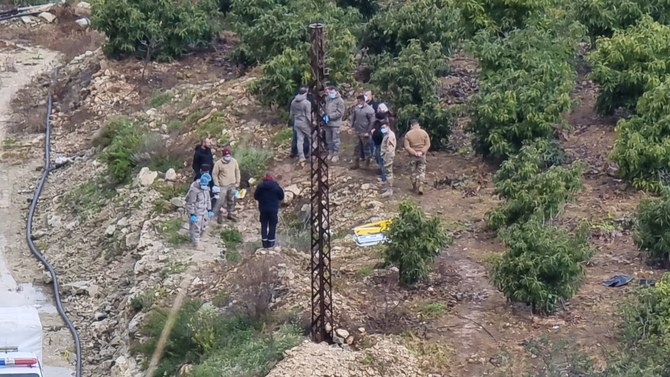
On March 25, specialized teams went to inspect the location — a valley that is difficult to reach to due to its rugged terrain.
Four bodies were discovered inside a cave between the towns of Ansar and Zrarieh.
Fayyad admitted that he had carried out the mass murder of the family and buried them in the cave.
He lured the victims to the location under the pretense of showing them land that he planned to buy.
Together with his accomplice, he killed the victims using a hunting weapon and covered their corpses with stones, dirt and concrete.
But despite Fayyad’s confession, he has not explained his motive for carrying out the murders.
On Sunday night, activists on social media circulated pictures of Hassan Al-Ghanaj, the Syrian accomplice in the crime.
Images showed him bleeding after men from the Lebanese Nasser Al-Din family managed to lure him from Syrian territory to the Lebanese border through illegal crossings.
He was severely beaten and handed over to Lebanese authorities. Footage showed scenes of celebration in Lebanon’s northern Bekaa region over the arrest of Al-Ghanaj.
Fayyad’s family repudiated the killers in a statement, condemning the crime.
Safawi said that he refused to accept “the law of the jungle and any retaliatory and irresponsible behavior.”
However, Ansar residents have called on the Lebanese president to “actually execute the murderer, not to sentence him to death and suspend the execution, as is customary.”