

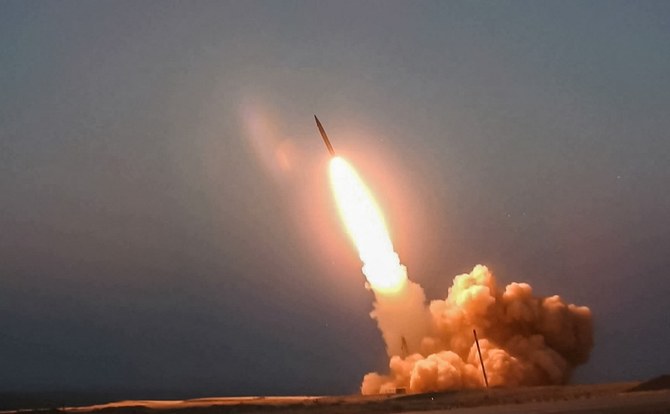

LONDON: Western countries should not overlook Iran’s growing missile capabilities, a former Israeli representative to the UN has warned.
Writing in the Sunday Telegraph, Dore Gold said the Joint Comprehensive Plan of Action, commonly known as the Iran nuclear deal, has failed to prevent the country from building a stockpile of ballistic missiles.
As a result, Iran’s missile capacity has grown “both in number and quality, including the range and accuracy of its missile force,” he added.
Gold drew a comparison with the UN’s treatment of the Saddam Hussein regime in Iraq, where resolutions required that ballistic missiles with a range greater than 150 km be “removed or destroyed under international supervision.”
That condition has not been applied to Iran, meaning that it “is already altering the balance of power in the region,” he said.
This was demonstrated in the 2020 attack on the US-controlled Al-Asad Airbase in Iraq and the activities of Yemen’s Iran-backed Houthi militia, Gold added.
He noted comments by Gen. Kenneth McKenzie, commander of the US Central Command, who said this month that Iran’s 3,000 ballistic missiles have become “the greatest threat to Middle Eastern security.”
Gold argued that rather than moderating Iran’s behavior, the JCPOA has had the opposite effect in licensing Tehran to “rapidly increase the number of Shiite militias” and making the Middle East “far more dangerous.”
He said the removal of Western economic sanctions on Iran “prepared the groundwork for funding militias across the region, especially in Iraq, Syria and Yemen.”
Tehran is using the Islamic Revolutionary Guard Corps as “its chosen instrument for spreading the new militancy,” he added.
Under the JCPOA, Gold said, the IRGC was stripped of its terrorist label — a decision that was “morally and factually wrong” and likely to empower the network “to conduct more attacks,” referencing its rocket strike on the US Consulate in Irbil earlier this month.
“Without some major change in Iranian intentions towards Western states, European countries are not likely to remain merely political rivals,” Gold concluded. “They could soon become the very real targets of Iran’s increasingly robust missile forces.”


