France must do more to aid Afghan refugees’ mental health: HRW

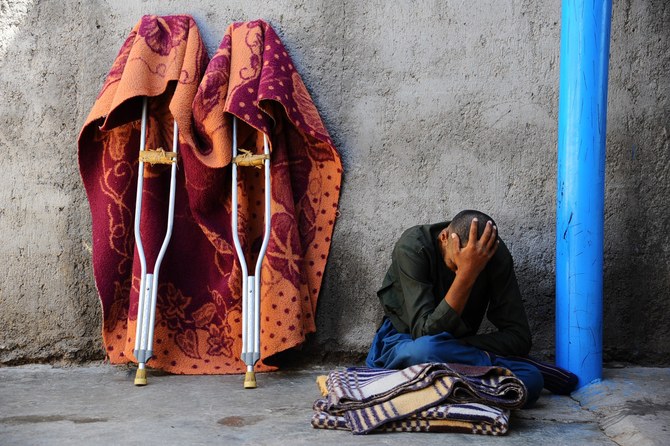
Decades of violent conflict is driving a growing mental health crisis in Afghanistan, Human Rights Watch has warned. (AFP/Getty Images)
Short Url
Updated 26 March 2022
Follow

France must do more to aid Afghan refugees’ mental health: HRW

  • Thousands of people arrived from Kabul displaying signs of trauma, depression, anxiety
  • Despite praising country’s initial response, rights group says services overwhelmed

LONDON: Many Afghan refugees who fled the Taliban for France are in desperate need of mental health support, Human Rights Watch has warned.

The French government evacuated 2,630 Afghans between Aug. 15 and 26 last year as the Taliban took control of Kabul, resettling them across the country. Many had experienced trauma, with some being forced to leave relatives behind.

They arrived in Europe in varying states, with some displaying signs of “shock … anxiety, depression, insomnia, nightmares, and sometimes severe psychological distress, including post-traumatic stress,” HRW said, adding that while Paris had gone to great lengths to prioritize and assist Afghan refugees, their asylum claims and their wellbeing, more needs to be done.

Refugees received differing levels of service depending on where in France they were relocated, with those in more remote areas getting less effective help, HRW said. 

It added that asylum seekers in France did not receive full healthcare coverage for the first three months of their stay, which hampered much-needed mental health intervention.

“Afghans evacuated to France faced severely traumatic events and many continue to struggle with their mental health,” said HRW researcher Jonas Bull.

“People fleeing conflict shouldn’t face the added burden of having to wait weeks to be eligible for mental health support and then finding there are no appropriate services in their area,” he added.

“Afghans in France still need more support, and as European countries begin to welcome refugees from the Russia-Ukraine war, lessons from the Afghanistan evacuation in France underline the importance of putting mental health high on the agenda.”

One female refugee interviewed by HRW said: “I love my country; I love my people. But I have a hole in my heart, I can’t do anything from here. I was in shock mode, and now I am still in shock mode. I keep forgetting things, I even forget my name.” 

In addition to refugees, HRW also interviewed “psychologists, doctors, humanitarian experts, representatives of NGOs, staff of mental health centers, Afghan community leaders, interpreters, and government officials.” 

Through its interviews, it said it had established that even well-equipped mental health resources in French urban centers had been “overwhelmed” by demand even before the refugees were relocated from Afghanistan, and many lacked adequately trained, trauma-sensitive interpreters. 

HRW added that with millions of people currently fleeing Ukraine, France will need to learn the lessons of how it has provided for Afghan refugees.

France “should make mental health support services available immediately to evacuees and other people seeking protection,” it said. 

“Whenever a need for mental health support is voiced or identified, including in the asylum process, French authorities should direct people to psychosocial support services, ideally to dedicated centers with expertise in conflict-related trauma, qualified interpreters, and staff with relevant cultural competence and language skills,” it added.

“People seeking protection should be informed of the availability of support services and be able to choose the type of support most appropriate to their needs. They should have the right to withdraw from psychosocial support services at any point.”


US pledges $2 bn for UN aid, with ‘adapt, shrink or die’ warning

Updated 7 sec ago
Follow

US pledges $2 bn for UN aid, with ‘adapt, shrink or die’ warning

GENEVA:Washington on Monday pledged an initial $2 billion for United Nations humanitarian aid in 2026 — far less than it has provided in recent years — warning individual UN agencies to “adapt, shrink or die.”
With its pledge, announced at the US mission in Geneva alongside the United Nations’ aid chief Tom Fletcher, the United States is pursuing a dramatic overhaul of how it funds UN humanitarian work.
Instead of handing funds to individual agencies, the United States will funnel its contributions through the UN aid agency OCHA, headed by Fletcher, which earlier this year launched a so-called Humanitarian Reset to improve efficiency and accountability.
The US funds will then be distributed to more than a dozen selected countries, including the Democratic Republic of Congo, Myanmar and Sudan.
“It is an initial anchor commitment,” Jeremy Lewin, the senior US official for foreign assistance, humanitarian affairs and religious freedom, told reporters.
“There are other countries that we will add, as we continue to get more funding into this mechanism.”
He challenged other countries to match or beat US funding for UN aid.
“This new model will better share the burden of UN humanitarian work with other developed countries and will require the UN to cut bloat, remove duplication, and commit to powerful new impact, accountability and oversight mechanisms,” US Secretary of State Marco Rubio said on X.
According to UN data, the United States remained the top humanitarian aid donor in the world in 2025, but that amount fell significantly to $2.7 billion, down from around $11 billion in 2023 and 2024, and from over $14 billion in 2022.
Other key donor countries have also been tightening their belts, triggering major upheaval in the global aid sector.
“Individual UN agencies will need to adapt, shrink, or die,” a State Department statement said.
Hard priority choices
Fletcher, who is British, said the US pledge was an “extraordinary” commitment.
“The US has long been the world’s humanitarian superpower,” he said in a statement.
“Hundreds of millions of people are alive today because of American generosity — and many millions more will survive in 2026 because of this landmark investment in humanity.”
Fletcher said reform of the humanitarian system was in the pipeline, and US taxpayers would be able to see how their money was delivering life-saving impacts.
“The US is also placing a significant and encouraging vote of trust and confidence in the Humanitarian Reset, through which we are making humanitarian action faster, smarter and closer to the people on the front lines of emergencies,” he said.
“We’re cutting red tape, eliminating duplication and prioritising hard.”
When Fletcher launched the UN’s annual Global Humanitarian Appeal for 2026 earlier this month, he requested $23 billion to provide assistance to 87 million of the world’s neediest people, with a heavy focus on dire conflicts like those in Gaza, Ukraine, Sudan, Haiti and Myanmar.
The amount and number of people covered by the appeal has been dramatically reduced over recent years, as the UN strives to adapt to a new reality after President Donald Trump slashed US foreign aid spending.
The United Nations has stressed that the smaller appeal does not mean needs have shrunk.
It estimates that some 240 million people — in conflict zones, suffering from epidemics, or victims of natural disasters and climate change — are in need of emergency aid.
In 2025, the UN’s appeal for more than $45 billion was only funded to the $12 billion mark, the lowest in a decade.
That only allowed it to help 98 million people, 25 million fewer than the year before.