

Opposition party kicks off anti-government march to Islamabad

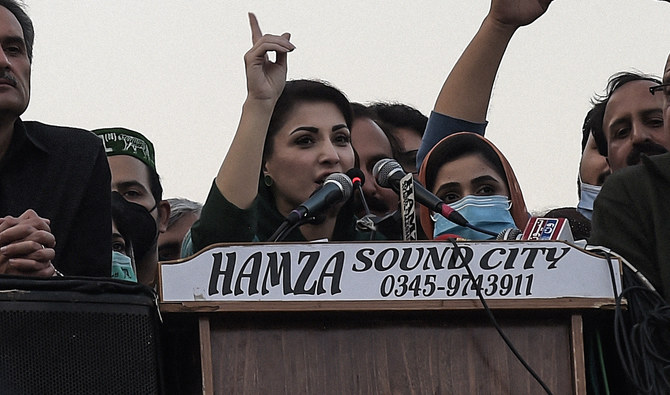
Maryam Nawaz Sharif addresses a protest rally in Islamabad, Pakistan, on January 19, 2021, against Prime Minister Imran Khan's ruling party. (AFP/File)
Short Url
Updated 26 March 2022
Follow

Opposition party kicks off anti-government march to Islamabad

  • PM Imran Khan asked supporters to attend a pro-government rally in the capital on Sunday
  • Government has beefed up security in Islamabad ahead of the demonstrations

ISLAMABAD: The Pakistan Muslim League-Nawaz (PML-N), a leading opposition party, started on Saturday an anti-government march to Islamabad, ahead of a no-confidence vote against Prime Minister Imran Khan.

Opposition parties filed a no-trust motion against Khan on March 8, accusing him of mismanaging the economy and foreign policy, and poorly governing the country. They also called for Khan to announce early elections, a demand his Pakistan Tehreek-e-Insaf (PTI) party has repeatedly rejected.

Calling it "the beginning of the end of this incompetent government," the PML-N began the march from the country’s second largest city of Lahore. PML-N vice presidents Hamza Shehbaz Sharif and Maryam Nawaz Sharif were leading the rally.


“The PML-N invites all segments of the society, including workers, farmers, students and laborers, to join the march,” PML-N spokesperson Marriyum Aurangzeb said in statement on Saturday morning.

Participants of the march would stay in Gujranwala on Saturday night and begin their journey toward the capital on Sunday, according to the statement.  

PM Khan, meanwhile, has called on supporters to attend a pro-government rally, also on Sunday. 

The government has beefed up security in Islamabad ahead of the rallies. Interior Minister Sheikh Rashid Ahmed on Friday urged political parties to organize their public gatherings at designated places.

The interior ministry said in a statement that additional forces from Punjab and Khyber Pakhtunkhwa would be brought to the capital to support Islamabad police.

“Additional troops of Rangers and Frontier Corps would also be deployed to ensure law and order in the federal capital,” it said.

On Friday, National Assembly Speaker Asad Qaiser adjourned a session of the House without taking up the no-trust motion after prayers were offered for a lawmaker who had passed away recently. The next session is now scheduled for Monday, March 28.

PML-N's president Shehbaz Sharif, the opposition leader in the National Assembly, accused the speaker of violating the constitution by delaying the tabling of the no-confidence motion.

“Speaker continues to trample upon constitutional provisions. This partisan behaviour does not suit the custodian of the House,” Sharif said on Twitter.  

"Adjournment of NA session is part of desperate efforts to disrupt no-confidence process. You cannot stop the inevitable through such underhand tactics!”


Pakistan reports current account surplus in Jan. owing to improved trade, remittances

Updated 17 February 2026
Follow

Pakistan reports current account surplus in Jan. owing to improved trade, remittances

  • Pakistan’s exports crossed the $3 billion mark in Jan. as the country received $3.5 billion in remittances
  • Last month, IMF urged Pakistan to accelerate pace of structural reforms to strengthen economic growth

ISLAMABAD: Pakistan recorded a current account surplus of more than $120 million in January, the country’s finance adviser said on Tuesday, attributing it to improved trade balance and remittance inflows.

Pakistan’s exports rebounded in January 2026 after five months of weak performance, rising 3.73 percent year on year and surging 34.96 percent month on month, according to data released by the country’s statistics bureau.

Exports crossed the $3 billion mark for the first time in January to reach $3.061 billion, compared to $2.27 billion in Dec. 2025. The country received $3.5 billion in foreign remittances in Jan. 2026.

Khurram Schehzad, an adviser to the finance minister, said Pakistan reported a current account surplus of $121 million in Jan., compared to a current account deficit of $393 million in the same month last year.

“Improved trade balance in January 2026, strong remittance inflows, and sustained momentum in services exports (IT/Tech) continue to reinforce the country’s external account position,” he said on X.

Pakistan has undergone a difficult period of stabilization, marked by inflation, currency depreciation and financing gaps, and international rating agencies have acknowledged improvements after Islamabad began implementing reforms such as privatizing loss-making, state-owned enterprises (SOEs) and ending subsidies as part of a $7 billion International Monetary Fund (IMF) loan program.

Late last month, the IMF urged Pakistan to accelerate the pace of these structural reforms to strengthen economic growth.

Responding to questions from Arab News at a virtual media roundtable on emerging markets’ resilience, IMF’s director of the Middle East and Central Asia Jihad Azour said Islamabad’s implementation of the IMF requirements had been “strong” despite devastating floods that killed more than 1,000 people and devastated farmland, forcing the government to revise its 4.2 percent growth target to 3.9 percent.

“What is important going forward in order to strengthen growth and to maintain the level of macroeconomic stability is to accelerate the structural reforms,” he said at the meeting.

Azour underlined Pakistan’s plans to privatize some of the SOEs and improve financial management of important public entities, particularly power companies, as an important way for the country to boost its capacity to cater to the economy for additional exports.

“This comes in addition to the effort that the authorities have made in order to reform their tariffs, which will allow the private sector of Pakistan to become more competitive,” the IMF official said.