


Saudi traveler redefining road trips in KSA

1 / 2
Since Abdullah Al-Qurashi moved into his campervan on Jan. 2, 2022, he has traveled in the west of the Kingdom, along the Red Sea, and the north. (Supplied)
2 / 2
Aladdin has all essentials you need or you have in your house, from the bed, sink, small kitchen, storage, air conditioning, tables, refrigerator, solar panels for electricity and lights, and finally a fan. (Supplied)
Short Url
Updated 26 March 2022
Follow

Saudi traveler redefining road trips in KSA

  • Abdullah Al-Qurashi’s little home on wheels called ‘Aladdin’ allowed him to experience the adventure

JEDDAH: Meet Abdullah Al-Qurashi, 30, who is redefining road trips in Saudi Arabia with the help of a campervan nicknamed Aladdin, which he describes as a “little home on wheels.”

Al-Qurashi was studying for a digital media master’s degree in Canada in 2014 but quit after two months of the program to travel and volunteer around the world.
But, before quitting his master’s, he met some travelers from Australia and Germany. “We became very good friends so they invited me to join them for a trip to Colombia,” he told Arab News.
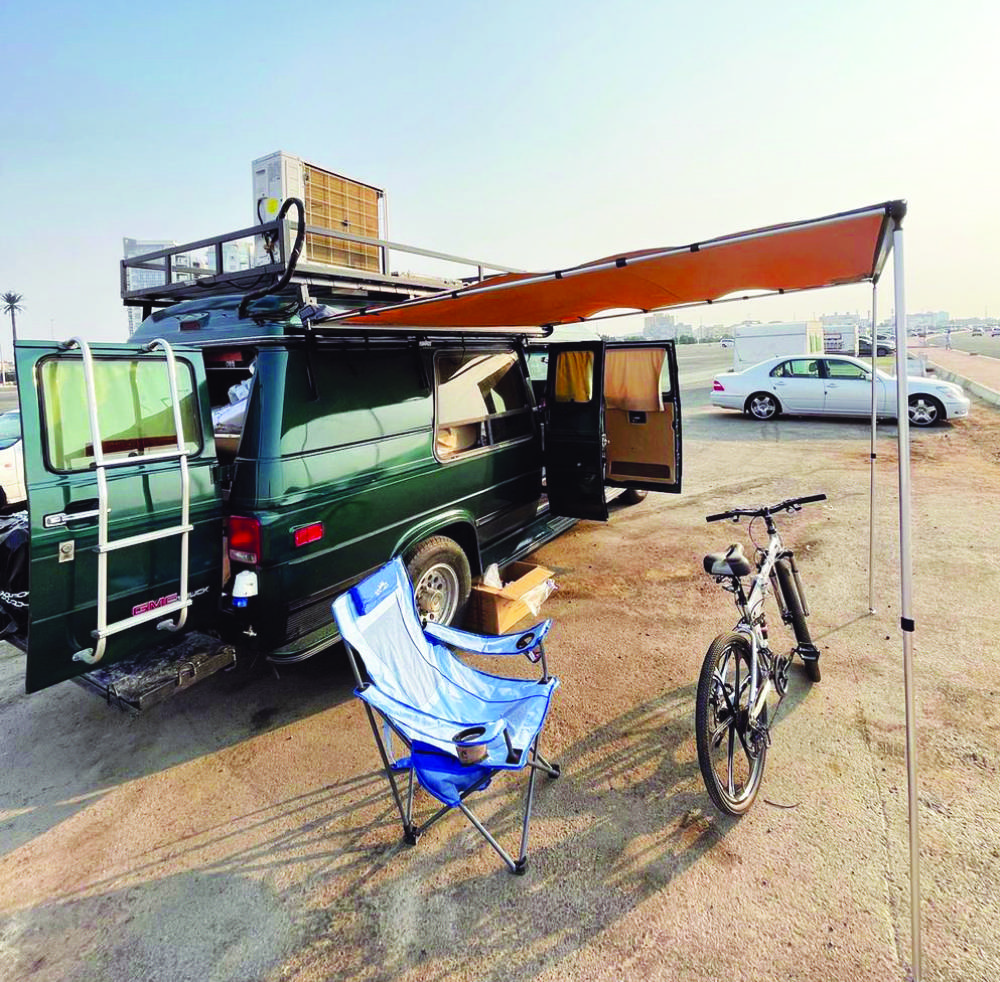


Aladdin has all essentials you need or you have in your house, from the bed, sink, small kitchen, storage, air conditioning, tables, refrigerator,
solar panels for electricity and lights, and finally a fan.

“After we finished the trip I decided to stop my master’s degree program to be able to travel as much as I could. Through my travels, I learned many different styles of traveling. One of them was traveling in a campervan.”
He said the idea of living and traveling in a campervan was very common in Canada.
In 2019, he went back to Canada to work and travel, working on an organic farm, and at the same time, he bought an old van and started converting it into something more liveable.

I could see the beauty of Saudi Arabia and how big our country is. The people I have met along the way and their generosity, inviting me for coffee or meals. In my experience, Saudis are one of the easiest going personalities to start a conversation with, and they would help immediately should you need anything.

Abdullah Al-Qurashi

“I named my campervan Aladdin. Aladdin has all essentials you need or you have in your house, from the bed, sink, small kitchen, storage, air conditioning, tables, refrigerator, solar panels for electricity and lights, and finally a fan,” he said. “We can say it’s a little home on wheels.”
And, because he liked road trips, his “Aladdin” allowed him to experience that adventure and lifestyle.
“Every single day is a totally different day, from the view I would wake to early morning, to the people I meet in every single stop I make, and living on the road here in the Kingdom is different from Canada,” he said.

“By that, I mean the community of campervans here is still new and, until today, I only met one couple living in their car. Also, where I can stop to sleep at night sometimes could be an issue here because there are no decent places for a campervan to camp overnight.”
Since he moved into his campervan on Jan. 2, 2022, he has traveled in the west of the Kingdom, along the Red Sea, and the north.
“I just came back from AlUla. For now, I’m preparing to go to the southern part of the Kingdom, and I am so excited to discover that part as I have never visited it in my life.”
He said his experience traveling around the Kingdom had been great so far.
“I could see the beauty of Saudi Arabia and how big our country is. The people I have met along the way and their generosity, inviting me for coffee or meals.”
He highlighted the diversity of the Kingdom, with each part having its own tradition, accent, food, and weather.
“In my experience, Saudis are one of the easiest-going personalities to start a conversation with, and they would help immediately should you need anything,” he said.


Saudi Arabia scales AI in national education

Updated 5 sec ago
Follow

Saudi Arabia scales AI in national education

  • Kingdom accelerates plan to lead the region in digital skills

RIYADH: As Saudi Arabia accelerates toward the goals of Vision 2030, the Kingdom is positioning technology, particularly artificial intelligence, as a cornerstone of its education reform strategy. 

By embedding AI across the national curriculum, policymakers aim to equip more than 6 million general education students with future-ready skills by 2025.

To achieve this, government bodies and private sector leaders have aligned efforts to integrate AI education into classrooms across the country. 

A collaborative initiative launched in 2025 brings together the National Centre for Curriculum, the Ministry of Education, the Ministry of Communications and Information Technology, and the Saudi Data and Artificial Intelligence Authority. The initiative is designed not only to teach students how to use AI tools, but to enable them to learn through AI-driven platforms. Teachers, too, are central to the transformation.

At the International Conference on Data and AI Capacity Building organized by SDAIA, participating entities outlined their progress and future ambitions, underscoring Saudi Arabia’s drive to become a global hub for AI-enabled education.

Offering a public sector perspective, Bedour Alrayes, deputy CEO of the Human Capability Development Program under Vision 2030, highlighted the importance of embedding AI into learning pathways early and systematically. “It’s not about how they learn AI, it’s about how they practice it,” Alrayes told Arab News.

DID YOU KNOW?

• Saudi Arabia plans to equip over 6 million students with AI skills nationwide.

• IBM has trained 500,000 in AI — targeting 1 million Saudis by 2030.

AI tools are being used not only to teach students but to help teachers design lessons.

She described a structured model that begins in elementary school. “When we talk about K-12, we start by enabling digital curriculum from the fourth grade, also AI curriculum in schools. We enable teachers to know how to use AI tools, and we have gamification tools where they use AI, including after-school activities and customized learning journeys,” she said.

Alrayes stressed the importance of maintaining a balance between technological advancement and human engagement, describing the approach as a “human-centric partnership” between people and AI. The strategy spans the full education continuum — from K-12 to university — and extends into lifelong learning and professional development, ensuring Saudi citizens remain competitive in a rapidly evolving global economy.

SDAIA has further strengthened this ecosystem with the introduction of the Saudi Academic Framework for AI Qualifications, a national benchmark guiding the development, evaluation and accreditation of AI programs in higher education. The framework has drawn interest from international technology firms eager to contribute to the Kingdom’s transformation.

Justina Nixon-Saintil, IBM’s vice president and chief impact officer, pointed to growing demand for AI capabilities in the local market.

“We launched our AI skilling programs just a few years ago, and as of last year we had already skilled 500,000 people,” she told Arab News.

“What I love is that there’s such demand here. People are eager to learn, eager to grow and eager to take advantage of AI skills. It’s also because it’s being led by the government, corporations and universities; everyone is aligned with Vision 2030 and they want to make sure their citizens are ready to take advantage of those opportunities.”

IBM collaborates with leading institutions including King Saud University and Princess Nourah University, delivering AI education and certification programs to faculty and students alike.

Nixon-Saintil underscored the necessity of close coordination between industry and academia.

“We do not implement any programs without input from the private sector. When we look at the training pathways and hands-on projects, we partner with the private sector to understand what skills they’re looking for and how jobs are evolving, because they are changing very quickly,” she said.

Reflecting the scale of ambition, she revealed IBM’s goal of equipping 1 million Saudis with AI skills by 2030.

Private sector innovators are also contributing to classroom transformation. Alex West, founder and CEO of Manifest XR, described how the company’s AI-powered tools are helping educators create dynamic learning content.

“The AI tools that we provide can produce content for teachers based on simple text prompts. They can upload documentation and create videos, assessments, quizzes and an entire course for students to then learn from. We provide structured training programs around how you can safely introduce AI technology, and we provide certificates for teachers,” he said.

West emphasized the urgency of narrowing the gap between workforce demands and the pace of educational adaptation.

“I think educators, if they want to stay ahead and remain competitive, should be introducing this technology so that their students can be prepared for industry work placements and the 2030 vision. In the next few years, things are going to look even more different. The Kingdom wants this technology everywhere and wants to improve the quality of learning. We allow this to scale not only for high-end international schools, but this can be used in any schools across the country, even in resource-deprived areas.”

Anees Ahmad, regional manager at Spectrum Networks, echoed that commitment to nationwide transformation.

“As part of Vision 2030 of the Kingdom, we are here to cater to all government, semi-government and enterprise customers in fulfilling the requirements of the transformation,” he told Arab News.