

Houthis hit ‘backbone of the global economy’ in Jeddah oil depot strike

1 / 3
A view of a fire at Saudi Aramco's petroleum storage facility, after an attack, in Jeddah, Saudi Arabia March 25, 2022. (Reuters)
2 / 3
The Coalition to Restore Legitimacy in Yemen said a “hostile” operation by Yemen’s Iran-backed Houthi militia targeted an Aramco oil facility in Jeddah. (AN Photo)
3 / 3
Saudi Arabia’s air defense forces destroyed seven drones and a missile launched by the Houthi militia targeting the southern part of the Kingdom, the Coalition said on Friday. (SPA)
Short Url
Updated 26 March 2022
Follow

Houthis hit ‘backbone of the global economy’ in Jeddah oil depot strike

  • Huge blaze and plumes of smoke over city
  • Militia aims to undermine world energy security, coalition says

JEDDAH: The Iran-backed militia in Yemen were accused on Friday of threatening global energy security with a wave of drone and missile attacks on oil facilities in the Kingdom.

A huge fire erupted at an Aramco oil storage facility in Jeddah after one attack.

Plumes of black smoke rose over the city and were visible to drivers practicing for the Formula 1 Grand Prix motor race at the Jeddah Corniche circuit.
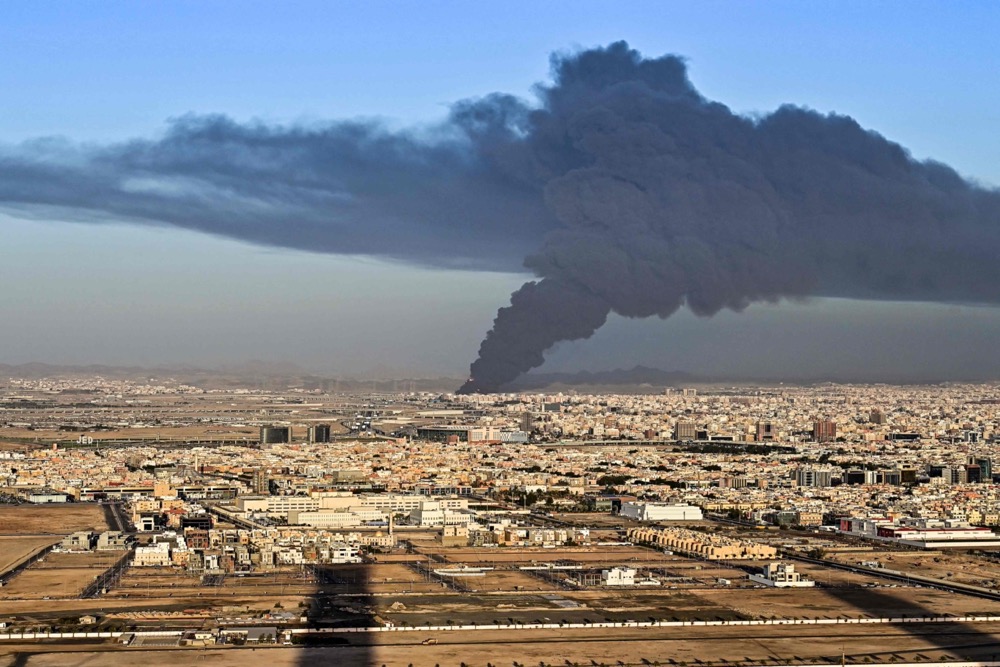


Smoke from the site could be seen across the city on Friday. (AFP)

F1 authorities said the race would go ahead on Sunday as planned.

The Coalition to Restore Legitimacy in Yemen said the fire in two tanks at the North Jeddah oil facility had been brought under control, and there were no casualties.

Coalition spokesman Brig. Gen. Turki Al-Malki said: “This hostile escalation targets oil facilities and aims to undermine energy security and the backbone of the global economy. These hostile attacks had no impact or repercussions in any way, shape or form on public life in Jeddah.”

The US State Department condemned the Houthi attacks as “unacceptable.”

British Prime Minister Boris Johnson also slammed the attacks. “These strikes put civilian lives at risk and must stop,” he said.

Earlier, Saudi air defenses forces destroyed seven drones and a missile launched by the Houthis targeting the southern part of the Kingdom.  The attacks deliberately targeted civilian areas and energy installations, the coalition said, and threatened both regional and international security.

Last weekend a Houthi assault on the Kingdom caused a temporary drop in output at a refinery and a fire at a petroleum products distribution terminal. On March 11, the group targeted a refinery in Riyadh, causing a small fire.

Saudi Arabia said after those attacks that it would bear no responsibility for any shortage of global oil supplies caused by Houthi attacks, and the Saudi Energy Ministry restated that view on Friday.

The North Jeddah plant stores diesel, gasoline and jet fuel for use in the city. It accounts for over a quarter of Saudi Arabia’s supplies and also provides fuel for a desalination plant.

The Houthis have twice targeted the plant with cruise missiles, once in November 2020 and most recently last Sunday. A UN panel of experts on the war in Yemen described it as a “civilian target.”
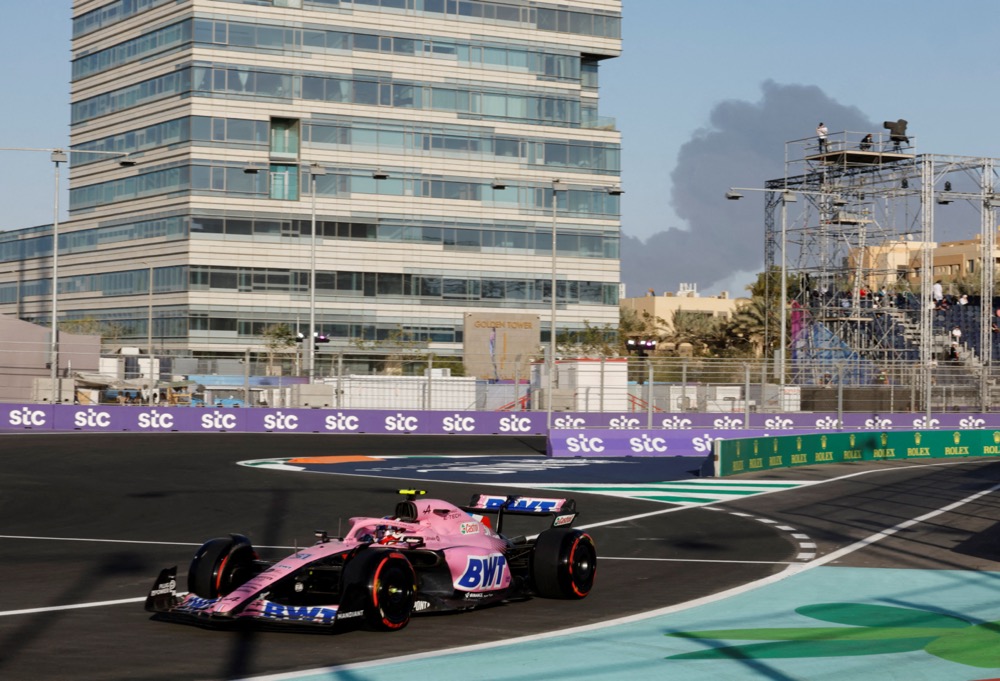


Plumes of smoke were visible to drivers practicing for the Formula 1 Grand Prix motor race at the Jeddah Corniche circuit. (Reuters)

“While the facility also supplies the Saudi military with petroleum products, it is mostly supplying civilian customers,” the panel said.

“If it had been out of service for a significant period, the impact on the Kingdom’s economy and the welfare of the residents of the western region would probably have been significant.”


Experimental farm in Al-Lith looks into future of Saudi Arabian agriculture

Updated 58 min 22 sec ago
Follow

Experimental farm in Al-Lith looks into future of Saudi Arabian agriculture

  • Research initiative reflects strategic transformation

JEDDAH: An experimental farm in Saudi Arabia’s Al-Lith Governorate is one of the research initiatives reflecting the strategic transformation taking place in the Kingdom’s agricultural sector.

The farm uses highly efficient, sustainable production models that combine scientific research with commercial application, contributing to strengthening the country’s food security system and the sustainability of water resources.

Located in the Ghumaiqa Center on an area of about 10 hectares, the cutting-edge farm is a testing platform for modern agricultural technologies that tackle the challenge of water scarcity.

The farm includes developed open fields and modern greenhouses, supported by smart irrigation encompassing drip and sprinkler irrigation alongside surface and subsurface technologies.

All the systems operate via smart controls that enable the monitoring of water consumption and ensure improved efficiency, thereby achieving a balance between agricultural production and water conservation.

The farm also uses treated and diluted low-salinity seawater.

It aims to diversify agricultural water sources, reduce reliance on freshwater, and open new horizons for agriculture in coastal and semi-arid environments.

The project represents a promising investment opportunity in the field of smart agriculture, enabling the development of commercially scalable production models, particularly for high-value vegetables and fruits, while reducing operational costs associated with water and energy, enhancing the economic feasibility of future agricultural projects.

In addition, the project contributes to transferring and localizing agricultural expertise, supporting local food supply chains, and creating an attractive environment for agricultural investment.

This aligns with Sustainable Development Goals and enhances the efficiency of the private sector in adopting innovative agricultural solutions.

Yahya bin Abdulrahman Al-Mahabi, the director of the Ministry of Environment, Water and Agriculture office in Al-Lith Governorate, told the Saudi Press Agency that the project represented the future of agriculture in the Kingdom.

He explained that the vision was based on investing in technology, enhancing the return on water per unit, and integrating scientific research with investment opportunities.

Al-Mahabi spoke of the experimental farm as a modern, scalable and replicable model applicable in several regions of the Kingdom, particularly in coastal environments.

Al-Mahabi highlighted the Ministry of Environment, Water and Agriculture’s commitment to supporting distinctive projects that contributed to achieving food security while developing rural areas and enhancing agricultural production efficiency, in line with the objectives of the Kingdom’s Vision 2030.