

Ukraine war reverberates on Taiwan’s ‘frontline of democracy’

1 / 4
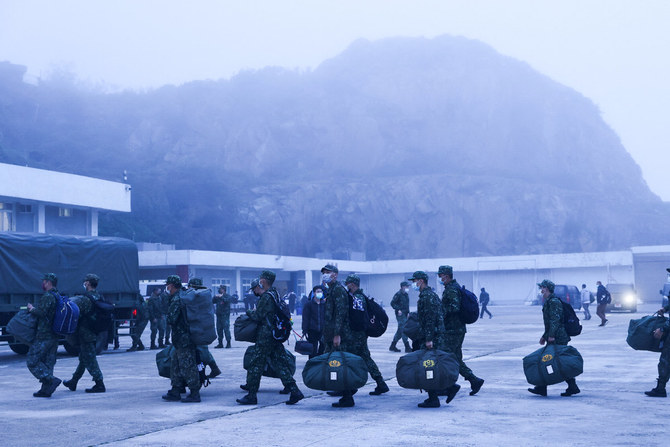
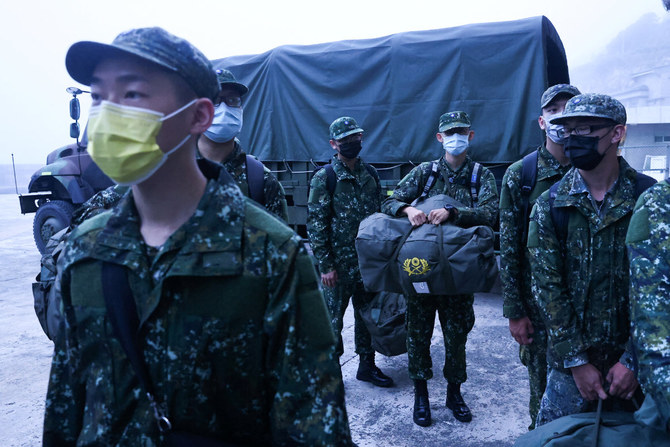
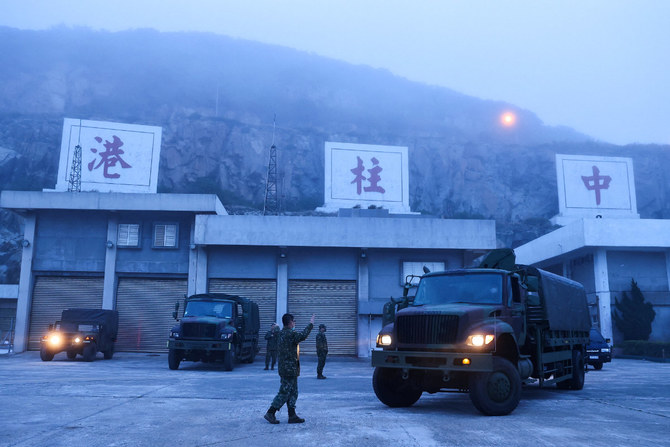
Taiwanese soldiers arrive by ferry at Dongyin island, near China's coast, on March 17, 2022. (REUTERS/Ann Wang)
2 / 4
Taiwanese soldiers arrive by ferry at Dongyin island, near China's coast, on March 17, 2022. (REUTERS/Ann Wang)
3 / 4
Taiwanese soldiers stand on the deck of a ferry bound for the mainland on March 17, 2022, after completing their three-month mandatory military service in Matsu island in Dongyin. (REUTERS/Ann Wang)
4 / 4
Taiwanese soldiers arrive by ferry at Dongyin island, near China's coast, on March 17, 2022. (REUTERS/Ann Wang)
Short Url
Updated 25 March 2022
Follow

Ukraine war reverberates on Taiwan’s ‘frontline of democracy’

  • Taiwan’s outlying islands, long known as military strongholds, can are being as “a frontline of democracy”
  • The Ukraine war is a common topic of conversation for some — including jokes about where to hide if China invades

DONGYIN/NANGAN, Taiwan: Lin Jih-shou was brewing tea last month in his popular breakfast joint when he heard the buzz of a plane – a rare sound on the remote Taiwanese-held island of Dongyin near China’s coast, which does not have an airport.
Lin, 64, rushed outside, but only saw the shadow of what the government later described as a small, propeller-driven Chinese aircraft that most likely was testing Taiwan’s military response.
It was a stark reminder to residents of Dongyin and Taiwan’s other islands off China’s coast of the threat from their huge neighbor, which considers Taipei’s democratically elected government illegitimate and Taiwan a rogue province to be taken by force if needed.
The Matsu islands were regularly bombarded by China at the height of the Cold War, and the history of conflict has focused minds on Russia’s invasion of Ukraine and whether the same fate may befall them.
“When we watch Russia and Ukraine fighting, our hearts hurt,” Lin told Reuters. “War is too scary. There’s no need.”
Taiwan has raised its alert level since the invasion, but has not reported any signs of imminent attack.



Dongyin native Tsai Pei-yuan chats with other co-founders of Salty Island Studio in Dongyin, Taiwan, on March 15, 2022. (REUTERS/Ann Wang)

Held by Taiwan since the defeated Republic of China government fled to Taipei in 1949 after losing the Chinese civil war, Matsu would probably be an immediate target for Beijing in a conflict, especially Dongyin’s missile base.
Yet even with China’s increased military pressure in recent years, the archipelago has seen trendy businesses and a nascent art scene spring up.
On the main island of Nangan, former military brothels and underground bunkers house exhibits that opened last month as part of the inaugural Matsu Biennial art festival.
“It’s a way to rebrand and retell the stories of Matsu,” said Lii Wen, who established the local branch of the ruling Democratic Progressive Party in 2020.
Taiwan’s outlying islands, long known as military strongholds, can be reframed as “a frontline of democracy,” Lii said, as a Ukrainian flag fluttered outside his office window. Although their regional contexts differ, Lii said, Taiwan stands in solidarity with Ukraine as a smaller democracy facing potential invasion.

Dongyin native Tsai Pei-yuan, born in 1993, the year after Matsu’s strict military rule ended, is part of a generation for whom war feels distant. Two years ago, Tsai and two former classmates co-founded Salty Island Studio, a cafe and community hub that has hosted arts workshops and plays.
“More urgent is trying to preserve our culture, which is disappearing,” Tsai said before a wine-tasting event last week.
The Ukraine war is a common topic of conversation for some — including jokes about where to hide if China invades.
“When we explore strongholds, we ask, if a war really starts, which nearby stronghold would we run to?” said Chung Jing-yei, 26, who manages Nangan’s Xiwei Peninsula restaurant.
Chung said it was only after she moved to Nangan that she understood why so many here want to maintain the status quo.
“My belief that we should be an independent country is resolute, but at the same time, I don’t want war to happen,” she said.
Dotting the islands’ rugged coastlines are bunkers, abandoned or transformed into tourist destinations and boutique hotels.
Older Matsu residents have vivid memories of hiding in shelters from Chinese shelling and not being allowed to own basketballs for fear that they may use them to float across to China.
“I don’t think the two sides will fight,” Lucy Lin, a 62-year-old taxi driver and bakery owner, said as a Chinese radio station played in her car. “As long as you don’t step over the red lines.”
Shih Pei-yin, who worked as an urban planner in Taipei before starting Xiwei, is keen to play her part in bettering the lives of Matsu’s people.
“For as long as it is possible, we hope to work with the island’s residents to improve this place,” Shih said. “Even if it is short-term, that is okay. At least we tried our best.”


In the Arctic, the major climate threat of black carbon is overshadowed by geopolitical tensions

Updated 2 sec ago
Follow

In the Arctic, the major climate threat of black carbon is overshadowed by geopolitical tensions

REYKJAVIK: As rising global temperatures speed up the melting of sea ice in the Arctic Ocean, it’s set off a boom of ships taking routes that previously were frozen and not traversable.
The increase in marine Arctic traffic, which received increased attention as President Donald Trump pushed for the United States to take over Greenland, has come with a heavy environmental cost: black carbon, or soot, that spews from ships and makes the ice melt even faster. Several countries are making a case for ships in the Arctic to use cleaner fuels that cause less pollution in meetings this week with international shipping regulators.
Glaciers, snow and ice covered in the soot emitted by ships have less ability to reflect the sun. Instead, the sun’s heat is absorbed, helping to make the Arctic the fastest warming place on Earth. In turn, melting Arctic sea ice can affect weather patterns around the world.
“It ends up in a never-ending cycle of increased warming,” said Sian Prior, lead adviser for the Clean Arctic Alliance, a coalition of nonprofits focused on the Arctic and shipping. “We need to regulate emissions and black carbon, in particular. Both are completely unregulated in the Arctic.”
In December, France, Germany, the Solomon Islands and Denmark proposed that the International Maritime Organization require ships traveling in Arctic waters to use “polar fuels,” which are lighter and emit less carbon pollution than the widely used maritime fuels known as residuals. The proposal includes steps that companies would take to comply and the geographic area it would apply to — all ships traveling north of the 60th parallel. The proposal was expected to be presented to the IMO’s Pollution Prevention and Response Committee this week and possibly another committee in April.
A 2024 ban on using a type of residual known as heavy fuel oil in the Arctic has had only modest impacts so far, partly because of loopholes.
Concerns about shipping pollution are overshadowed by geopolitics
The push to reduce black carbon, which studies have shown has a warming impact 1,600 times that of carbon dioxide over a 20-year span, is happening at a time of conflicting interests, both internationally and among the countries that have coastlines in the Arctic.
In recent months, Trump’s periodic comments about the need to “own” Greenland to bolster US security have raised many issues, from Greenland’s sovereignty to the future of the NATO alliance. Pollution and other environmental issues in the Arctic have taken a backseat.
Trump, who has called climate change a “con job,” has also pushed back against global policies aimed at fighting it. Last year, the IMO was expected to adopt new regulations that would have imposed carbon fees on shipping, which supporters said would have pushed companies to use cleaner fuels and electrify fleets where possible. Then Trump intervened, lobbying hard for nations to vote no. The measure was postponed for a year, its prospects at best uncertain. Given that, it’s hard to see the IMO making fast progress on the current proposal to limit black carbon in the Arctic.
Even inside Arctic nations, which are most impacted by black carbon and other shipping pollution, there are internal tensions around such regulations. Iceland is a good example. While the country is a world leader in green technologies such as carbon capture and the use of thermal energies for heating, conservationists say the country has made less progress on regulating pollution in its seas. That is because the fishing industry, one of the country’s most important, holds huge sway.
“The industry is happy with profits, unhappy with the taxes and not engaged in issues like climate or biodiversity,” said Arni Finnsson, board chair of the Iceland Nature Conservation Association.
Finnsson added that the costs of using cleaner fuels or electrifying fleets have also prompted resistance.
“I think the government is waking up, but they still have to wait for the (fishing) industry to say yes,” he said.
The country has not taken a position on the pending polar fuels proposal. In a statement, Iceland’s Ministry of Environment, Energy and Climate said the proposal was “positive with regard to its purpose and basic content,” but that further study was needed. The statement added that Iceland supports stronger measures to counter shipping emissions and reduce black carbon.
Arctic ship traffic and black carbon emissions both rise
Soot pollution has increased in the Arctic as cargo ships, fishing boats and even some cruise liners are traveling more in the waters that connect the northernmost parts of Iceland, Greenland, Canada, Russia, Norway, Finland, Sweden and the United States.
Between 2013 and 2023, the number of ships entering waters north of the 60th parallel increased by 37 percent, according to the Arctic Council, an intergovernmental forum made up of the eight countries with territory in the Arctic. In that same period, the total distance traversed by ships in the Arctic increased 111 percent.
Black carbon emissions have also increased. In 2019, 2,696 metric tons of black carbon was emitted from ships north of the 60th parallel compared with 3,310 metric tons in 2024, according to a study by Energy and Environmental Research Associates. The study found that fishing boats were the biggest source of black carbon.
It also found that the 2024 ban on heavy fuel oil would only result in a small reduction in black carbon. Waivers and exceptions allow some ships to continue using it until 2029.
Environmental groups and concerned countries see regulating ship fuel as the only way to realistically reduce black carbon. That is because getting nations to agree to limit traffic would likely be impossible. The lure of fishing, resource extraction and shorter shipping distances is too great. Ships can save days on some trips between Asia and Europe by sailing through the Arctic.
Still, the path known as the Northern Sea Route is only traversable a few months of the year, and even then ships must be accompanied by icebreakers. Those dangers, combined with Arctic pollution concerns, have driven some companies to pledge to stay away — at least for now.
“The debate around the Arctic is intensifying, and commercial shipping is part of that discussion,” wrote Søren Toft, CEO of Mediterranean Shipping Company, the world’s largest container shipping company, in a LinkedIn post last month. “Our position at MSC is clear. We do not and will not use the Northern Sea Route.”