


Shahid VIP to dominate MENA’s streaming market for next 5 years: Report

Short Url
Updated 24 March 2022
Follow

Shahid VIP to dominate MENA’s streaming market for next 5 years: Report

  • In 2021, StarzPlay, Netflix, and Shahid VIP were the market leaders commanding more than 60 percent of the share of subscribers

DUBAI: Arabic content platform Shahid VIP will continue to lead the streaming market in the Middle East and North Africa region for the next five years, outperforming local and international competitors, according to market research firm Dataxis.

The streaming industry has grown rapidly with a 30 percent increase in subscribers between 2020 and 2021. The current number of subscribers is close to 10 million and was expected to reach 30 million by 2026.

In 2021, StarzPlay, Netflix, and Shahid VIP were the market leaders commanding more than 60 percent of the share of subscribers. However, going forward, Shahid VIP was expected to lead, followed by Netflix, with each forecasted to hold more than 20 percent market share by 2026.
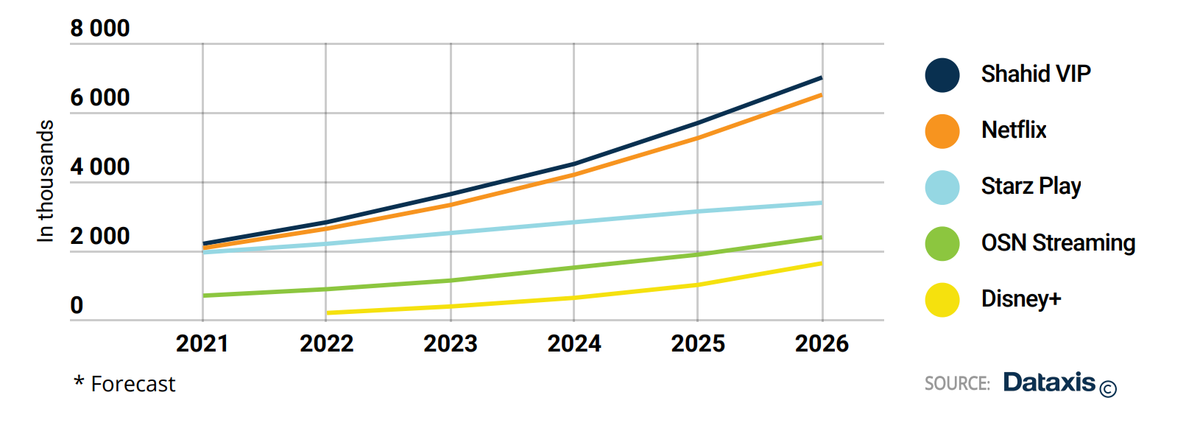
Shahid VIP had more than 2 million subscribers in 2021, with the number predicted to reach nearly 3 million by the end of this year, and 7 million by the close of 2026 — ahead of all other players.

Natasha Matos-Hemingway, chief commercial and marketing officer at Shahid, said: “As always, we are absolutely delighted with Shahid VIP’s achievements — our position as the market leader in the region is, by no means, a privilege we take lightly.

“Rather, it is testament to our continuous focus on our audiences, bringing the best and most diverse premium Arabic stories to multiple screens in the region and beyond, along with high-quality partnerships with major brands — from news and drama to entertainment and sport from around the world,” she added.

The states covered by the Gulf Cooperation Council make up the biggest percentage of streaming service users, according to the Dataxis report, with approximately 3 million subscribers in Saudi Arabia and more than 2 million in the UAE.



Israel extends foreign media ban law until end of 2027

Updated 15 sec ago
Follow

Israel extends foreign media ban law until end of 2027

  • Order replaces temporary emergency legislation that allowed authorization of so-called ‘Al Jazeera bill’
  • Extension of temporary order empowers Communications Ministry to restrict foreign channels deemed to cause ‘real harm to state security’

LONDON: Israel’s Knesset approved late Monday an extension of the temporary order empowering the Communications Ministry to shut down foreign media outlets, pushing the measure through until Dec. 31, 2027.

The bill, proposed by Likud lawmaker Ariel Kallner, passed its second and third readings by a 22-10 vote, replacing wartime emergency legislation known as the “Al Jazeera Law.”

Under the extended order, the communications minister — with prime ministerial approval and security cabinet or government ratification — can restrict foreign channels deemed to cause “real harm to state security,” even outside states of emergency.

Measures include suspending broadcasts, closing offices, seizing equipment, blocking websites, and directing the defense minister to block satellite signals, including in the West Bank, without disrupting other channels.

Administrative orders last 90 days, with possible extensions. Unlike the temporary measure, the new law does not require court approval to shut down a media outlet.

The move has drawn sharp criticism from human rights and media groups, who warn it entrenches restrictions on Arab and foreign outlets amid a broader erosion of press freedoms.

“Israel is openly waging a battle against media outlets, both local and foreign, that criticize the government’s narrative; that is typical behavior of authoritarian regimes,” International Federation of Journalists General Secretary Anthony Bellanger said in November after the bill’s first reading.

“We are deeply concerned about the Israeli parliament passing this controversial bill, as it would be a serious blow to free speech and media freedom, and a direct attack on the public’s right to know.”

In a parallel development, the Israeli Cabinet unanimously approved on Monday the shutdown of Army Radio (Galei Tzahal) after 75 years, with operations ceasing on March 1, 2026.

In a statement, Attorney General Gali Baharav-Miara warned the decision “undermines public broadcasting in Israel and restricts freedom of expression,” lacking a legal basis.